Facts
The appellant was convicted by the Special Judge, Bongaigaon, under Section 376(3) IPC read with Section 4 of the POCSO Act and sentenced to 20 years of rigorous imprisonment.
Source reference: p. 2The prosecution alleged that the appellant, who had an illicit relationship with the victim’s mother and resided in their house, committed sexual intercourse with the 13-year-old victim (PW-3) on December 25, 2019, and on previous occasions.
Source reference: p. 4-5The appellant challenged the conviction, citing material contradictions between the victim's testimony and her prior statement under Section 164 Cr.PC.
Source reference: p. 2Issues
1. Whether the term "bad act" used by the victim in her Section 164 Cr.PC statement can be interpreted as "sexual intercourse" to sustain a conviction under Section 376(3) IPC.
Source reference: p. 3, 72. Whether the prosecution proved the guilt of the appellant beyond reasonable doubt given the discrepancies regarding the victim's location on the date of the alleged incident.
Source reference: p. 11, 14Law Applied
Section 376(3) of the IPC and Section 4 of the POCSO Act regarding aggravated penetrative sexual assault.
Source reference: p. 2Section 164 Cr.PC, noting that such statements can be used for corroboration or contradiction.
Source reference: p. 15The "sterling witness" principle and the precedent from Bharwada Bhoginbhai Hirjibhai v. State of Gujarat, which mandates a sensitive approach to victim testimony.
Source reference: p. 3-4Distinction of Basir Uddin v. State of Assam and State of Haryana v. Anil Kumar, noting that while "bad acts" may imply rape, it must be supported by specific clarifications or attending circumstances.
Source reference: p. 7-8Reasoning
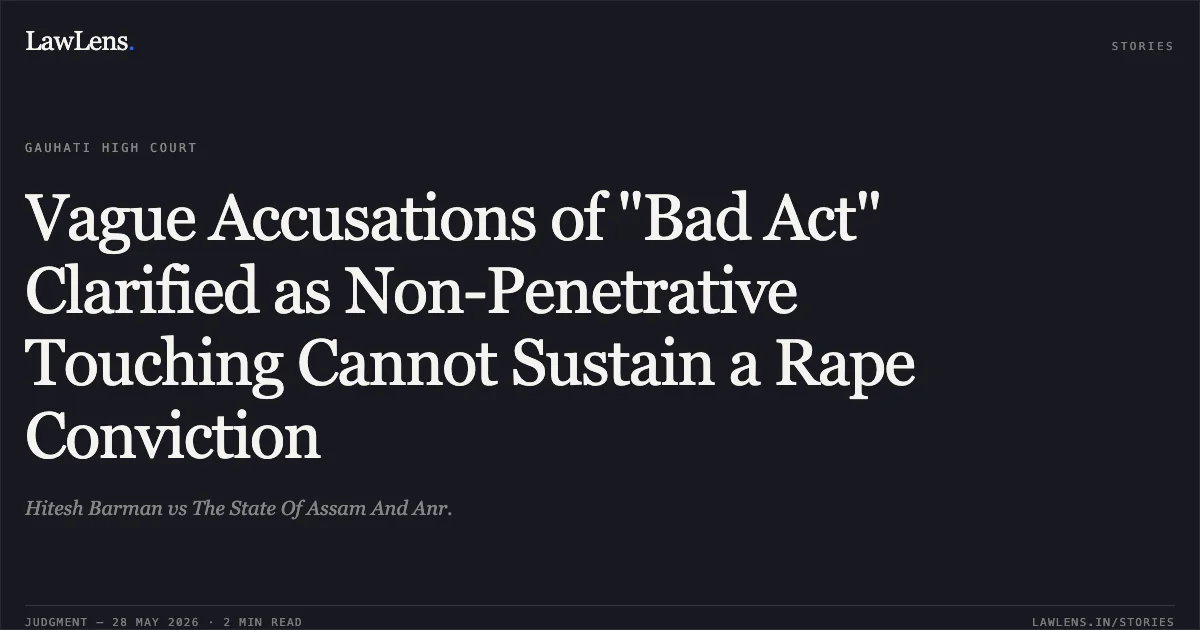
The Court found a major contradiction: in her Section 164 Cr.PC statement, the victim defined "bad act" specifically as the appellant touching her chest/vagina and inserting a finger, whereas in her trial testimony, she alleged "sexual intercourse" for the first time without mentioning the finger insertion.
Source reference: p. 4, 6, 10The Court held that "bad act" is not automatically synonymous with intercourse and requires clarification.
Source reference: p. 8-9Internal contradictions in the prosecution's evidence (PW-1 and PW-3) suggested the victim was at her sister’s house in Barpeta on the date of the alleged crime (Dec 25), making the occurrence at her mother's house improbable.
Source reference: p. 11The Court found it "quite unbelievable" that the appellant could rape the victim on a bed shared with her mother without the mother's knowledge.
Source reference: p. 10Consequently, the victim failed to meet the standard of a "sterling witness".
Source reference: p. 15Holding
The Court answered Issue 1 in the negative, ruling that the shifted testimony from "bad acts" (clarified as digital penetration) to "sexual intercourse" appeared to be a result of "bettering the case" by afterthought.
The Court held the prosecution failed to prove the case beyond reasonable doubt due to the alibi-related discrepancies and lack of corroboration.
Source reference: p. 14-15The appeal was allowed, the conviction and sentence were set aside, and the appellant was ordered to be set at liberty forthwith.
Source reference: p. 15-16Acts & Sections Cited
8 provisions across 3 statutes referred to in this judgment. Each provision opens on LawLens.
Indian Penal Code, 18601
Protection of Children from Sexual Offences Act, 20124
Code of Criminal Procedure, 19733
Original Court PDF
Hitesh BarmanvsThe State Of Assam And Anr.
Click to open original judgment
Original judgment, available to read, download and summarize on LawLens.in