Facts
The complainant’s marriage with the son of petitioners Nos. 1 and 2 was solemnized on 1 November 2013, and they had two children.
Source reference: p.2, para. 3–4After allegedly leaving the matrimonial home on 21 July 2022, the complainant initiated Criminal Miscellaneous Application No. 316 of 2022 under Sections 18, 19, 20, 22 and 23 of the Protection of Women from Domestic Violence Act, 2005, against her husband and his family members.
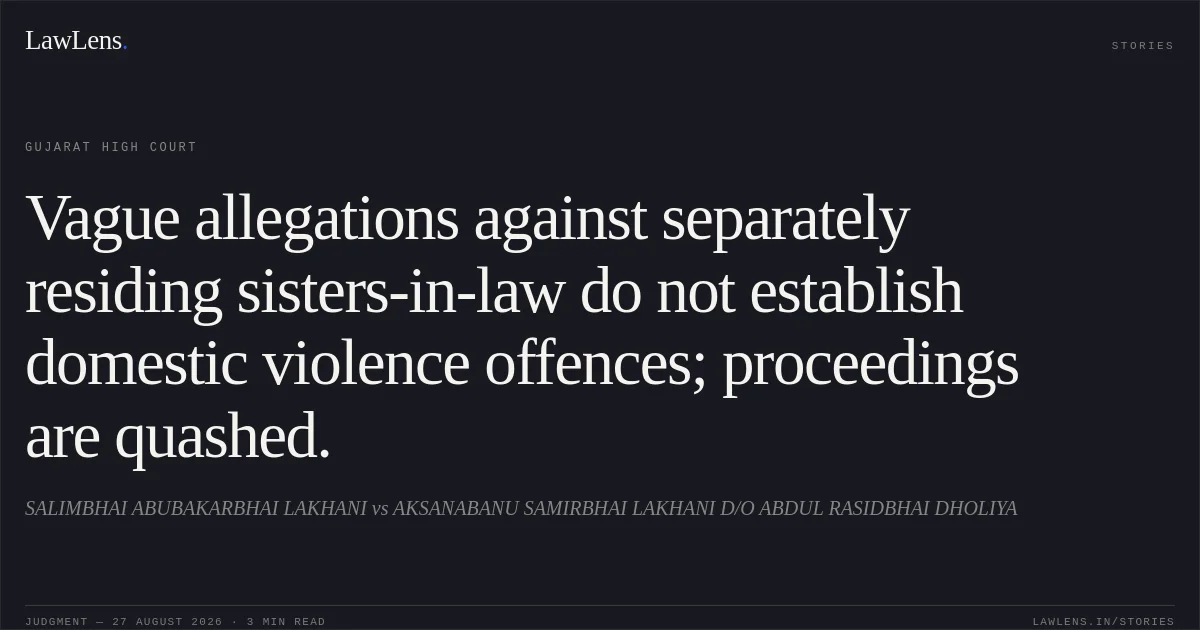
Source reference: p.2, para. 3–4Petitioners Nos. 3 and 4, the husband’s sisters, sought quashing of the proceedings on the ground that the allegations against them were vague and general, that they had married before the complainant’s marriage, and that they had always resided separately.
Source reference: p.3, para. 5.1–5.3The complainant alleged that the petitioners had subjected her to mental and physical harassment and had instigated her husband in connection with demands for a laptop, watch and mobile phone.
Source reference: p.4, para. 6–6.3The Court noted that earlier proceedings, including proceedings under the Domestic Violence Act, had been withdrawn after settlement between the parties.
Source reference: p.6, para. 9At the hearing, the petition was not pressed against petitioners Nos. 1 and 2 and was dismissed as not pressed qua them.
Source reference: p.1, para. 2Issues
1. Whether the allegations in the Domestic Violence Act complaint disclosed the commission of domestic violence or made out the statutory ingredients of Sections 18, 19, 20, 22 and 23 against petitioners Nos. 3 and 4, the married sisters-in-law residing separately from the complainant?
Source reference: p.5–6, para. 7–9, 122. Whether the proceedings against petitioners Nos. 3 and 4 were liable to be quashed where the allegations against them were general and principally concerned alleged instigation of the husband?
Source reference: p.6, para. 8, 12–13Law Applied
The Court considered Sections 18, 19, 20, 22 and 23 of the Protection of Women from Domestic Violence Act, 2005, which provide, respectively, for protection orders, residence orders, monetary reliefs, compensation orders and interim or ex parte reliefs; such reliefs require factual allegations establishing domestic violence and the respondent’s involvement.
Source reference: no citationThe Court applied the principle that criminal or quasi-criminal proceedings may be quashed where the complaint, read as a whole, does not disclose the necessary ingredients against a particular accused.
Source reference: no citationIt relied on Arnesh Kumar v. State of Bihar, (2014) 8 SCC 273, regarding the misuse and over-implication of the husband’s relatives in matrimonial proceedings.
Source reference: p.7, para. 10Preeti Gupta v. State of Jharkhand, (2010) 7 SCC 667, which stressed that vague, exaggerated allegations against relatives living separately must be scrutinised carefully and with circumspection.
Source reference: p.8–10, para. 11Reasoning
The Court found that the principal allegations concerned the complainant’s husband, who was not a petitioner in the present proceedings.
Source reference: p.5, para. 7; p.6, para. 8The allegations against the husband’s family were that they had instigated him to demand dowry-related articles; no specific acts of physical or mental violence were attributed to petitioners Nos. 3 and 4.
Source reference: p.5, para. 7; p.6, para. 8Since petitioners Nos. 3 and 4 were married before the complainant’s marriage and were residing separately, the Court held that the allegation of their continuing involvement in domestic harassment was inherently general and unsupported by specific particulars.
Source reference: p.6, para. 8Applying the caution expressed in Arnesh Kumar and Preeti Gupta against mechanically implicating the husband’s relatives, the Court concluded that the complaint did not disclose the ingredients necessary to sustain proceedings under Sections 18, 19, 20, 22 or 23 of the Domestic Violence Act against them.
Source reference: p.7–10, para. 10–12Holding
The petition was dismissed as not pressed against petitioners Nos. 1 and 2.
It was allowed in respect of petitioners Nos. 3 and 4.
Source reference: p.11, para. 13Criminal Miscellaneous Application No. 316 of 2022, pending before the 10th Additional Chief Judicial Magistrate, Bhavnagar, and all proceedings arising from it were quashed and set aside qua petitioners Nos. 3 and 4.
Source reference: p.11, para. 13Rule was made absolute, with direct service permitted.
Source reference: p.11, para. 14Acts & Sections Cited
6 provisions across 2 statutes referred to in this judgment. Each provision opens on LawLens.
Protection of Women from Domestic Violence Act, 20055
Code of Criminal Procedure, 19731
Original Court PDF
SALIMBHAI ABUBAKARBHAI LAKHANIvsAKSANABANU SAMIRBHAI LAKHANI D/O ABDUL RASIDBHAI DHOLIYA
Click to open original judgment
Original judgment, available to read, download and summarize on LawLens.in
![Courts will not interfere with transfers absent mala fides or violation of statutory rules.. M Ramya vs EMPLOYEES STATE INSURANCE CORPORATION (ESIC). CAT - ['Chennai']. LawLens](/stories/thumbnails/courts-will-not-interfere-with-transfers-absent-mala-fides-or-violation-of-statutory-rules-a6845e9ca6f548fca284c51c8351957f.webp)
![Courts cannot direct one-time recruitment age relaxation absent authority in the governing rules or advertisement.. UT OF PUDUCHERRY vs M ANDAL. CAT - ['Chennai']. LawLens](/stories/thumbnails/courts-cannot-direct-one-time-recruitment-age-relaxation-absent-authority-in-the-governing-895d78fde47143e2a8ed0207c4b6a44f.webp)
![A review cannot correct an allegedly erroneous decision absent an error apparent on the record.. Ajit Kumar Jha vs RAILWAY BOARD. CAT - ['Delhi']. LawLens](/stories/thumbnails/a-review-cannot-correct-an-allegedly-erroneous-decision-absent-an-error-apparent-on-the-re-8ac952fd4eba470c92f7da20af72a220.webp)