01Facts
The complainant married Utkarsh Awasthi on April 16, 2017
¶ 3On November 15, 2023, she lodged FIR No. 758/2023 at P.S. Mohammadi, alleging that her husband and the appellants (her sister-in-law and parents-in-law) harassed her for dowry (₹8,50,000 and a car) since the inception of the marriage
¶ 4, 9Specific allegations included: a forced miscarriage in July 2017 after an assault by the husband and appellants
¶ 6inappropriate conduct/molestation by the father-in-law in October 2017
¶ 7and a final assault/expulsion from the matrimonial home on November 12, 2023
¶ 8The sister-in-law resided separately in Ghaziabad, while the parents-in-law (aged 73 and 71) resided in Kanpur
¶ 16, 18Following investigation, a chargesheet was filed under Sections 323, 354, and 498A of the IPC and Sections 3 and 4 of the Dowry Prohibition (DP) Act; notably, the charge under Section 313 IPC (miscarriage) was dropped for lack of medical evidence
¶ 13, 14, 23The Allahabad High Court refused to quash the proceedings, leading to the present appeals
¶ 1102Issues
i.1. Whether the criminal proceedings against the appellants constitute an abuse of the process of law warranting quashment under the principles of State of Haryana v. Bhajan Lal
¶ 12, 27ii.2. Whether the delay of over six years in filing the FIR, coupled with vague and omnibus allegations, is fatal to the prosecution of the husband's relatives
¶ 21, 2403Law Applied
The Court primarily applied Section 498A of the IPC regarding cruelty by a husband or his relatives, noting that "cruelty" requires wilful conduct likely to cause grave injury or harassment for unlawful property demands
¶ 20It relied on Dara Lakshmi Narayana v. State of Telangana (2025), which cautioned against the "growing tendency" to implicate all family members in matrimonial disputes through generalized accusations
¶ 22The Court invoked the limitation and fairness principles from State of Punjab v. Sarwan Singh (1981), emphasizing that the law protects the vigilant, not those who sleep on their rights
¶ 24Finally, it applied the seven categories for quashing criminal proceedings established in State of Haryana v. Bhajan Lal (1992), specifically focusing on cases where allegations are inherently improbable or maliciously instituted
¶ 27Provisions in the judgment · 7 · Linked ones open on LawLens
Indian Penal Code, 1860 Section 313Section 321Section 323Section 334Section 354
04Reasoning
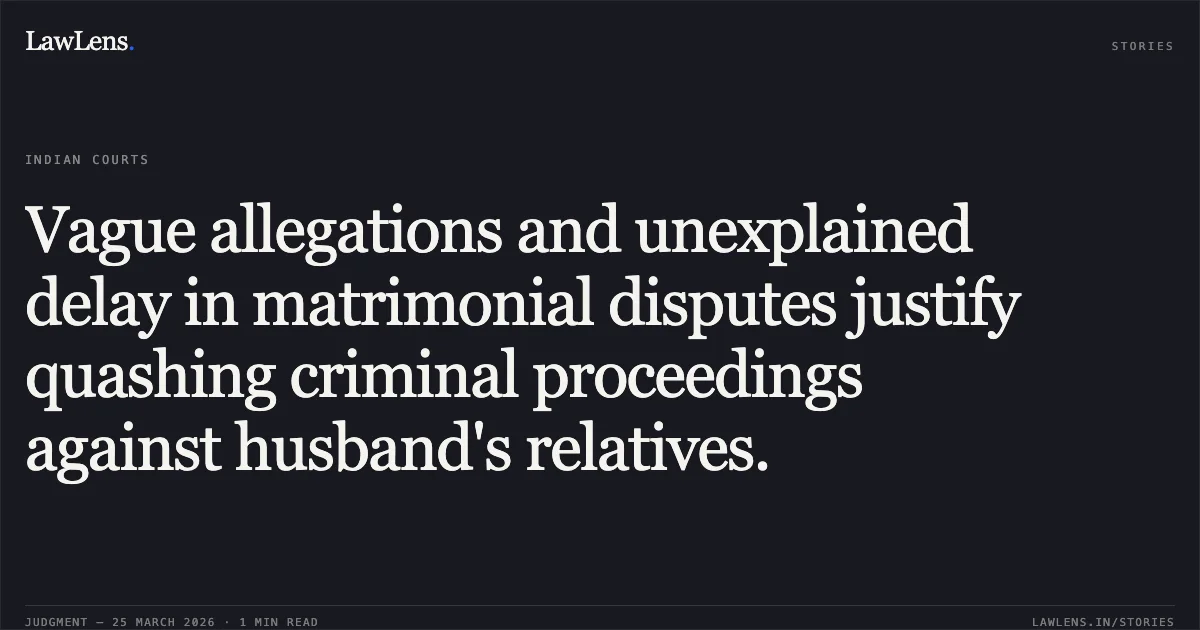
The Court observed that the FIR was lodged after a significant delay of six years and seven months without sufficient explanation, which casts doubt on the prosecution's narrative
¶ 17, 21It found the allegations against the appellants to be "vague and omnibus," lacking material evidence or specific details regarding the dowry demands or the alleged instigation by the sister-in-law
¶ 16, 22Regarding the miscarriage claim (Section 313 IPC), the Court noted the investigating officer dropped the charge due to a lack of medical evidence, contradicting the complainant's primary assertion of physical violence
¶ 23For the Section 354 IPC charge against the 73-year-old father-in-law, the Court found the allegations of "obscene acts" lacked substantive detail and failed to meet the threshold of outraging a woman’s modesty
¶ 25The Court highlighted that the sister-in-law lived separately in Ghaziabad and the parents-in-law in Kanpur, making a shared household—and thus the alleged daily harassment—highly improbable
¶ 16, 1805Holding
The Supreme Court held that the allegations were improbable, lacked evidentiary backing, and were likely intended as a personal vendetta
¶ 26, 28The Court allowed the appeals and set aside the Allahabad High Court’s order
¶ 29Consequently, FIR No. 758/2023, Chargesheet No. 01/2024, and Criminal Case No. 634/2025 were quashed specifically regarding the sister-in-law and the parents-in-law
¶ 29The Court clarified that this judgment does not affect any other pending matrimonial proceedings between the parties
¶ 30Original Court PDF
Charul ShuklavsState Of U.P.
Click to open original judgment
Original judgment, available to read, download and summarize on LawLens.in