Facts
The respondent sued the appellant for recovery of ₹12,24,939 for goods supplied on credit.
Source reference: para. 1–6, 13–13.1After appearing in person on 25 January 2024, the appellant did not file a written statement within the prescribed period. He was later absent from proceedings, including when the respondent’s witnesses were examined and when final arguments were heard. The Trial Court passed an ex parte decree on 26 November 2024.
Source reference: para. 1–6, 13–13.1The appellant sought to set it aside under Order IX Rule 13 CPC, attributing his absence to his counsel’s failure to respond to calls or inform him of the proceedings. The Trial Court dismissed the application, finding no sufficient cause. The appellant challenged that dismissal under Section 13 of the Commercial Courts Act, 2015.
Source reference: para. 1–6, 13–13.1Issues
1. Whether the appellant established “sufficient cause” under Order IX Rule 13 CPC for his non-appearance when the suit was heard and decreed ex parte
Source reference: para. 10–12, 17, 202. Whether the alleged failure of the appellant’s counsel to communicate the proceedings justified setting aside the ex parte decree in the circumstances of this case
Source reference: para. 14–20Law Applied
Section 13 of the Commercial Courts Act, 2015 provides the appellate route invoked here; Order IX Rule 13 CPC permits a court to set aside an ex parte decree where the defendant proves that summons were not duly served or that sufficient cause prevented appearance.
Source reference: no citationUnder G.P. Srivastava v. R.K. Raizada, “sufficient cause” is assessed in light of the circumstances on the date the matter proceeded ex parte, and the court has discretion to do substantial justice where the absence was not deliberate or negligent.
Source reference: para. 11Parimal v. Veena explains that sufficient cause requires an honest explanation showing that the party was not negligent, inactive, or lacking bona fides; the applicant must show that they intended to appear and did their best to do so.
Source reference: para. 12Under Salil Dutta v. T.M. and M.C. Private Ltd. and Rajneesh Kumar v. Ved Prakash, a litigant cannot automatically disown counsel or shift all responsibility to counsel, and remains responsible for vigilance in pending proceedings.
Source reference: para. 14–15The Court also relied on Kalu Ram Dhingra v. Jee Financial Consultant LLP and Nitin Mahadeo Jawale v. Bhaskar Mahadeo Mutke concerning litigant diligence and unsupported allegations of counsel negligence.
Source reference: para. 16, 18Reasoning
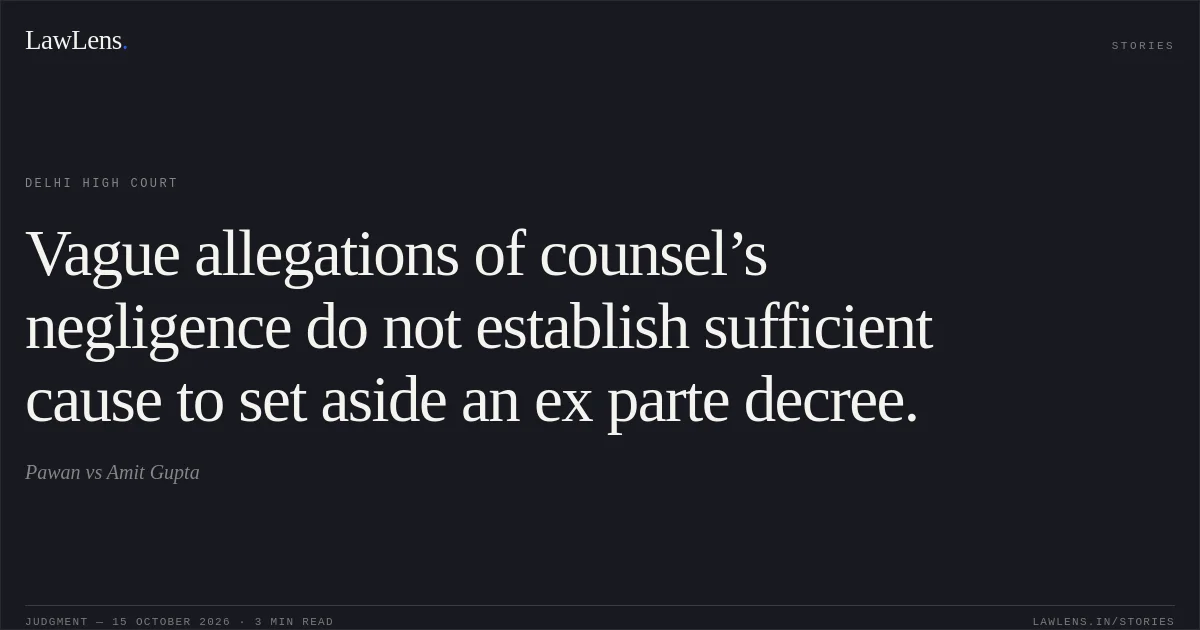
The appellant’s explanation that he had tried to contact counsel for a “huge length of time” was vague: he gave no dates or particulars of his attempts, did not explain why he failed to contact counsel in person or check the case status, and did not explain his absence on the dates final arguments were heard and judgment was pronounced.
Source reference: para. 17, 20His prior personal appearance, business activity, and concern about his CIBIL score undermined his claim that he could not access available means of checking the proceedings.
Source reference: para. 18–19The Court held that the appellant had a duty to remain vigilant, even if counsel was negligent, and that the unsupported allegation against counsel did not establish sufficient cause.
Source reference: para. 18–19In the absence of a satisfactory explanation showing that he honestly intended to appear and did his best to do so, the requirements of Order IX Rule 13 CPC were not met.
Source reference: para. 20Holding
The Court held that the appellant had not established sufficient cause for his non-appearance and that the Trial Court rightly dismissed his application under Order IX Rule 13 CPC.
The appeal was dismissed, and pending applications were disposed of.
Source reference: para. 22Acts & Sections Cited
1 provisions across 1 statute referred to in this judgment. Each provision opens on LawLens.
Commercial Courts Act, 20151
Original Court PDF
PawanvsAmit Gupta
Click to open original judgment
Original judgment, available to read, download and summarize on LawLens.in