Facts
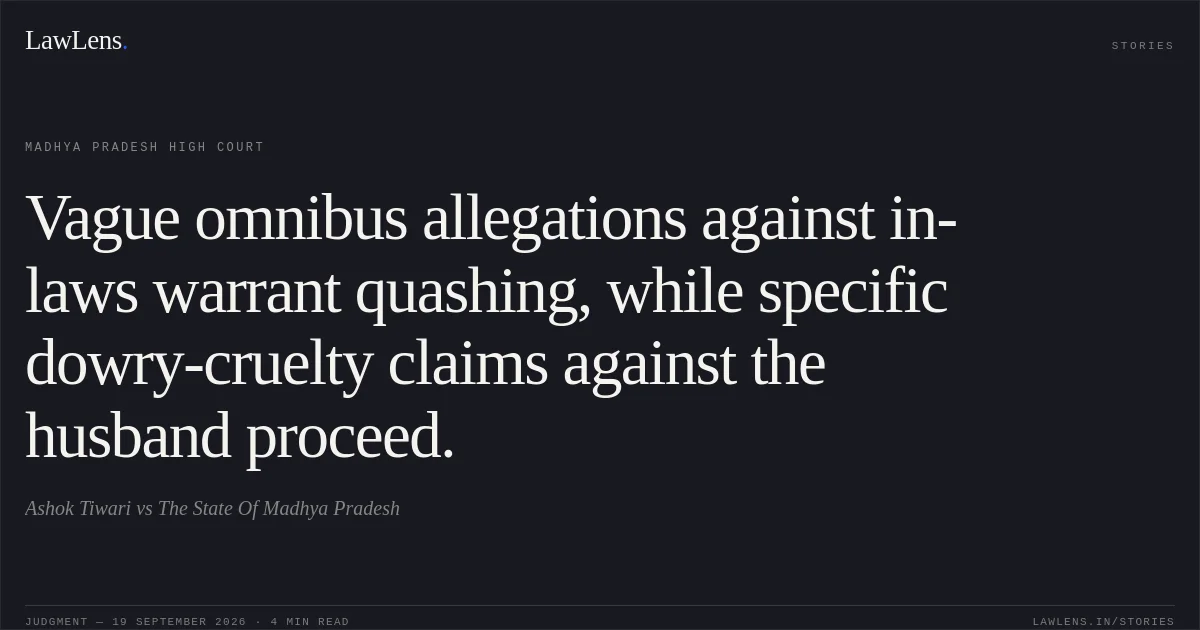
Respondent No. 2, Priyanka Vyas, married petitioner Kartik Tiwari on 01.06.2023. She alleged cruelty, dowry demands and harassment against her husband, father-in-law Ashok Tiwari and mother-in-law Kiran Tiwari. An FIR, Crime No. 23/2024, was registered at Police Station Mahila Thana Jahangirabad, Bhopal, under Sections 498-A read with 34 of the IPC and Sections 3 and 4 of the Dowry Prohibition Act; allegations under Section 377 IPC were also raised against the husband.
Source reference: paras. 2–5The wife left the matrimonial home in August 2023. Before registration of the FIR, Kartik Tiwari instituted proceedings for judicial separation under Section 10 of the Hindu Marriage Act, 1955, on 06.09.2023. The petitioners contended that the FIR, lodged thereafter on 17.01.2024, was delayed and constituted a counterblast to the matrimonial proceedings. The wife maintained that she had initially refrained from filing a criminal complaint in the hope of preserving the marriage and acted only after learning of the judicial-separation proceedings.
Source reference: paras. 4, 6The petitioners invoked the High Court’s inherent jurisdiction under Section 528 of the Bharatiya Nagarik Suraksha Sanhita, 2023, seeking quashing of the FIR and consequential criminal proceedings.
Source reference: para. 2Issues
1. Whether the institution of judicial-separation proceedings by the husband, and the alleged delay in lodging the FIR, justified quashing the criminal proceedings as a counterblast?
Source reference: paras. 8–112. Whether the allegations against husband Kartik Tiwari disclosed offences under Sections 498-A IPC and 3 and 4 of the Dowry Prohibition Act warranting continuation of the prosecution?
Source reference: paras. 12–133. Whether Section 377 IPC was attracted against Kartik Tiwari in respect of alleged unnatural acts committed upon his wife?
Source reference: para. 124. Whether the allegations against father-in-law Ashok Tiwari and mother-in-law Kiran Tiwari were vague and omnibus, warranting quashing of the proceedings against them?
Source reference: para. 14Law Applied
The Court applied Section 528 of the BNSS, 2023, governing the High Court’s inherent power to prevent abuse of process and secure the ends of justice.
Source reference: para. 2It held that where the allegations in the FIR prima facie constitute an offence, criminal proceedings should not be quashed absent material demonstrating abuse of process or failure of justice, relying on Smt. Chand Dhawan v. Jawahr Lal, 1992 AIR 1379, and Y. Sham Kumar v. State of A.P.
Source reference: para. 9It further applied the principle that civil or matrimonial proceedings and criminal proceedings are distinct and may proceed independently; filing a matrimonial petition is not, by itself, a ground to quash an FIR, as held in Pratibha v. Rameshwari Devi, 2007 AIR SCW 5933.
Source reference: para. 10The Court also relied on the settled principle that proceedings under Section 377 IPC are not maintainable against a husband for alleged unnatural acts committed with his wife, while such conduct may, depending on the allegations, be relevant to an offence under Section 498-A IPC.
Source reference: para. 12Conversely, vague, general and omnibus allegations against relatives, without specific attribution of acts, justify quashing proceedings against them.
Source reference: para. 14Reasoning
The Court found that the FIR contained specific allegations against Kartik Tiwari concerning cruelty, harassment and dowry demands. The fact that he had filed a petition for judicial separation before the FIR, or that the FIR was lodged after some delay, did not conclusively establish that it was a counterblast.
Source reference: paras. 8–11The Court accepted that the wife’s initial silence could be explained by her attempt to preserve the matrimonial relationship; these matters could not be conclusively assessed in a quashing petition.
Source reference: paras. 8–11Accordingly, the allegations against Kartik prima facie attracted Sections 498-A IPC and 3 and 4 of the Dowry Prohibition Act.
Source reference: paras. 12–13However, following the cited authorities, the Court held that Section 377 IPC was not made out against the husband because the alleged acts were attributed to him in his capacity as the wife’s husband.
Source reference: para. 12In contrast, the allegations against Ashok and Kiran Tiwari lacked specific particulars and were merely general and omnibus. Applying the rule against continuation of prosecution based on such allegations, the Court quashed the proceedings against them.
Source reference: para. 14Holding
The Court dismissed M.Cr.C. No. 37382/2024 filed by Kartik Tiwari insofar as it sought quashing of the FIR and proceedings under Sections 498-A IPC and 3 and 4 of the Dowry Prohibition Act.
However, the criminal proceedings against him under Section 377 IPC were quashed.
Source reference: paras. 12–13The Court allowed M.Cr.C. No. 37385/2024 and quashed the FIR and all consequential proceedings against Ashok Tiwari and Kiran Tiwari under Sections 498-A read with 34 IPC and Sections 3 and 4 of the Dowry Prohibition Act, on the ground that the allegations against them were vague, general and omnibus.
Source reference: paras. 14–15Acts & Sections Cited
9 provisions across 5 statutes referred to in this judgment. Each provision opens on LawLens.
Bharatiya Nagarik Suraksha Sanhita, 20231
Indian Penal Code, 18602
Hindu Marriage Act, 19552
Code of Criminal Procedure, 19732
Original Court PDF
Ashok TiwarivsThe State Of Madhya Pradesh
Click to open original judgment
Original judgment, available to read, download and summarize on LawLens.in