01Facts
The petitioners, including elected members of Kondarajanahalli Grama Panchayat, were arraigned as accused Nos. 1–4 in Crime No. 312 of 2021 for offences under Sections 504 and 506 read with Section 34 of the Indian Penal Code (IPC), and Sections 3(1)(r) and 3(1)(s) of the Scheduled Castes and Scheduled Tribes (Prevention of Atrocities) Act, 1989 (“SC/ST Act”)
¶ 2–3Before the complaint was filed, the petitioners and other Panchayat members had submitted representations to the Deputy Commissioner and other officials alleging interference and threats by the complainant’s husband
¶ 3–5The petitioners challenged the cognizance order and subsequent proceedings in Special Case (SC/ST Act) No. 38 of 2021, contending that the complaint was retaliatory and did not disclose the alleged offences
pp. 2–3 · ¶ 5–602Issues
i.1. Whether the complaint and accompanying material disclosed the essential particulars necessary to sustain offences under Sections 3(1)(r) and 3(1)(s) of the SC/ST Act
¶ 6ii.2. Whether the proceedings for offences under Sections 504 and 506 IPC could continue in the absence of independent material supporting those charges
¶ 8iii.3. Whether the pending criminal proceedings against the petitioners warranted quashing in the exercise of the High Court’s inherent jurisdiction
¶ 903Law Applied
The petition invoked Articles 226 and 227 of the Constitution and Section 482 of the Code of Criminal Procedure, 1973, seeking quashing of the proceedings
p. 3 · ¶ 2The Court considered the alleged offences under Sections 504 and 506 read with Section 34 IPC and Sections 3(1)(r) and 3(1)(s) of the SC/ST Act
¶ 2, 8It applied the principle that criminal proceedings may be quashed where the complaint and collected material do not disclose the requisite basis for the alleged offences and their continuation would be futile
¶ 6, 8–9Provisions in the judgment · 5 · Linked ones open on LawLens
Indian Penal Code, 1860 Section 504Section 506Section 34
Code of Criminal Procedure, 1973 Section 482
Scheduled Castes and the Scheduled Tribes (Prevention of Atrocities) Act, 1989 Section 3
04Reasoning
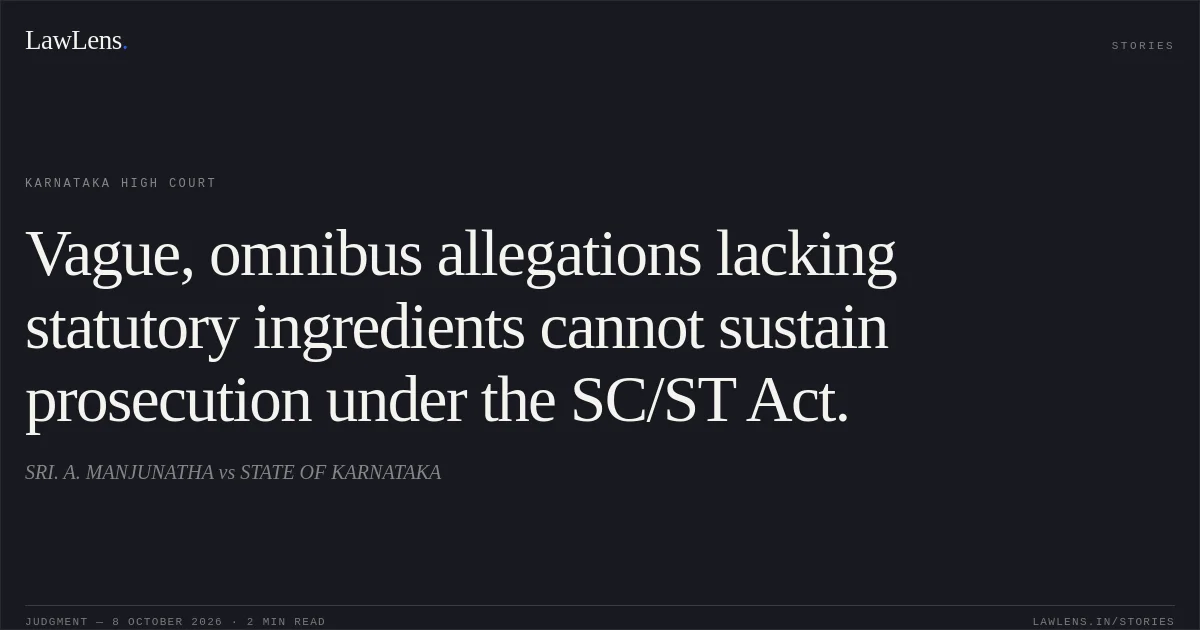
The Court found that the complaint contained only omnibus allegations and did not provide particulars sufficient to invoke Sections 3(1)(r) and 3(1)(s) of the SC/ST Act
¶ 6It also considered the timing of the complaint in light of the earlier representations made by the Panchayat members and treated the complaint as a counterblast to those representations
¶ 5–6As to the IPC offences, the material consisted of witness statements, but the Court found no independent evidence beyond what it described as self-serving testimony
¶ 8In those circumstances, it concluded that continuing the prosecution would be futile
¶ 905Holding
The High Court allowed the petition and quashed the proceedings against the petitioners in Special Case (SC/ST Act) No. 38 of 2021, arising out of Crime No. 312 of 2021, before the II Additional District and Sessions Judge, Kolar
p. 7 · ¶ 10Original Court PDF
SRI. A. MANJUNATHAvsSTATE OF KARNATAKA
Click to open original judgment
Original judgment, available to read, download and summarize on LawLens.in



