Facts
The second respondent alleged that, following her 2016 marriage to petitioner No. 1, he and his relatives subjected her to physical and mental harassment, including demands for additional dowry.
Source reference: pp. 4–5, para. 1The police registered a case and filed a charge sheet against the petitioners for offences under Sections 498A, 344, 109 and 504 read with Section 149 of the IPC, and Sections 3 and 4 of the Dowry Prohibition Act; the Magistrate took cognizance.
Source reference: pp. 4–5, para. 1–2The petitioners sought quashing under Section 482 CrPC, relying, among other things, on the allegedly general nature of the accusations, the complainant’s subsequent marriage and children with another man, and petitioner No. 1’s earlier complaint to the police.
Source reference: pp. 5–6, para. 4The second respondent was not served.
Source reference: p. 5, para. 3Issues
1. Whether the allegations and witness statements disclosed sufficiently specific allegations against the petitioners to justify continuing the criminal proceedings.
Source reference: pp. 7–10, paras. 7–82. Whether continuation of the proceedings, in light of the materials relied upon by the petitioners and the absence of particularised allegations, amounted to an abuse of process warranting relief under Section 482 CrPC.
Source reference: pp. 5–10, paras. 4, 7–8Law Applied
Section 482 CrPC empowers the High Court to quash criminal proceedings where their continuation would amount to abuse of the process of court.
Source reference: pp. 8–10, paras. 7–8The Court applied the principle that relatives of a husband should not be prosecuted in a matrimonial dispute merely because they are named; specific allegations indicating their individual involvement are required, and courts should guard against vague, generalised accusations. It relied on K. Subba Rao v. State of Telangana, 2024 INSC 960, and Dara Lakshmi Narayan v. State of Telangana, (2025) 3 SCC 735, as cited in the judgment.
Source reference: pp. 8–10, paras. 7–8Reasoning
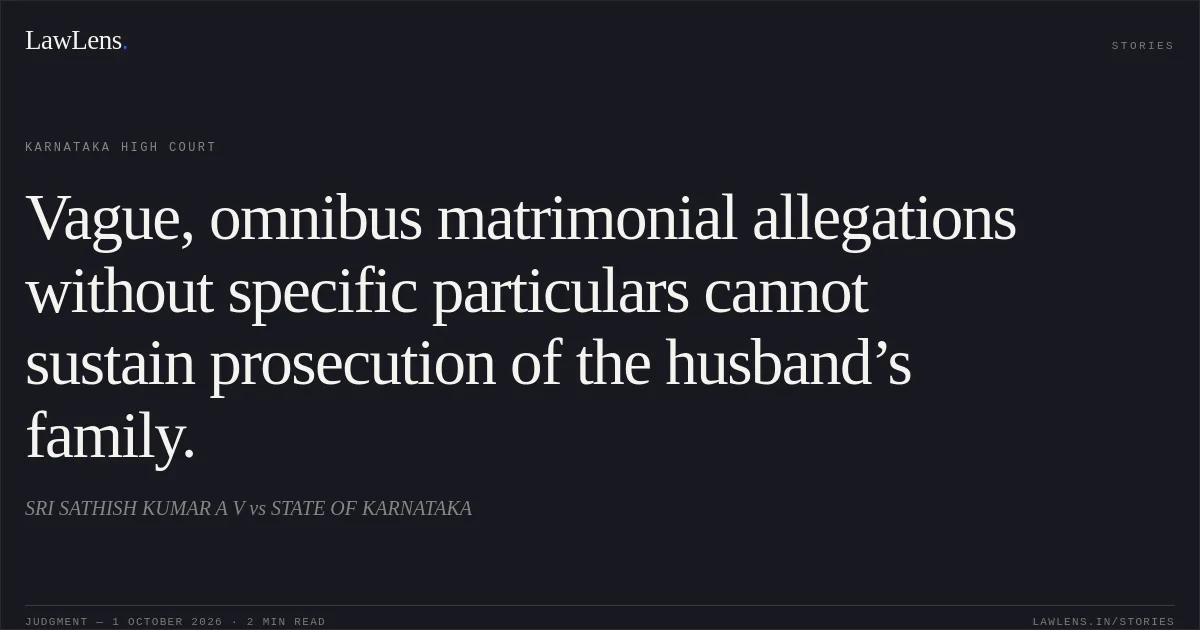
The Court found that the complaint and witness statements contained only omnibus allegations and did not specify dates, times or other particulars of the alleged harassment by the petitioners.
Source reference: pp. 7–8, para. 7It also considered the materials indicating that the complainant had married Hemanth Kumar and had two children, had withdrawn her domestic-violence case, and that petitioner No. 1 had made an earlier complaint alleging threats of false proceedings.
Source reference: pp. 7–8, para. 7Applying the cited principles on particularised allegations in matrimonial prosecutions, the Court concluded that the proceedings could not be sustained and characterised their continuation as an abuse of process.
Source reference: pp. 8–10, paras. 7–8Holding
The proceedings could not be sustained.
The High Court allowed the petition and quashed the proceedings against all petitioners in C.C. No. 1780/2018, arising from Crime No. 77/2017, pending before the IV Additional Civil Judge and JMFC, Hassan, for the offences under the IPC and the Dowry Prohibition Act specified in the order.
Source reference: p. 10, OrderActs & Sections Cited
8 provisions across 3 statutes referred to in this judgment. Each provision opens on LawLens.
Code of Criminal Procedure, 19731
Indian Penal Code, 18605
Original Court PDF
SRI SATHISH KUMAR A VvsSTATE OF KARNATAKA
Click to open original judgment
Original judgment, available to read, download and summarize on LawLens.in