Facts
The appellant (husband) and respondent no. 1 (wife) married on 22.06.2007.
Source reference: p. 2-3The appellant alleged that the wife deserted him in 2007, refused conjugal rights, and entered into an illicit relationship with respondent no. 2.
Source reference: p. 2-3The wife contested, alleging demand for dowry, physical torture leading to a miscarriage in September 2007, and filing a cruelty case (Section 498A IPC) in 2009.
Source reference: p. 4-5The Principal Judge, Family Court, Muzaffarpur, dismissed the appellant's divorce petition (Matrimonial Case No. 57 of 2010) on 08.09.2017.
Source reference: p. 1-2The appellant challenged this dismissal, arguing that the trial court failed to appreciate evidence regarding adultery and desertion despite noting that the parties could not live together.
Source reference: p. 6-7Issues
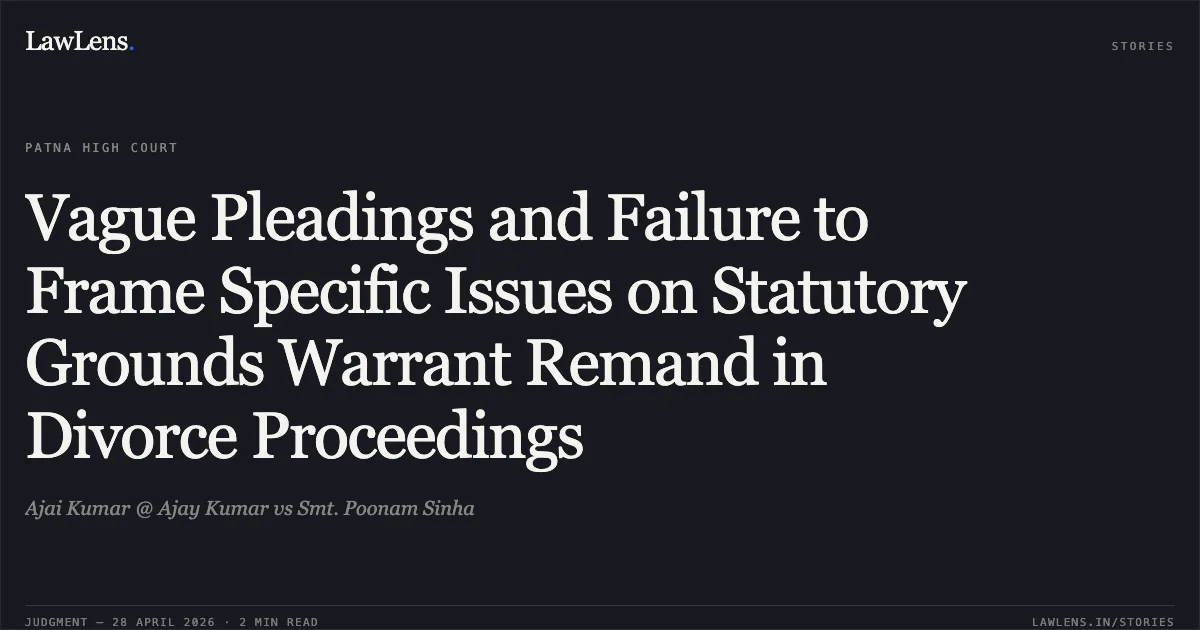
1. Whether the trial court failed to properly frame and discuss specific issues related to the grounds of divorce under Section 13 of the Hindu Marriage Act.
Source reference: p. 9 / para. 7(i)2. Whether the impugned judgment suffered from fundamental errors in the appreciation of evidence and procedural irregularities regarding the consideration of extraneous criminal cases.
Source reference: p. 10 / para. 7(v)-(vii)Law Applied
Section 13 of the Hindu Marriage Act, 1955, which provides the statutory grounds for divorce, including adultery, cruelty, and desertion.
Source reference: p. 9Section 13B regarding divorce by mutual consent as a suggested alternative.
Source reference: p. 8The court emphasized the mandatory requirement for parties to disclose assets and liabilities as per the Supreme Court mandates in Rajnesh v. Neha (2021) and Aditi @ Mithi v. Jitesh Sharma (2023) to secure financial rights during matrimonial litigation.
Source reference: p. 11Reasoning
The High Court found the trial court's judgment legally "vague" and "diabolical".
Source reference: p. 8, 10It noted that while the trial court concluded it was impossible for the parties to lead a conjugal life, it failed to frame specific issues based on the pleadings (plaint and written statement) as required by law.
Source reference: p. 9The High Court observed that the trial court relied on a criminal miscellaneous case (Cr. Misc. No. 17810 of 2024) which was not part of the original pleadings or issues.
Source reference: p. 10Furthermore, the trial court failed to describe or specifically evaluate the depositions of the witnesses (OPW Nos. 1, 2, and 3), rendering the assessment a "ballpark assessment" rather than a judicial determination based on record.
Source reference: p. 10-11The court also highlighted the failure to follow mandatory formats for disclosure of assets and liabilities.
Source reference: p. 11Holding
The High Court set aside the trial court's judgment and decree dated 08.09.2017 and 19.09.2017.
The matter was remanded to the Family Court, Muzaffarpur, for a fresh hearing. The trial court was directed to frame specific issues under Section 13 of the Hindu Marriage Act, allow parties to file additional pleadings regarding their current status, and dispose of the case within six months.
Source reference: p. 11-12Acts & Sections Cited
1 provisions across 1 statute referred to in this judgment. Each provision opens on LawLens.
Hindu Marriage Act, 19551
Original Court PDF
Ajai Kumar @ Ajay KumarvsSmt. Poonam Sinha
Click to open original judgment
Original judgment, available to read, download and summarize on LawLens.in