Facts
The Petitioner, a worker at Muttack Tea Estate, was issued a general notice on 02.11.2006 warning against the unauthorized occupation or construction on garden lands
Source reference: p.3-4On 16.11.2006, the Management issued a show-cause notice alleging the Petitioner constructed a kutcha house on 12.11.2006 without permission, violating the Standing Orders
Source reference: p.4The Petitioner replied claiming ancestral possession and produced a revenue certificate
Source reference: p.5Dissatisfied, the Management held a domestic enquiry where the Petitioner allegedly pleaded guilty
Source reference: p.6Consequently, he was dismissed on 01.04.2007
Source reference: p.7The Petitioner challenged this under Section 2A of the Industrial Disputes Act, 1947. The Industrial Tribunal, Dibrugarh, dismissed his application via an Award dated 06.10.2017, upholding the dismissal
Source reference: p.2-3Issues
1. Whether the show-cause notice dated 16.11.2006 was defective or vague so as to prejudice the Petitioner
Source reference: p.8 / para. 132. Whether the lack of a formal eviction notice prior to disciplinary proceedings rendered the dismissal perverse
Source reference: p.10 / para. 153. Whether the High Court, in exercise of its certiorari jurisdiction under Article 226, should interfere with the Industrial Tribunal’s Award
Source reference: p.3 / para. 4Law Applied
Section 2A of the Industrial Disputes Act, 1947, regarding individual industrial disputes
Source reference: p.3Clause 10(a) of the Standing Orders for Tea Estates in Assam, which defines "gross misconduct"
Source reference: p.14Principles of certiorari jurisdiction established in Central Council for Research in Ayurvedic Sciences v. Bikartan Das, holding that interference is permitted only in cases of perversity or jurisdictional error
Source reference: p.19-20Precedent of Sur Enamel and Stamping Works Limited v. Workmen regarding the necessity of matching charges with specific acts of misconduct
Source reference: p.9, 17Reasoning
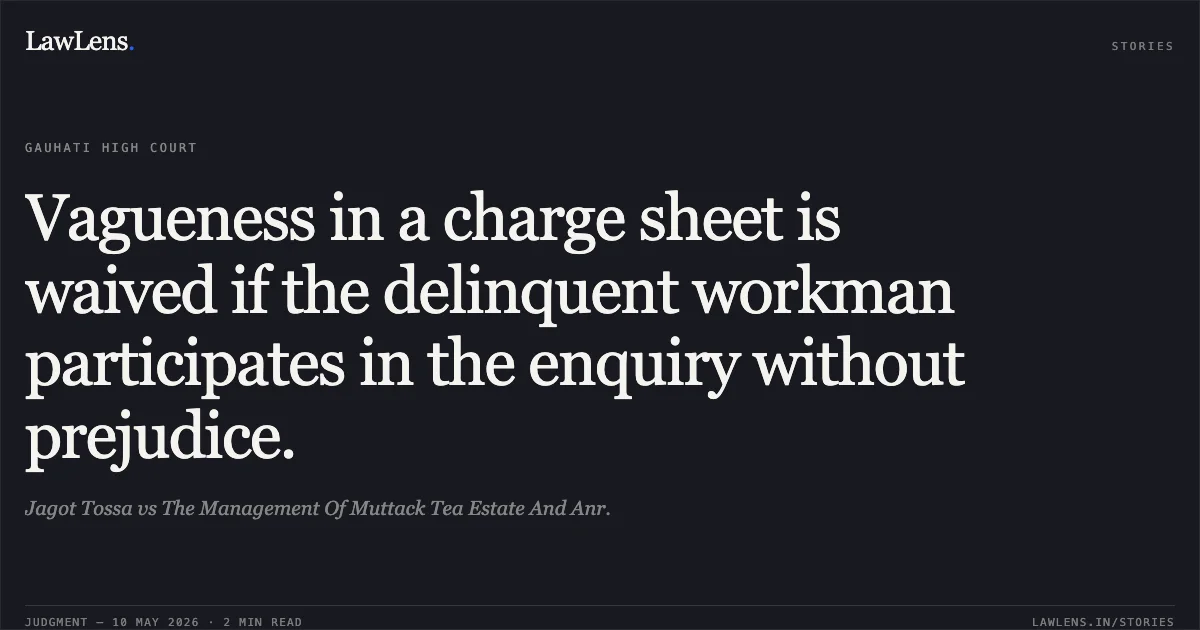
The Court found that the Petitioner’s challenge to the vagueness of the show-cause notice was an "afterthought," as he had participated in the enquiry for years without raised objections and had understood the nature of the charges
Source reference: p.13-16The Court noted that even if the notice cited Clause 10(a)2 instead of 10(a)(ii), the factual allegations (unauthorized construction) were clear and definite
Source reference: p.17Regarding the lack of an eviction notice, the Court held it irrelevant to the disciplinary charge; the misconduct was the act of constructing a house in defiance of the General Notice dated 02.11.2006
Source reference: p.18-19The Court observed that the Industrial Tribunal had correctly found the domestic enquiry fair and the findings supported by evidence, including the Petitioner’s own admissions during cross-examination
Source reference: p.11, 19Holding
The High Court dismissed the writ petition, upholding the Industrial Tribunal's Award
The Petitioner failed to demonstrate any perversity or violation of natural justice in the domestic enquiry or the Tribunal’s findings
Source reference: para. 34The Court further struck out the Respondent No. 2 (Presiding Officer) from the array of parties, reiterating that judicial authorities should not be made parties to writ proceedings challenging their orders
Source reference: para. 2No costs were awarded
Source reference: p.20Acts & Sections Cited
2 provisions across 2 statutes referred to in this judgment. Linked provisions open on LawLens.
Industrial Disputes Act, 19471
Standing Orders for the Tea Estate in Assam1
Original Court PDF
Jagot TossavsThe Management Of Muttack Tea Estate And Anr.
Click to open original judgment
Original judgment, available to read, download and summarize on LawLens.in


