Facts
The Claimant’s land, bearing CTS No. 54 (15.5 sq. metres) in Village Hariyali, Mumbai, was acquired under the Land Acquisition Act, 1894, for the construction of a railway overbridge
Source reference: p. 2, para 1-2(A)A Section 4 notification was issued on August 24, 2006, and possession was taken under the urgency provisions of Section 17 on February 12, 2008
Source reference: p. 2, para 2(B)-(E)On October 16, 2008, the Special Land Acquisition Officer (SLAO) passed an award granting compensation of Rs. 1,62,102/-
Source reference: p. 3, para 2(F)Dissatisfied, the Claimant sought a reference under Section 18 for enhancement
Source reference: p. 3, para 2(G)During the proceedings, the Claimant remained absent during the final hearing despite repeated notices
Source reference: p. 3, para 3The Claimant had produced a valuation report and a municipal license for "Hotel Sanjay" but did not examine the valuer or claim damages for loss of business
Source reference: p. 3-4, para 4-7Issues
1. Whether the Claimant discharged the burden of establishing that the compensation awarded by the SLAO was inadequate and warranted enhancement
Source reference: p. 5, para 92. Whether a valuation report can be treated as substantive evidence in the absence of the testimony of its author
Source reference: p. 5, para 11Law Applied
The Court applied Section 18 of the Land Acquisition Act, 1894, regarding the procedure for enhancement of compensation
Source reference: p. 2, para 1It relied on Section 60 of the Indian Evidence Act, 1872, which mandates that oral evidence must be direct, meaning opinion evidence must be proved by the person who holds that opinion
Source reference: p. 4, para 5; p. 5, para 11The Court followed the precedent in Chimanlal Hargovindas v. Special Land Acquisition Officer, Poona (AIR 1988 SC 1652), establishing that an SLAO’s award is merely an offer, and the burden lies on the claimant to prove entitlement to higher compensation through cogent evidence, as a reference is not an appeal
Source reference: p. 4, para 6; p. 5, para 12Reasoning
The Court reasoned that in a Section 18 reference, the claimant carries the burden of proof to demonstrate that the SLAO's award is insufficient
Source reference: p. 5, para 10In this instance, the Claimant only examined himself and failed to produce independent witnesses or comparable sale instances
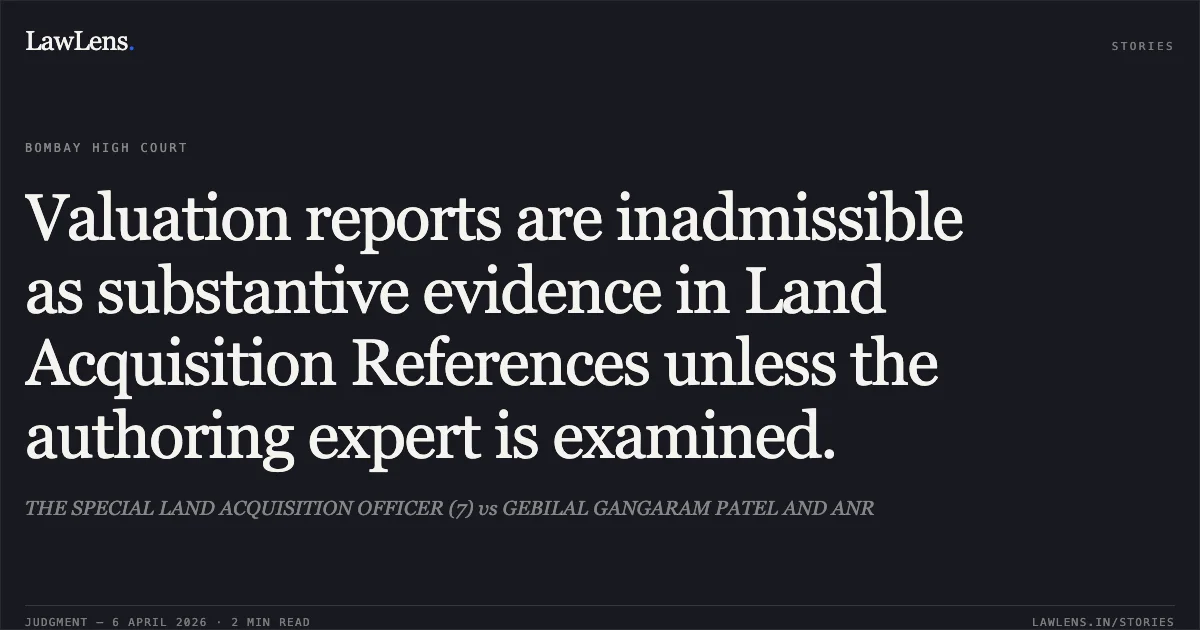
Source reference: p. 5, para 11While a valuation report by M/s. Atts Associates was submitted, the Court held it lacked evidentiary value because the valuer was not called as a witness to prove the report, violating Section 60 of the Evidence Act
Source reference: p. 5, para 11Regarding the commercial use of the land, the Court noted that the Claimant explicitly admitted in cross-examination that he was not seeking compensation for loss of business
Source reference: p. 4, para 7; p. 6, para 13Consequently, since the Claimant failed to provide any substantive evidence to establish a higher market value than that determined by the SLAO, the court found no grounds for enhancement
Source reference: p. 6, para 14Holding
The Court dismissed the Reference and upheld the SLAO’s award dated October 16, 2008, granting compensation of Rs. 1,62,102/-
The Court held that the Claimant failed to discharge the burden of proof required to justify an enhancement of the compensation amount
Source reference: p. 6, para 14No order as to costs was made
Source reference: p. 6, para 15(B)Acts & Sections Cited
6 provisions across 2 statutes referred to in this judgment. Linked provisions open on LawLens.
Land Acquisition Act, 18945
Indian Evidence Act, 18721
Original Court PDF
THE SPECIAL LAND ACQUISITION OFFICER (7)vsGEBILAL GANGARAM PATEL AND ANR
Click to open original judgment
Original judgment, available to read, download and summarize on LawLens.in


