Facts
The Respondent-Assessee, a fertilizer reseller, filed its VAT returns for the period April 1, 2017, to June 30, 2017.
Source reference: no citationThe Assessing Officer (AO) determined a tax liability of ₹67,472/- against an available Input Tax Credit (ITC) of ₹6,69,720/-
Source reference: p. 5, 8The AO disallowed the ITC of ₹13,08,117/- claimed by the assessee under GSTR TRAN-1 (transitioning from VAT to GST) and raised a demand of ₹13,69,988/-, including interest and penalty, based on the differential amount between the actual available ITC and the TRAN-1 claim
Source reference: p. 4, 11The First Appellate Authority dismissed the appeal due to non-payment of pre-deposit
Source reference: p. 5The Gujarat Value Added Tax Tribunal subsequently allowed the assessee’s appeal, holding that VAT liability must first be adjusted against available ITC and that any discrepancies in TRAN-1 filings fall under GST laws, not VAT laws
Source reference: p. 7-10Issues
1. Whether the Tribunal erred in holding that a demand regarding undue ITC carried forward via TRAN-1 constitutes a breach of GST laws rather than GVAT laws.
Source reference: p. 22. Whether VAT liability must be adjusted against available ITC before determining the balance to be carried forward, following the ratio in State of Gujarat v. Cosmos International Ltd.
Source reference: p. 2-3, 73. Whether the Assessing Officer had the jurisdiction under the VAT Act to tax the differential amount of ITC transitioning into the GST regime.
Source reference: p. 6, 17Law Applied
Tax liability under the GVAT Act must be adjusted against available ITC first, with only the remainder being carried forward, as established in State of Gujarat v. Cosmos International Limited (Tax Appeal No. 857 of 2013).
Source reference: p. 7, 31Rule 117 of the GST Rules, 2017, regarding the transition of credit into the electronic credit ledger.
Source reference: p. 31-32Rule 121 of the GST Rules prescribes that verification and recovery of wrongly availed transitional credit must be initiated under Sections 73 or 74 of the GST Act.
Source reference: p. 32-33Section 142(3) of the GST Act, which regulates the refund of accumulated credit from the erstwhile regime.
Source reference: p. 13-16Reasoning
The assessment for the period prior to the implementation of GST must be governed by the VAT Act, which permits the set-off of tax payable against available ITC.
Source reference: p. 30, 34Since it was undisputed that the assessee had a net tax credit of ₹6,69,720/- against a liability of ₹67,472/-, the Tribunal correctly applied the Cosmos International ratio to eliminate the VAT demand, interest, and penalty.
Source reference: p. 8, 30Once the credit transitions into the GST regime via TRAN-1, any "wrongly availed" credit is subject to verification and recovery under Rule 121 of the GST Rules, 2017.
Source reference: p. 32-33The VAT authorities do not have the jurisdiction to penalize the differential amount under VAT laws; rather, their remedy is to inform the concerned GST Officer of the discrepancy to initiate proceedings under the GST Act.
Source reference: p. 33-34Holding
The High Court dismissed the appeal, holding that no substantial question of law arose.
The tax liability of ₹67,472/- is to be adjusted against the available ITC of ₹6,69,720/-, leaving a balance of ₹6,02,248/- eligible for carry forward.
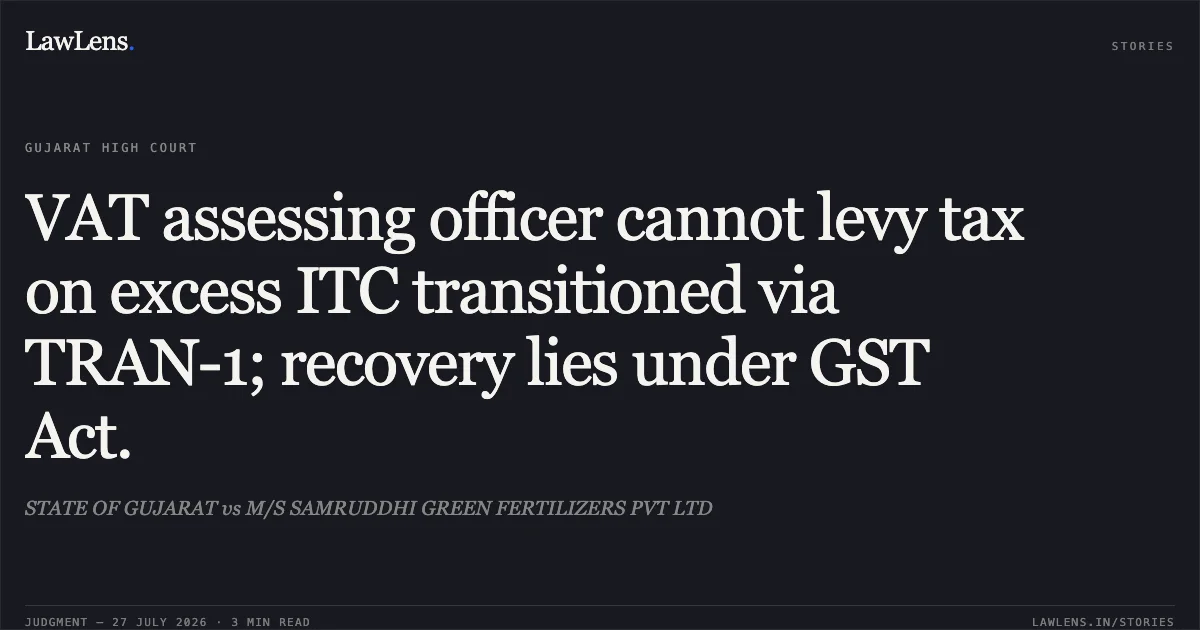
Source reference: p. 8, 33The VAT Department cannot levy tax, interest, or penalty on the differential amount claimed in TRAN-1, as such recovery is exclusively governed by the GST Act and its transitioning rules.
Source reference: p. 33-34All stay applications were disposed of accordingly.
Source reference: p. 35Acts & Sections Cited
3 provisions across 2 statutes referred to in this judgment. Each provision opens on LawLens.
Gujarat Value Added Tax Act, 2003.1
Central Goods and Services Tax Act, 20172
Original Court PDF
STATE OF GUJARATvsM/S SAMRUDDHI GREEN FERTILIZERS PVT LTD
Click to open original judgment
Original judgment, available to read, download and summarize on LawLens.in


![Subsequent exoneration does not retrospectively invalidate a finalized promotion select list.. UNNIKRISHNAN M vs M/o Environment And Forests. CAT - ['Ernakulam']. LawLens](/stories/thumbnails/subsequent-exoneration-does-not-retrospectively-invalidate-a-finalized-promotion-select-li-ce80a0e84f2f4887857271e8b4341c42.webp)