Facts
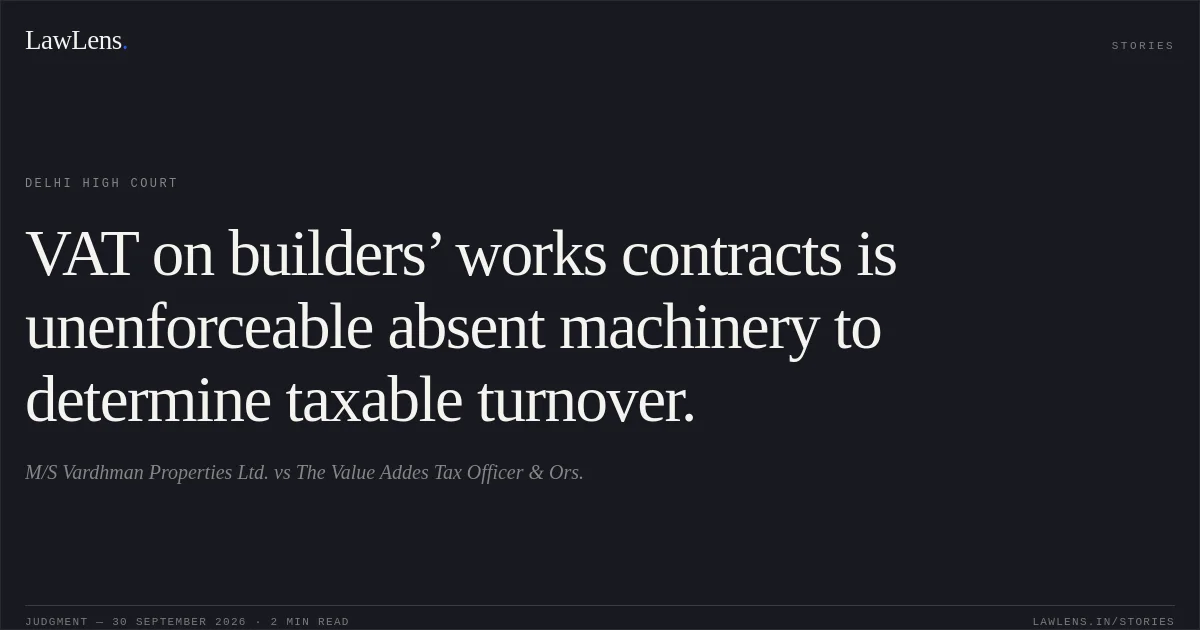
The petitioner, a registered dealer and builder of commercial complexes, challenged a demand dated 16 January 2009 and a notice of default assessment dated 28 January 2009 concerning assessment year 2005–06.
Source reference: p.1, para. 1; p.2, para. 4It accepted that its construction activity could constitute a works contract, but argued that the demand could not be enforced because the machinery for calculating taxable turnover was introduced only when Rule 3 of the Delhi Value Added Tax Rules, 2005 was substituted with effect from 7 September 2006.
Source reference: pp.2–3, paras. 4–4.1The respondents sought remand for consideration of factual aspects as well as the legal issues.
Source reference: p.3, para. 5Issues
1. Whether the petitioner’s construction activity as a builder fell within the definition of “works contract” under Section 2(1)(zo) of the DVAT Act and was exigible to VAT.
Source reference: p.2, para. 3(i); p.5, para. 72. Whether VAT could be enforced for assessment year 2005–06 in the absence of machinery provisions for determining the taxable turnover of the works contract.
Source reference: p.2, para. 3(ii); pp.9–10, paras. 14–15Law Applied
Section 2(1)(zo) of the Delhi Value Added Tax Act, 2004 governs the definition of “works contract.”
Source reference: no citationIn Larsen and Toubro Ltd. v. State of Karnataka, (2014) 1 SCC 708, the Supreme Court held that a developer’s construction becomes a works contract from the stage at which the developer enters into a contract with the purchaser; construction completed before such an agreement does not constitute a works contract with that purchaser.
Source reference: pp.3–5, para. 6In Commissioner, Central Excise & Customs, Kerala v. Larsen & Toubro Ltd., (2016) 1 SCC 170, the Supreme Court held that a composite contract cannot be assessed without statutory machinery for determining the taxable component, and that an assessing authority cannot make an arbitrary assessment in the absence of such machinery.
Source reference: pp.5–6, paras. 8–10Rule 3 of the DVAT Rules, as substituted with effect from 7 September 2006, provided a mechanism for determining taxable turnover in works contracts.
Source reference: p.2, 6, paras. 4.1, 11The Court also relied on Dhingra Jardine Infrastructure Pvt. Ltd. v. State of Haryana, (2017) 101 VST 34 (P&H), which treated the levy as unenforceable for periods lacking machinery provisions to calculate taxable turnover.
Source reference: pp.6–9, paras. 12–13Reasoning
Applying Larsen and Toubro, the Court held that the petitioner’s activity fell within the statutory definition of a works contract.
Source reference: p.5, para. 7However, Rule 3’s substituted mechanism took effect only on 7 September 2006, after the assessment year in question.
Source reference: pp.6, 9–10, paras. 11–14For 2005–06, there was no provision stipulating how taxable turnover for the relevant works contracts was to be calculated.
Source reference: pp.6, 9–10, paras. 11–14Following the principle that a levy cannot be assessed without machinery to determine its taxable measure, and relying on Dhingra Jardine, the Court found the demand unenforceable despite the activity being exigible to VAT in principle.
Source reference: pp.6, 9–10, paras. 11–14Holding
The Court answered the first issue in the affirmative: the petitioner’s activity was covered by the definition of “works contract.”
It held that the demand for assessment year 2005–06 was unsustainable because the necessary machinery provisions were then absent.
Source reference: p.10, paras. 14–16The demand dated 16 January 2009 and notice dated 28 January 2009 were set aside, and the petition was allowed.
Source reference: pp.5, 10, paras. 7, 14–16Acts & Sections Cited
4 provisions across 2 statutes referred to in this judgment. Linked provisions open on LawLens.
Delhi Value Added Tax Act, 20041
Karnataka Electricity (Taxation on Consumption or Sale) Act, 19593
Original Court PDF
M/S Vardhman Properties Ltd.vsThe Value Addes Tax Officer & Ors.
Click to open original judgment
Original judgment, available to read, download and summarize on LawLens.in