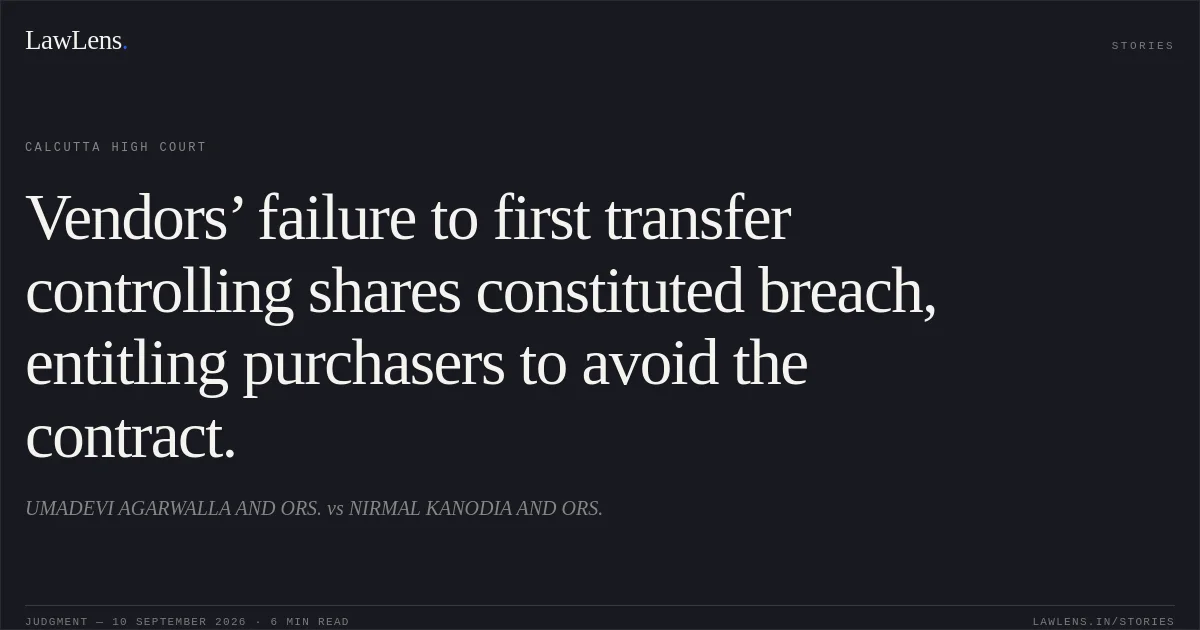
Facts
The vendors and purchasers entered into a Memorandum of Understanding dated 20 September 2010 for the purchasers to acquire control of Bhoomi Minerals Limited, a financially distressed company operating a sponge-iron manufacturing unit, for a total consideration of ₹28.01 crore.
Source reference: paras. 4–5The company owed approximately ₹22 crore to Indian Overseas Bank, whose securities included charges over the factory, personal guarantees of the vendors and collateral securities.
Source reference: paras. 4–5The purchasers had paid ₹1 crore towards the company’s bank dues, although the MOU stipulated payment of ₹50 lakh upon execution and the balance by 30 November 2010, subject to transfer of at least 51% of the company’s shareholding.
Source reference: paras. 5, 12, 20The MOU also required the vendors to transfer at least 51% of the shares and reconstitute the company’s Board in favour of the purchasers’ nominees, while the purchasers were to assume the bank liability and subsequently secure release of the vendors’ guarantees and collateral.
Source reference: paras. 12–18The vendors neither transferred the shares nor reconstituted the Board.
Source reference: para. 6After the vendors proposed amendments to the MOU on 21 September 2010, the purchasers sent an SMS on 24 September 2010 cancelling the MOU and seeking refund of the money paid.
Source reference: para. 6The vendors subsequently claimed damages on the basis of an alleged February 2011 distress sale for ₹22.50 crore.
Source reference: paras. 6, 29–31The vendors instituted C.S. No. 124 of 2011 seeking damages. The purchasers instituted C.S. No. 264 of 2012 seeking refund of ₹1 crore.
Source reference: para. 3The learned Single Judge held that the purchasers had breached the MOU, awarded the vendors ₹5.51 crore, and directed refund of ₹1 crore to the purchasers.
Source reference: para. 3The purchasers appealed against the damages decree; the vendors filed a cross-objection and a separate appeal challenging the refund and seeking adjustment of that amount against the damages decree.
Source reference: paras. 3, 7–8Issues
1. Whether, on a proper construction of the MOU, the vendors were required to transfer at least 51% of the shareholding and reconstitute the Board before the purchasers’ obligation to pay the balance consideration arose?
Source reference: paras. 12–182. Whether the purchasers breached the MOU by cancelling it on 24 September 2010, or whether the vendors had first breached the MOU by failing to transfer shares and reconstitute the Board?
Source reference: paras. 19–253. Whether the vendors were entitled to damages of ₹5.51 crore under Section 73 of the Indian Contract Act, 1872?
Source reference: paras. 28–344. Whether the vendors were entitled to retain or forfeit the ₹1 crore paid by the purchasers in the absence of an express forfeiture clause?
Source reference: paras. 35–395. Whether the decree directing refund of ₹1 crore in C.S. No. 264 of 2012 was liable to be set aside or adjusted against any damages decree?
Source reference: paras. 39–45Law Applied
Commercial contracts must be construed as a whole and in a manner that gives business efficacy to all their provisions; a construction rendering another clause otiose or commercially absurd must be rejected.
Source reference: para. 11The Court relied on Nabha Power Ltd. v. Punjab State Power Corporation Ltd., (2018) 11 SCC 508, Bank of India v. K. Mohandas, (2009) 5 SCC 313, and Radha Sundar Dutta v. Mohd. Jahadur Rahim, AIR 1959 SC 24, for these principles.
Source reference: para. 11Sections 51–54 of the Indian Contract Act, 1872 govern reciprocal promises and the order of performance; a party who has failed to perform the promise required to be performed first cannot demand performance of the reciprocal promise.
Source reference: paras. 21–22Section 73 requires compensatory damages based on proved loss, subject to the ordinary measure of damages and mitigation; damages cannot be awarded on conjecture or speculation, as recognised in Murlidhar Chiranjilal v. Harishchandra Dwarkadas, AIR 1962 SC 366, and Kanchan Udyog Ltd. v. United Spirits Ltd., (2017) 8 SCC 237.
Source reference: para. 28Section 60 of the Sale of Goods Act, 1930 does not dispense with the requirement of proving damages.
Source reference: para. 34Forfeiture of earnest money or advance requires clear contractual language; a forfeiture clause cannot be implied merely because the agreement contains no refund clause.
Source reference: paras. 35–38Section 65 of the Contract Act requires restoration of advantages received under a contract that has been rightfully avoided.
Source reference: paras. 35–38The Court distinguished K.R. Suresh v. R. Poornima & Ors., 2025 SCC OnLine SC 1014, because that case involved an express forfeiture clause and purchaser default.
Source reference: para. 36Reasoning
The Court construed Clauses 3, 6, 14 and 15 harmoniously.
Source reference: paras. 12–18Clauses 14 and 15 required the purchasers to assume the bank liability and procure release of the vendors’ guarantees and collateral, obligations that were commercially intelligible only if control of the company passed immediately to the purchasers.
Source reference: paras. 12–18Clause 3 required prompt reconstitution of the Board, while Clause 6 made payment of the balance consideration subject to transfer of at least 51% of the shares.
Source reference: paras. 14–18Clause 15’s provision for payment of the balance even pending transfer of the remaining 49% shares also contradicted the vendors’ contention that no shares were transferable until the entire balance consideration had been paid.
Source reference: paras. 14–18The purchasers had paid ₹1 crore, exceeding the stipulated initial payment of ₹50 lakh.
Source reference: paras. 19–20The vendors admittedly neither transferred any shares nor convened a Board meeting or appointed the purchasers’ nominees.
Source reference: paras. 19–20Accordingly, the vendors failed to perform the obligations that were to be performed first, and the purchasers’ obligation to pay the balance consideration had not become enforceable under Sections 51–54 of the Contract Act.
Source reference: paras. 21–22The purchasers’ cancellation was therefore a lawful avoidance following the vendors’ prior breach, not a wrongful repudiation.
Source reference: paras. 21–22The Court also found that the purchasers’ contemporaneous letter of 30 April 2011 recorded the same complaints regarding non-transfer of shares and non-reconstitution of the Board, disproving the finding that their justification was an afterthought.
Source reference: paras. 23–25The claim for ₹5.51 crore failed because the vendors did not prove that the alleged February 2011 MOU resulted in any actual sale, transfer of shares or receipt of consideration.
Source reference: paras. 29–32No statutory company records or contemporaneous evidence established the alleged distress sale, and the vendors’ March 2011 letter did not refer to it.
Source reference: paras. 29–32The difference between the contractual price and the alleged sale price represented only an expected profit, not proved loss under Section 73.
Source reference: para. 33The vendors also had no contractual right to forfeit the ₹1 crore.
Source reference: paras. 35–38The amount paid towards the company’s bank dues constituted part payment of the price, and no forfeiture clause existed.
Source reference: paras. 35–38Holding
The Court held that the MOU was valid and binding, but the vendors—not the purchasers—were in breach because they failed to transfer 51% of the shareholding and reconstitute the Board as required under the MOU.
The purchasers’ cancellation of the MOU was lawful, and they were not liable for the vendors’ alleged damages.
Source reference: paras. 41–42The decree for ₹5.51 crore in C.S. No. 124 of 2011 was set aside and that suit was dismissed.
Source reference: para. 43The purchasers were entitled to restitution of the ₹1 crore paid under the MOU.
Source reference: paras. 39–40The decree in C.S. No. 264 of 2012 directing refund of ₹1 crore was affirmed in its entirety, and no question of adjustment arose because no damages decree remained.
Source reference: paras. 39–40, 45APD No. 5 of 2026 was allowed; OCOT No. 5 of 2026 and APDT No. 18 of 2026 were dismissed.
Source reference: paras. 43–46There was no order as to costs in any of the matters.
Source reference: paras. 43–46Acts & Sections Cited
8 provisions across 3 statutes referred to in this judgment. Each provision opens on LawLens.
Securitisation and Reconstruction of Financial Assets and Enforcement of Security Interest Act, 20021
Indian Contract Act, 18726
Sale of Goods Act, 19301
Original Court PDF
UMADEVI AGARWALLA AND ORS.vsNIRMAL KANODIA AND ORS.
Click to open original judgment
Original judgment, available to read, download and summarize on LawLens.in
![Termination of a police constable was set aside where acquittal followed absence of incriminating evidence.. RAJA RAM vs GNCTD. CAT - ['Delhi']. LawLens](/stories/thumbnails/termination-of-a-police-constable-was-set-aside-where-acquittal-followed-absence-of-incrim-ae8bb62b882e4de0a5ac7c7f1ed6156f.webp)