Facts
The deceased, Pratapbhai Bhimjibhai Damor, was allegedly kidnapped in a car by Accused No. 1 (Govind Samat Ahir) and the Applicant (Accused No. 2) on February 21, 2002.
Source reference: para 5.0The prosecution alleged that the Applicant caught hold of the deceased while Accused No. 1 sprinkled petrol and set him ablaze.
Source reference: para 5.0The deceased was shifted to Rambaug Hospital and later G.K. General Hospital, where a dying declaration was recorded by an Executive Magistrate after a fitness certification by a Medical Officer.
Source reference: para 6.5The deceased succumbed to injuries on February 22, 2002.
Source reference: para 3.1Following the charge-sheet, the Applicant filed a second discharge application (Exh. 50) under Section 227 of the CrPC, which was rejected by the Additional Sessions Judge, Gandhidham, on January 1, 2009.
Source reference: para 1.0, 2.1The Applicant challenged this rejection, citing inconsistent dying declarations, the deceased's intoxication (0.125 ml alcohol found in the post-mortem), and non-compliance with Section 226 of the CrPC.
Source reference: para 3.0, 3.1, 5.1Issues
1. Whether the material on record, specifically the allegedly inconsistent dying declarations and medical evidence of intoxication, justified a discharge under Section 227 of the CrPC?
Source reference: para 5.1, 6.42. Whether the trial court's failure to strictly follow Section 226 of the CrPC before framing charges invalidated the order?
Source reference: para 8.03. What is the scope of a revisional court’s jurisdiction when reviewing an order rejecting a discharge application?
Source reference: para 9.3, 9.4Law Applied
The Court applied Sections 226, 227, and 228 of the Code of Criminal Procedure (CrPC), which govern the opening of a case, discharge, and framing of charges in Sessions trials.
Source reference: para 6.0, 8.0It relied on P. Vijayan v. State of Kerala and Ram Prakash Chaddha v. State of U.P., establishing that at the discharge stage, the Court has the power to sift evidence only to determine if a "prima facie case" or "grave suspicion" exists, rather than conducting a "mini-trial".
Source reference: para 6.0, 6.1Regarding dying declarations, it applied Section 32(1) of the Indian Evidence Act and the principles from Laxman v. State of Maharashtra, emphasizing that a consistent statement made in a fit mental state is admissible.
Source reference: para 6.7, 6.8The Court further noted the limitations of revisional jurisdiction under Sections 397/401 of the CrPC as per Amit Kapoor v. Ramesh Chander, which prohibits re-appreciation of facts unless the lower court's finding is perverse.
Source reference: para 9.3, 9.4Reasoning
The Court observed that the Executive Magistrate recorded the dying declaration after obtaining a medical certificate of fitness, and this statement specifically named the Applicant and his role in "catching hold" of the deceased.
Source reference: para 6.5, 6.6It rejected the Applicant's argument regarding inconsistencies, noting that hearsay statements from hospital staff recorded days later cannot override the primary dying declaration at the discharge stage.
Source reference: para 6.6, 6.8Regarding intoxication, the Court noted that the presence of 0.125 ml ethyl alcohol in the post-mortem report does not conclusively prove mental unfitness at the time of the statement, as blood alcohol levels are affected by putrefaction, endogenous production, and timing.
Source reference: para 7.1, 7.2On the procedural issue of Section 226 CrPC, the Court found that since this was the Applicant’s second attempt at discharge and he was well-aware of the charges, the spirit of "opening the case" was satisfied.
Source reference: para 8.1, 8.2The Court condemned the Applicant's "dilatory tactics," noting the trial had been stalled for over 24 years through multiple discharge applications and revisions.
Source reference: para 8.5, 8.6Holding
The High Court dismissed the revision application and confirmed the trial court's order rejecting the discharge.
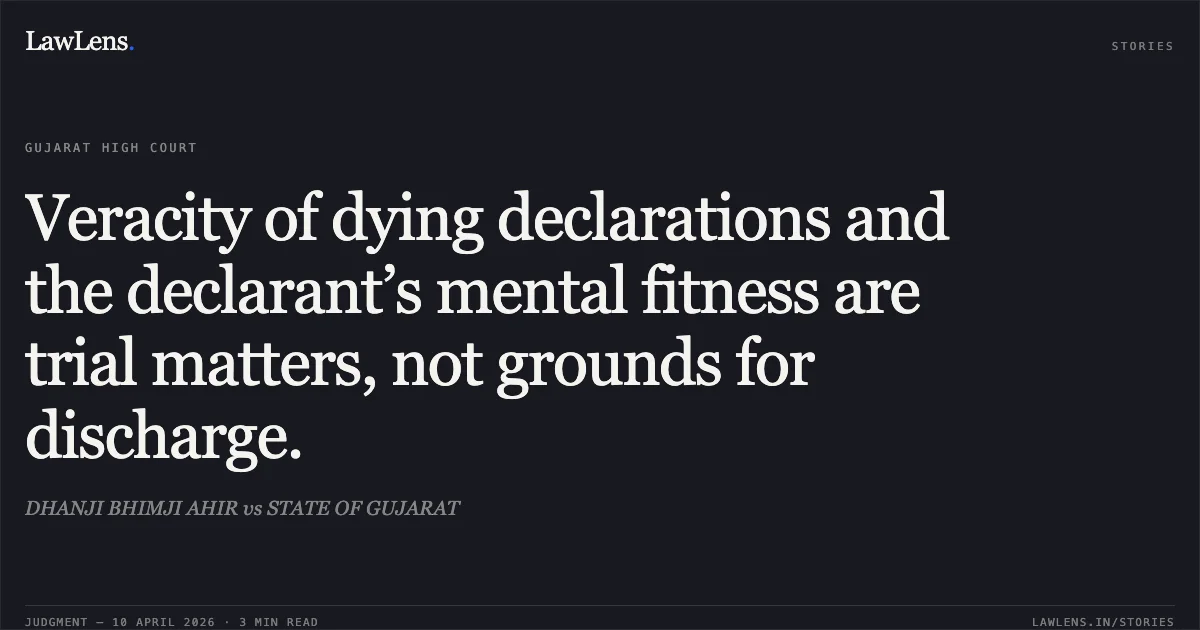
The Court held that there was sufficient material to proceed with the trial and that the Applicant’s defenses regarding the veracity of the dying declaration and intoxication were matters for trial, not discharge.
Source reference: para 9.0, 9.2The Court directed the trial court to expedite the proceedings on a day-to-day basis and vacated all previous interim reliefs.
Source reference: para 10.0Acts & Sections Cited
14 provisions across 3 statutes referred to in this judgment. Each provision opens on LawLens.
Code of Criminal Procedure, 19736
Indian Penal Code, 18607
Scheduled Castes and the Scheduled Tribes (Prevention of Atrocities) Act, 19891
Original Court PDF
DHANJI BHIMJI AHIRvsSTATE OF GUJARAT
Click to open original judgment
Original judgment, available to read, download and summarize on LawLens.in


