Facts
The appellant filed a claim for statutory compensation for grievous injuries sustained on 01.04.2018 while attempting to re-board Train No. 54417 at Jataula Jodi Sampla station after deboarding to drink water.
Source reference: p. 2The Railway Claims Tribunal dismissed the application on 06.03.2019, doubting the appellant's status as a bona fide passenger because the journey ticket was produced two days after the incident and the appellant was found on the "off side" of the track without direct eyewitnesses to the fall.
Source reference: p. 3-4The appellant challenged this dismissal via the present appeal, which was filed with a 175-day delay.
Source reference: p. 1-2Issues
1. Whether the delay of 175 days in filing the appeal should be condoned based on the appellant’s socio-economic condition.
Source reference: p. 2, para 3-42. Whether the injuries sustained by the appellant fall within the ambit of an "untoward incident" under the Railways Act.
Source reference: p. 3, para 63. Whether the appellant was a bona fide passenger at the relevant time.
Source reference: p. 3, para 6Law Applied
The Court applied Section 124-A of the Railways Act, 1890, which defines "untoward incidents" and provides for compensation unless specific exceptions (like self-inflicted injury) apply.
Source reference: p. 4, para 9It relied on the principle from Mohsina v. Union of India, allowing condonation of delay by considering the socio-economic condition of claimants in beneficial legislation.
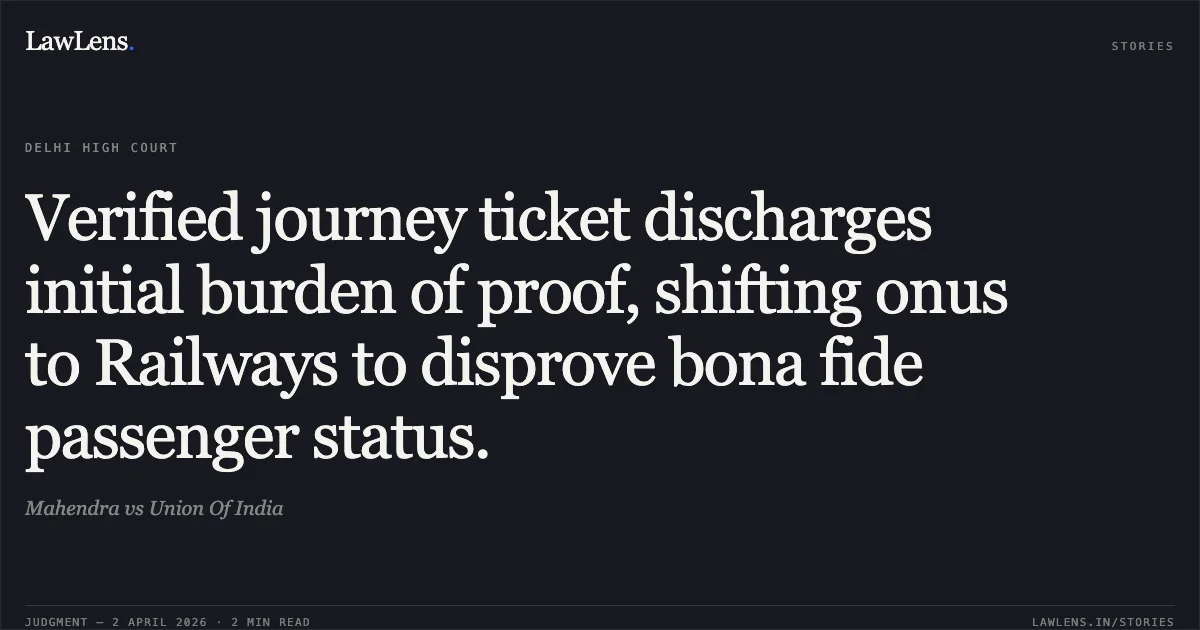
Source reference: p. 2, para 3Regarding the burden of proof, the Court applied the doctrine established in Union of India v. Rina Devi, which holds that once a claimant proves the possession of a valid ticket, the initial burden of being a bona fide passenger is discharged, and the onus shifts to the Railways to disprove it.
Source reference: p. 5, para 11Reasoning
The Court first condoned the delay, noting that the inability to provide timely legal advice due to paucity of funds constitutes sufficient cause in beneficial legislation.
Source reference: p. 2, para 4-5On the merits, the Court found that the Tribunal erred in dismissing the claim due to a lack of eyewitnesses. It noted that the Station Master's record of hearing cries and the subsequent discovery of the injured appellant by a pointsman (who was not examined by the respondent) supported the appellant's version.
Source reference: p. 4, para 7The Court highlighted that the Medico-Legal Certificate (MLC) was a contemporaneous record describing the event as a "railway track accident," which carries high evidentiary value.
Source reference: p. 4, para 8Regarding the bona fide passenger status, the Court held that the recovery and subsequent verification of a valid ticket (No. 93324412) discharged the appellant's burden.
Source reference: p. 5, para 10The two-day delay in producing the ticket was reasonably explained by the appellant’s hospitalization and grievous injuries; therefore, no adverse inference could be drawn.
Source reference: p. 5, para 10-11Holding
The High Court set aside the Tribunal’s judgment, holding that the incident constituted an "untoward incident" and the appellant was a bona fide passenger.
The appeal was allowed, and the matter was remanded to the Railway Claims Tribunal to assess the quantum of compensation.
Source reference: p. 5-6, para 12-13The Tribunal was directed to disburse the compensation within two months of the order and to list the matter for the first instance on 10.04.2026.
Source reference: p. 6, para 12Acts & Sections Cited
1 provisions across 1 statute referred to in this judgment. Each provision opens on LawLens.
Railway Claims Tribunal Act, 19871
Original Court PDF
MahendravsUnion Of India
Click to open original judgment
Original judgment, available to read, download and summarize on LawLens.in