Facts
On December 23, 2017, the appellant was traveling from Gurgaon to Delhi via the Janta Express.
Source reference: p. 1-2 / para. 2Upon reaching Patel Nagar Railway Station, he alighted to fetch water and sustained grievous injuries resulting in the amputation of both legs while attempting to re-board the moving train.
Source reference: p. 1-2 / para. 2The Railway Claims Tribunal (the "Tribunal") dismissed the appellant’s claim for compensation on July 9, 2019, despite finding the event was an "untoward incident".
Source reference: p. 2 / para. 6The dismissal was primarily based on the non-recovery of a journey ticket at the spot and the findings of the Divisional Railway Manager (DRM) report, which suggested the appellant was not a bona fide passenger.
Source reference: p. 2 / para. 4The appellant challenged this, asserting the ticket had been verified by the Railways and recorded in contemporaneous documents.
Source reference: p. 2 / para. 3Issues
1. Whether the appellant was a bona fide passenger at the time of the incident, notwithstanding the non-recovery of a physical ticket from his person at the scene.
Source reference: p. 3 / para. 7Law Applied
Section 123(c) of the Railways Act, 1989, which defines an "untoward incident" to include an accidental fall from a train.
Source reference: p. 2 / para. 6The court further applied the evidentiary principle that once foundational facts regarding an incident and the existence of a verified ticket are established, the onus of proof shifts to the Railways to demonstrate the passenger was not bona fide.
Source reference: p. 4 / para. 9The court relied on the principle that internal enquiry reports, such as DRM reports, do not constitute substantive evidence and cannot override contemporaneous documentary evidence.
Source reference: p. 4 / para. 10Reasoning
The Court observed that the Tribunal's finding of an "untoward incident" had attained finality, as it was supported by the General Diary entry, station master memo, and medical records describing a "railway track accident".
Source reference: p. 3 / para. 6On the issue of bona fide travel, the Court noted that a journey ticket (No. 31139829) had been identified, verified by the Railway authorities, and taken into custody via a seizure memo (fard) during investigation.
Source reference: p. 3-4 / para. 8-9The Court held that the Railways failed to discharge their burden of proof, as they produced no evidence of ticketless travel—such as penalty proceedings—to counter the verified ticket.
Source reference: p. 4 / para. 10The Court rejected the DRM report’s conclusions, noting they were based on inferences of negligence rather than direct evidence and could not supersede contemporaneous records.
Source reference: p. 4 / para. 10Holding
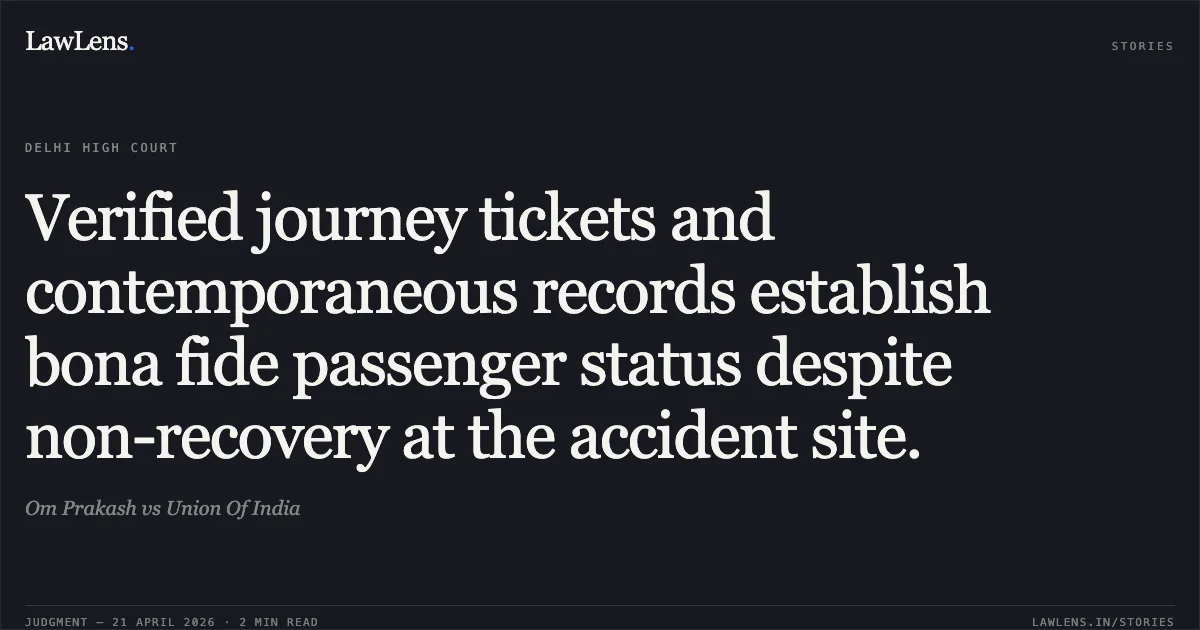
The Court held that the appellant successfully established his status as a bona fide passenger.
The High Court set aside the Tribunal’s judgment and allowed the appeal.
Source reference: p. 5 / para. 12The matter was remanded to the Tribunal with directions to assess the quantum of compensation and ensure disbursement within two months.
Source reference: p. 4-5 / para. 11Acts & Sections Cited
2 provisions across 2 statutes referred to in this judgment. Each provision opens on LawLens.
Railway Claims Tribunal Act, 19871
Railways Act, 19891
Original Court PDF
Om PrakashvsUnion Of India
Click to open original judgment
Original judgment, available to read, download and summarize on LawLens.in


