Facts
On 06.06.2024, the deceased, Sanju Yadav, purchased a journey ticket from Tundla to Bharthana
Source reference: p. 2, para. 3Upon reaching Bharthana station, she was unable to deboard due to heavy rush and allegedly fell from the moving train shortly after, sustaining fatal injuries
Source reference: p. 2, para. 3The Railway Claims Tribunal ("Tribunal") dismissed the appellants' claim on 30.10.2025, holding that the deceased was not a bona fide passenger because no ticket was recovered during the jamatalashi (search of the body) and that the incident was not an "untoward incident" as she had allegedly "jumped" from the train
Source reference: p. 1-2, para. 1-2; p. 2, para. 5The appellants challenged this, producing a verified ticket subsequently found in the deceased's belongings
Source reference: p. 3-4, para. 9Issues
1. Whether the deceased was a bona fide passenger despite the non-recovery of the journey ticket during the initial police search?
Source reference: p. 4, para. 92. Whether the death of the deceased, resulting from an alleged jump from a moving train based on hearsay evidence, constitutes an "untoward incident" under Section 123(c)(2) read with Section 124-A of the Railways Act, 1989?
Source reference: p. 4, para. 10Law Applied
The Court primarily applied Section 124-A of the Railways Act, 1989, which establishes the principle of strict liability for "untoward incidents," regardless of fault, unless specific statutory exceptions apply
Source reference: p. 5, para. 11It relied on Union of India v. Rina Devi (2019) 3 SCC 572, which holds that once a valid journey ticket is produced and verified, a presumption of bona fide travel arises in favor of the passenger
Source reference: p. 4, para. 9The Court cited Union of India v. Prabhakaran Vijaya Kumar (2008) 9 SCC 527, emphasizing that Section 124-A is a beneficial provision that must be interpreted liberally to provide relief to victims
Source reference: p. 5, para. 11Reasoning
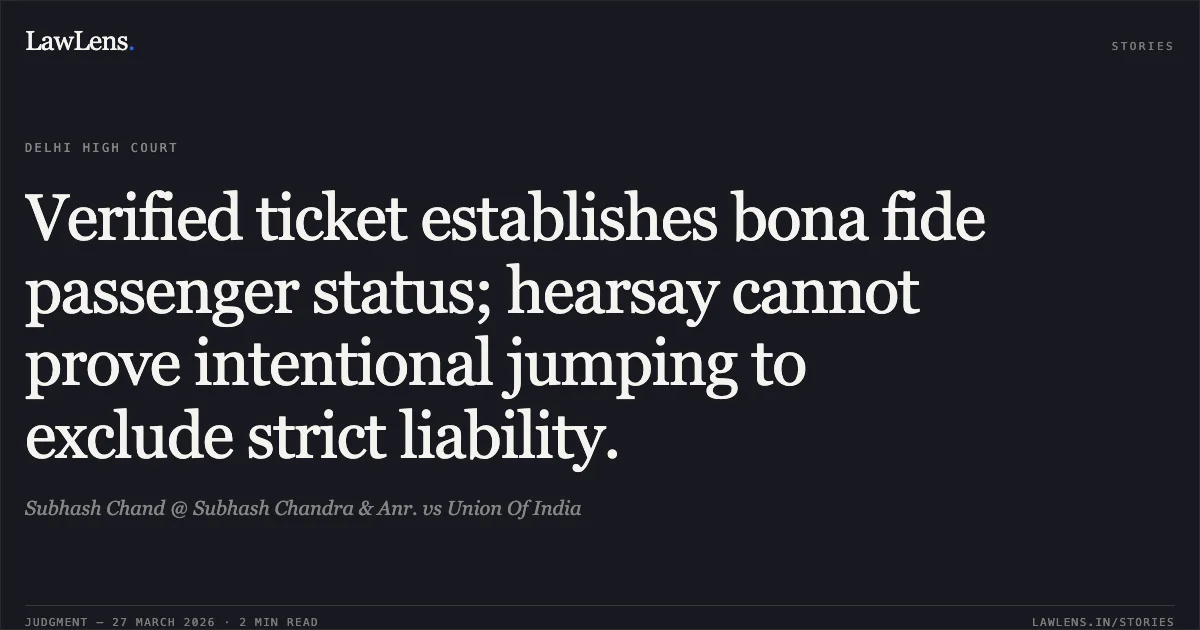
The Court found that the Tribunal’s rejection of the bona fide passenger status was unsustainable because the ticket, though not found during jamatalashi, was subsequently produced by the father and verified as valid by the Railway authorities
Source reference: p. 4, para. 9Under the Rina Devi precedent, this shifted the burden to the Railways to prove the passenger was not bona fide, which they failed to do
Source reference: p. 4, para. 9Regarding the nature of the incident, the Court observed that the Respondent’s claim that the deceased "jumped" was based entirely on the hearsay statement of an unidentified passenger recorded by an RPF official
Source reference: p. 4, para. 10Since no eyewitness was examined and no medical evidence supported a deliberate act, the Court held that the "jumping" theory was speculative
Source reference: p. 4-5, para. 10Consequently, the incident was categorized as an accidental fall, falling squarely within the definition of an "untoward incident" under Section 123(c)(2)
Source reference: p. 5, para. 11Holding
The High Court allowed the appeal, setting aside the Tribunal’s judgment
The Court held that the deceased was a bona fide passenger and her death resulted from an untoward incident
Source reference: p. 4, para. 9; p. 5, para. 11The matter was remanded to the Tribunal to assess the quantum of compensation and ensure disbursement to the appellants within four weeks
Source reference: p. 5, para. 13The parties were directed to appear before the Tribunal on 06.04.2026
Source reference: p. 6, para. 14Acts & Sections Cited
2 provisions across 2 statutes referred to in this judgment. Each provision opens on LawLens.
Railway Claims Tribunal Act, 19871
Railways Act, 19891
Original Court PDF
Subhash Chand @ Subhash Chandra & Anr.vsUnion Of India
Click to open original judgment
Original judgment, available to read, download and summarize on LawLens.in


