Facts
On 13.08.2000, two Government Railway Police (GRP) constables, Parmanand Bhoi (PW-1) and Yogendra Singh (PW-2), intercepted members of a liquor mafia unloading illicit liquor near Charoda railway station
Source reference: p. 2-3The appellants, along with other co-accused, arrived in a Commander Jeep armed with knives and sticks.
Source reference: p. 3They assaulted the constables to reclaim the seized liquor
Source reference: p. 3PW-2 sustained life-threatening stab wounds to his stomach, ribs, and head, requiring emergency surgery
Source reference: para 23, 27PW-1 also sustained injuries
Source reference: para 26The accused fled with the liquor cartons
Source reference: para 3The Trial Court (Special Judge, Raipur) convicted the appellants under Sections 148, 307/149, 324/149, and 395/397 of the IPC, sentencing them to maximum terms of seven years’ Rigorous Imprisonment (RI)
Source reference: p. 2The appellants challenged the conviction on grounds of identification errors, lack of motive, and contradictions in witness testimonies
Source reference: para 8-15Issues
1. Whether the conviction of the appellants under Sections 148, 307, 149, and 395/397 of the IPC is legally sustainable based on the evidence of injured witnesses
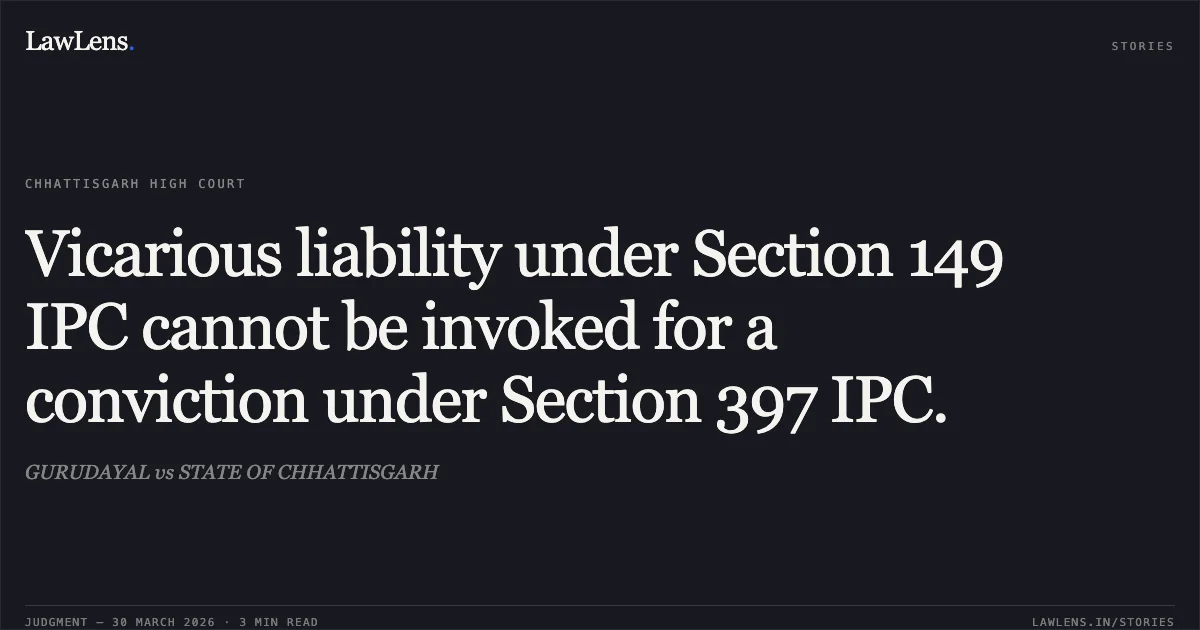
Source reference: para 192. Whether the vicarious liability under Section 149 can be extended to a conviction under Section 397 of the IPC
Source reference: para 563. Whether the sentence of seven years is appropriate given the 26-year lapse since the incident and the appellants' ages at the time of the offence
Source reference: para 59Law Applied
The Court relied on Section 307 IPC, noting that conviction requires proof of intention or knowledge that the act could cause death, irrespective of the actual result
Source reference: para 41-42It applied the principle from Balu Sudam Khalde v. State of Maharashtra regarding the high evidentiary value of injured eye-witnesses
Source reference: para 31Regarding Section 149 IPC, the Court applied Zainul v. State of Bihar and Dablu v. State of M.P., establishing that members of an unlawful assembly are vicariously liable for acts done in prosecution of a common object
Source reference: para 51-52Critically, it applied Ganesan v. State to hold that Section 397 IPC (use of deadly weapons during dacoity) applies only to the specific offender who uses the weapon and cannot be fastened via constructive liability under Section 149
Source reference: para 56Reasoning
The Court found the testimonies of PW-1 and PW-2 highly credible, noting that injured witnesses are unlikely to spare real culprits to falsely implicate others
Source reference: para 31-32Medical evidence from PW-6 and PW-16 confirmed that PW-2's injuries were "life-threatening," satisfying the ingredients of Section 307 IPC
Source reference: para 40, 43The Court rejected the argument regarding the absence of Mohammad Hasnen’s name in the FIR, ruling that the FIR is not an encyclopedia and his specific role in stabbing PW-2 was established during trial
Source reference: para 34-35The Court identified a legal error in the Trial Court's application of Section 397 IPC.
Source reference: para 56-57Citing Ganesan, the Court held that since Section 397 uses the word "offender," it refers only to the individual who actually uses the deadly weapon; therefore, the Trial Court erred by convicting all appellants under Section 397 via Section 149 without identifying which specific appellant used the weapon for the purpose of the dacoity charge
Source reference: para 56-57Holding
The High Court maintained the conviction under Sections 148, 307, 324, and 149 of the IPC.
It set aside the conviction under Section 397 IPC but maintained the conviction for the lesser offence of dacoity under Section 395 IPC
Source reference: para 57Addressing the sentence, the Court noted the incident occurred 26 years prior when the appellants were aged 19–26
Source reference: para 59Consequently, it reduced the sentence for Sections 307 and 395 IPC from seven years to four years’ RI, while affirming the sentences for Sections 148 and 324 IPC, all to run concurrently
Source reference: para 59, 63The appellants were directed to surrender within two months to serve the remaining sentence
Source reference: para 61Acts & Sections Cited
24 provisions across 4 statutes referred to in this judgment. Each provision opens on LawLens.
Indian Penal Code, 1860
Code of Criminal Procedure, 19733
Arms Act, 19591
Bharatiya Nagarik Suraksha Sanhita, 20231
Original Court PDF
GURUDAYALvsSTATE OF CHHATTISGARH
Click to open original judgment
Original judgment, available to read, download and summarize on LawLens.in


![Subsequent exoneration does not retrospectively invalidate a finalized promotion select list.. UNNIKRISHNAN M vs M/o Environment And Forests. CAT - ['Ernakulam']. LawLens](/stories/thumbnails/subsequent-exoneration-does-not-retrospectively-invalidate-a-finalized-promotion-select-li-ce80a0e84f2f4887857271e8b4341c42.webp)