Facts
The appellant was convicted by the Trial Court under Sections 315 (act done with intent to prevent child being born alive) and 506 (criminal intimidation) of the IPC, and Section 4 of the POCSO Act, 2012.
Source reference: para. 1The victim (a minor neighbour) alleged that in April 2018 (Chaitra), the appellant forcibly raped her while her parents were harvesting his fields.
Source reference: para. 2She became pregnant and the appellant allegedly took her for an abortion on 06.07.2018 but fled when her family intervened.
Source reference: para. 2The victim subsequently gave birth to a child who later died.
Source reference: para. 37, 42The appellant challenged the conviction citing a delay of 4-5 months in lodging the FIR, lack of DNA evidence, and failure to strictly prove the victim’s age.
Source reference: para. 11, 13, 15Issues
1. Whether the delay in lodging the FIR and the absence of DNA profiling were fatal to the prosecution's case.
Source reference: para. 29, 46, 492. Whether the victim's testimony could be categorized as that of a "sterling witness" despite minor contradictions.
Source reference: para. 17, 49-503. Whether the prosecution successfully determined the age of the victim to attract the provisions of the POCSO Act.
Source reference: para. 52, 61-65Law Applied
The court applied Section 94 of the Juvenile Justice (Care and Protection of Children) Act, 2015, which mandates a hierarchy of evidence for age determination: first, school/matriculation certificates; second, municipal/panchayat birth certificates; and only in their absence, medical ossification tests.
Source reference: para. 52, 61It relied on Jarnail Singh v. State of Haryana, which extends these JJ Act procedures to victims.
Source reference: para. 13, 52The court also cited Rai Sandeep @ Deepu v. State (NCT of Delhi) regarding the "sterling witness" standard.
Source reference: para. 49Jaya Mala v. Home Secretary, J&K, establishing a two-year margin of error for medical age tests.
Source reference: para. 63Section 42 of the POCSO Act was applied to determine whether IPC or POCSO sentences should prevail based on the "greater in degree" principle.
Source reference: para. 59-60Reasoning
The Court found the delay in FIR was satisfactorily explained by the victim’s fear of the appellant and her marginalized socio-economic status.
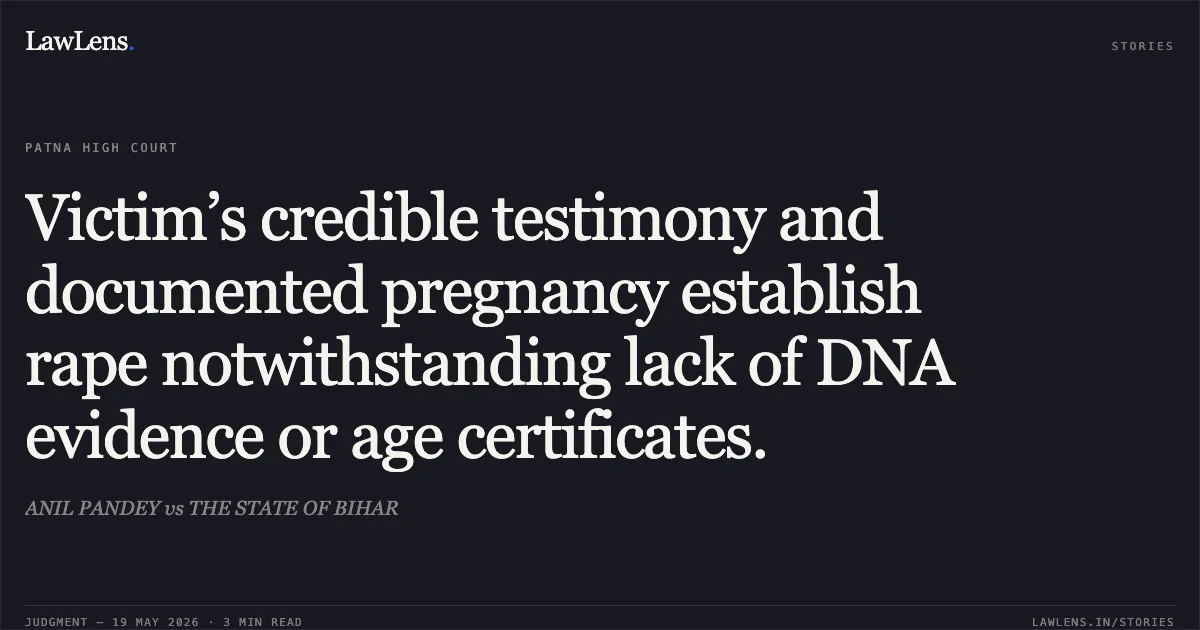
Source reference: para. 46Although no DNA test was conducted due to the infant's death, the victim was deemed a "sterling witness" because her core testimony remained unassailable and was corroborated by medical evidence confirming pregnancy.
Source reference: para. 49-50Regarding age, the Court noted the absence of primary school records and birth certificates.
Source reference: para. 62The medical officer estimated the age at "about 15 years". Applying the two-year margin of error from Jaya Mala, the Court concluded the victim could have been over 16 but remained under 18, thus maintaining the POCSO Act's applicability but potentially mitigating the sentence.
Source reference: para. 40, 63-65Crucially, the Court noted the 2018 IPC amendment (increasing the minimum sentence to 10 years) took effect on 21.04.2018; however, since the offense occurred during "Chaitra" (ending 21.04.2018), the un-amended Section 376 IPC (7-year minimum) was applicable.
Source reference: para. 66-67Holding
The Court upheld the conviction but modified the sentence. It held that while the appellant was guilty, the lack of a Medical Board (as opposed to an individual doctor's report) for age determination warranted the benefit of the margin of error.
The sentence of life imprisonment was reduced to the period already undergone (approximately 7 years and 9 months), considering the appellant’s clean antecedents and family responsibilities; the fine remained unchanged and the appellant was ordered to be released forthwith.
Source reference: para. 69-70Acts & Sections Cited
16 provisions across 4 statutes referred to in this judgment. Each provision opens on LawLens.
Code of Criminal Procedure, 19733
Indian Penal Code, 18606
Juvenile Justice (Care and Protection of Children) Act, 2015.3
Protection of Children from Sexual Offences Act, 20124
Original Court PDF
ANIL PANDEYvsTHE STATE OF BIHAR
Click to open original judgment
Original judgment, available to read, download and summarize on LawLens.in


![Authorities must decide pensionary and retiral-benefit claims through a reasoned order within eight weeks.. Habibullah khan vs HOME DEPARTMENT. CAT - ['Srinagar']. LawLens](/stories/thumbnails/authorities-must-decide-pensionary-and-retiral-benefit-claims-through-a-reasoned-order-wit-d0cbe8a8119c48fbabe7df9f2d353488.webp)