Facts
The petitioner, father of the deceased Yogesh Kumari, challenged the order dated 23.03.2026 passed by the Additional Sessions Judge dismissing his criminal revision and affirming the Trial Court’s order dated 08.01.2026.
Source reference: para. 2–3The proceedings arose from FIR No. 691/2017 registered at Police Station New Ashok Nagar under Sections 365, 302, 174A and 34 of the IPC concerning the victim’s disappearance and subsequent death.
Source reference: para. 2–3The petitioner, dissatisfied with the investigation, applied for directions requiring the accused persons to undergo narco-analysis testing.
Source reference: para. 4–6Two accused expressly declined to undergo the test, while the Trial Court recorded that all three surviving accused had refused and dismissed the application on the ground that narco-analysis could not be compelled.
Source reference: para. 4–6Issues
Whether accused persons who have expressly refused to consent to narco-analysis can nevertheless be compelled to undergo the test at the instance of the complainant or victim’s family member?
Source reference: para. 16Whether the victim’s right to a fair investigation and trial under Article 21 can override the accused’s constitutional protections under Articles 20(3) and 21?
Source reference: para. 16Law Applied
The Court applied Article 227 of the Constitution and Section 528 of the BNSS in determining whether interference with the concurrent orders was warranted.
Source reference: para. 1–2Under Selvi v. State of Karnataka, compulsory administration of narco-analysis, polygraph and similar techniques violates the right against self-incrimination under Article 20(3), substantive due process, personal liberty and mental privacy under Article 21; such tests may be conducted only voluntarily and subject to safeguards, and the test results themselves are not admissible, although material subsequently discovered under Section 27 of the Evidence Act may be relied upon.
Source reference: para. 17–18Amlesh Kumar v. State of Bihar reaffirmed that Articles 20 and 21 are non-derogable, that involuntary narco-analysis is unconstitutional, and that even an accused has no indefeasible right to undergo such testing without judicial consideration of consent and safeguards.
Source reference: para. 19–20The Court also recognised from Zahira Habibulla H. Sheikh and Pooja Pal v. Union of India that fair trial includes fair investigation and protects the interests of the accused, victim and society.
Source reference: para. 10–11Sakiri Vasu v. State of U.P. confirms that the Magistrate may ensure proper investigation or direct further investigation, while the High Court should ordinarily require the aggrieved party to pursue those remedies.
Source reference: para. 22, 24Reasoning
The Court held that consent is a personal and non-derogable safeguard belonging to the person subjected to the test.
Source reference: para. 21Since the surviving accused had expressly refused narco-analysis, the complainant could not compel them to undergo it merely by invoking the seriousness of the offence or the victim’s right to a fair investigation.
Source reference: para. 21The Court distinguished the legitimate right to a fair investigation from any claimed entitlement to override the accused’s constitutional protection against self-incrimination.
Source reference: para. 22Although fair investigation is an incident of fair trial and the victim’s interests are constitutionally relevant, it cannot authorise an involuntary intrusion into the accused’s mental privacy or personal liberty contrary to Selvi and Amlesh Kumar.
Source reference: para. 22The Court further found no jurisdictional error, perversity or illegality in the concurrent orders.
Source reference: para. 23–24It noted that, since the charge-sheet had been filed, the appropriate court could examine the remaining investigative aspects and the petitioner could seek further investigation or monitoring through the legally recognised remedies.
Source reference: para. 23–24Holding
The Court answered both issues against the petitioner.
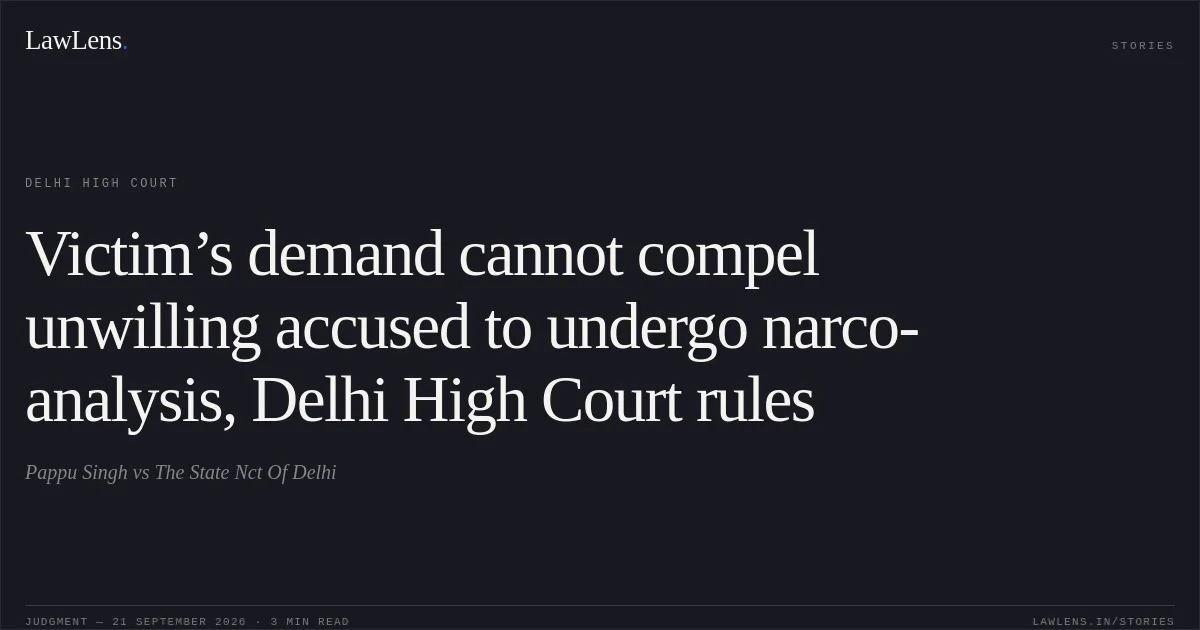
An accused who has refused consent cannot be compelled to undergo narco-analysis at the instance of the complainant, and the victim’s right to fair investigation under Article 21 cannot override the accused’s protections under Articles 20(3) and 21.
Source reference: para. 21–23The petition was dismissed, and the orders dated 08.01.2026 of the Trial Court and 23.03.2026 of the Revisional Court were upheld.
Source reference: para. 23–25The petitioner was granted liberty to pursue further investigation or monitoring before the competent court in accordance with law.
Source reference: para. 23–25Acts & Sections Cited
11 provisions across 3 statutes referred to in this judgment. Each provision opens on LawLens.
Bharatiya Nagarik Suraksha Sanhita, 20231
Indian Penal Code, 18603
Code of Criminal Procedure, 19737
Original Court PDF
Pappu SinghvsThe State Nct Of Delhi
Click to open original judgment
Original judgment, available to read, download and summarize on LawLens.in