Facts
The applicant, a retired Sub-Divisional Engineer (SDE) of the Department of Telecommunications (DOT/BSNL), was charged with misconduct for engaging casual laborers and making payments between 14.02.1998 and 31.07.2001 to maintain 12 telephone exchanges.
Source reference: p. 2The respondents alleged this violated a DOT ban on casual labor engagement dated 12.02.1999.
Source reference: p. 2Initially, the department attempted a summary recovery of Rs. 2,74,557/-, which was quashed by the Tribunal in O.A. No. 182/2002 with directions to follow due procedure under CCS (CCA) Rules.
Source reference: p. 2Post-retirement, the applicant was charge-sheeted in 2009. On 06.05.2013, the Disciplinary Authority imposed a 15% pension cut for three years and directed the recovery of Rs. 2,74,557/- from his gratuity.
Source reference: p. 2On 13.11.2017, the Reviewing Authority (CMD, BSNL) modified the penalty to only include the recovery of the disallowed Imprest Bill (IB) amount from the gratuity.
Source reference: p. 3The applicant challenged these orders, arguing the work was an "exigency" to maintain public services and that his superior (SW-1) had approved the bills.
Source reference: p. 3Issues
1. Whether the engagement of casual laborers for departmental work in violation of administrative instructions constitutes "grave misconduct" or "failure to maintain absolute integrity" justifying recovery from retirement benefits.
Source reference: p. 82. Whether the recovery order is sustainable when the superior authority (SW-1) testified to having approved the relevant Imprest Bills during the inquiry.
Source reference: p. 7Law Applied
BSNL Conduct, Disciplinary and Appeal Rules, 2006, and CCS (CCA) Rules.
Source reference: no citationUnion of India v. J. Ahmed (AIR 1979 SC 2022), which holds that negligence or an error of judgment does not constitute "misconduct" unless there is ill motive or a lack of integrity causing loss.
Source reference: p. 6DG P&T Letter dated 13.02.1981, which stipulates that recovery from pay/gratuity is only permissible if the lapse led to fraud or misappropriation.
Source reference: p. 5Administrative instructions from DOT Letter No. 269-4/93-STN-II dated 12.02.1999 regarding the ban on casual labor.
Source reference: p. 6Reasoning
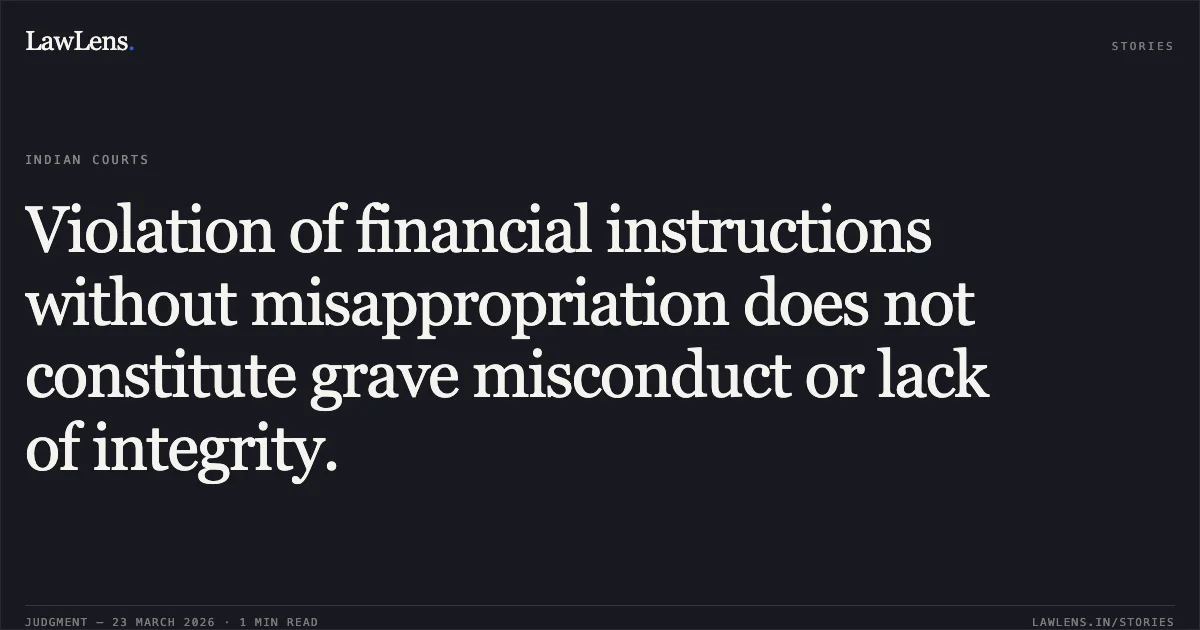
The Tribunal found that while the applicant technically violated financial instructions regarding the engagement of casual labor, such actions did not amount to "grave misconduct" or a "failure to maintain absolute integrity".
Source reference: p. 8The Tribunal noted that the Executive Engineer (SW-1) explicitly admitted during the inquiry that he had approved the Imprest Bills in question.
Source reference: p. 7It was observed that the applicant engaged the laborers to ensure the continuous functioning of 12 telephone exchanges in the interest of the public and the department.
Source reference: p. 3-4Significantly, the respondents made no allegations of embezzlement, misappropriation, or personal gain against the applicant.
Source reference: p. 4, 8The Tribunal reasoned that the department failed to distinguish whether the expenditure was incurred for legitimate departmental purposes and emphasized that procedural irregularities in the absence of fraud do not warrant post-retirement recovery from gratuity.
Source reference: p. 8Holding
The Tribunal answered the issues in favor of the applicant, holding that the alleged violations did not constitute grave misconduct.
The Tribunal set aside the punishment order dated 06.05.2013 and the review order dated 13.11.2017 and directed to refund the recovered amount to the applicant.
Source reference: p. 8The respondents were directed to perform a reassessment within four months to fix responsibility for actual financial loss, if any, on the basis of definite responsibility rather than procedural lapses.
Source reference: p. 8Acts & Sections Cited
1 provisions across 1 statute referred to in this judgment. Each provision opens on LawLens.
Administrative Tribunals Act, 19851
Original Court PDF
ANANT KUMAR SAHNIvsM/o Telecommun Ication
Click to open original judgment
Original judgment, available to read, download and summarize on LawLens.in