Facts
The complainant alleged that the accused borrowed ₹8,50,000 in cash for business on 24 November 2001 and issued a cheque for that amount, which was dishonoured with the endorsement “refer to drawer.”
Source reference: paras. 1–9, 10.3–10.8, 11.3–11.9; pp. 1–6The accused admitted his signature on the cheque but denied the loan, asserting that the cheque had been lost or stolen and misused.
Source reference: paras. 1–9, 10.3–10.8, 11.3–11.9; pp. 1–6The Magistrate convicted him under Section 138 of the Negotiable Instruments Act, 1881, and sentenced him to 18 months’ simple imprisonment and payment of ₹10,00,000 as compensation; the Sessions Court dismissed his appeal.
Source reference: paras. 1–9, 10.3–10.8, 11.3–11.9; pp. 1–6He challenged both decisions in revision, principally disputing the complainant’s capacity, the presentation and dishonour of the cheque, and the existence of a legally enforceable debt.
Source reference: paras. 1–9, 10.3–10.8, 11.3–11.9; pp. 1–6The complainant had deposited ₹7.5 lakh and furnished a bank guarantee of ₹2.5 lakh during the revision proceedings.
Source reference: paras. 1–9, 10.3–10.8, 11.3–11.9; pp. 1–6Issues
1. Whether the concurrent conviction under Section 138 disclosed a legal or factual error warranting interference in revision
Source reference: paras. 13, 26; pp. 7, 132. Whether the accused rebutted the presumptions under Sections 118 and 139 of the NI Act by raising a probable defence concerning the loan, the cheque’s presentation and dishonour, or the complainant’s financial capacity
Source reference: paras. 14–18, 23–25; pp. 8–133. Whether the alleged cash nature of the loan or non-compliance with income-tax provisions rendered the debt unenforceable under Section 138
Source reference: para. 22; p. 11Law Applied
Sections 118 and 139 of the NI Act require a presumption, once execution of the cheque is admitted, that it was issued for discharge of a debt or liability; the accused may rebut that presumption on a preponderance of probabilities by raising a probable defence (*Basalingappa v. Mudibasappa*)
Source reference: para. 14; p. 8In revision under Sections 397 and 401 of the Code of Criminal Procedure, the High Court ordinarily does not reappreciate evidence to replace concurrent factual findings absent a basis for interference (*State v. Manimaran*)
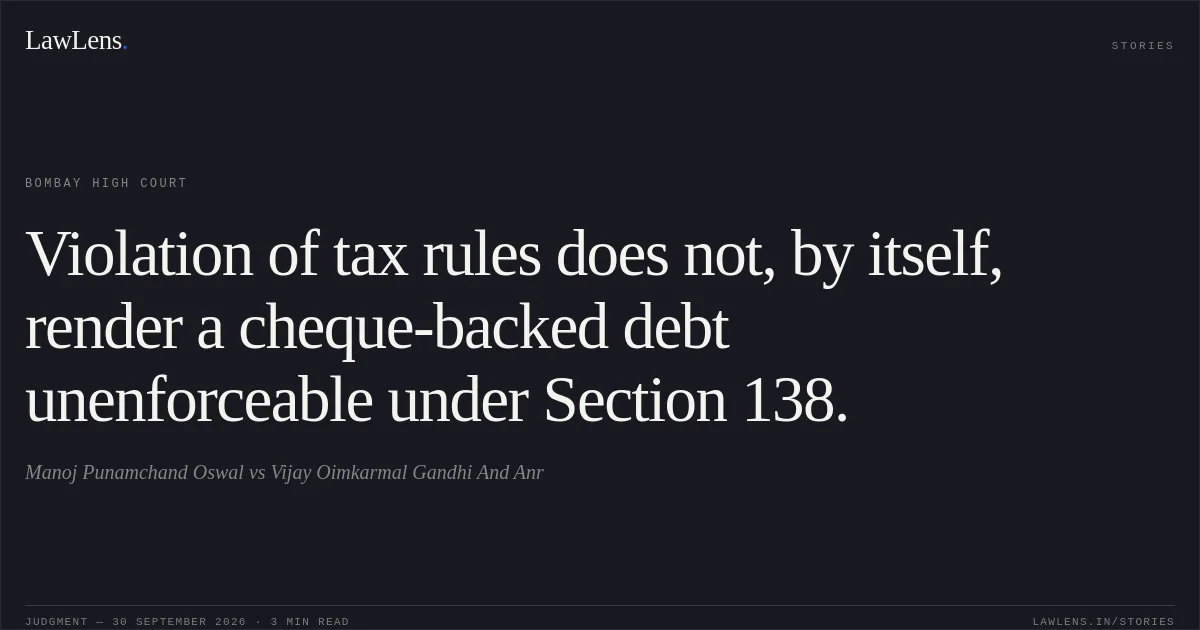
Source reference: para. 13; p. 7The court also applied the rule that an income-tax-law violation, including a cash transaction contrary to Section 269SS, does not by itself make the transaction unenforceable in a Section 138 proceeding (*Prakash Madhukarrao Desai v. Dattatraya Sheshrao Desai*)
Source reference: para. 22; p. 11“Refer to drawer” is a reason for dishonour within the scope of Section 138, as explained in *Laxmi Dyechem v. State of Gujarat*
Source reference: para. 25; p. 13Reasoning
The accused’s admitted signature attracted the statutory presumptions, and the High Court found that his shifting accounts—that the cheque was lost or, alternatively, stolen—did not establish a probable defence.
Source reference: paras. 14, 23; pp. 8, 12The bank witness confirmed that the cheque was credited to the complainant’s account and that it was dishonoured; the court therefore rejected the contention that the payee, presenter, and dishonour record broke the statutory chain.
Source reference: para. 15; p. 8The complainant’s evidence about the sources of the loan amount was considered by the courts below, while the alleged prior Section 138 proceeding against him did not establish an inability to advance the loan.
Source reference: para. 16; pp. 9–10The court also rejected the challenges based on the bank endorsement, the loan’s purpose, and the delay in depositing the cheque, and held that the cash transaction did not become unenforceable merely because of an alleged income-tax violation.
Source reference: paras. 17–22; pp. 10–11Finding no perversity in the concurrent findings, the court declined to interfere in revision.
Source reference: paras. 13, 26; pp. 7, 13Holding
The High Court answered the revision issues against the accused and dismissed the Criminal Revision Application, discharged the rule, and directed the accused to surrender within three weeks.
It permitted the complainant, after that period, to realise the bank guarantee and withdraw the deposited amounts, with accrued interest, if any; the pending interim application was disposed of accordingly.
Source reference: paras. 27–28; p. 14Acts & Sections Cited
5 provisions across 2 statutes referred to in this judgment. Each provision opens on LawLens.
Code of Criminal Procedure, 19732
Negotiable Instruments Act, 18813
Original Court PDF
Manoj Punamchand OswalvsVijay Oimkarmal Gandhi And Anr
Click to open original judgment
Original judgment, available to read, download and summarize on LawLens.in