Facts
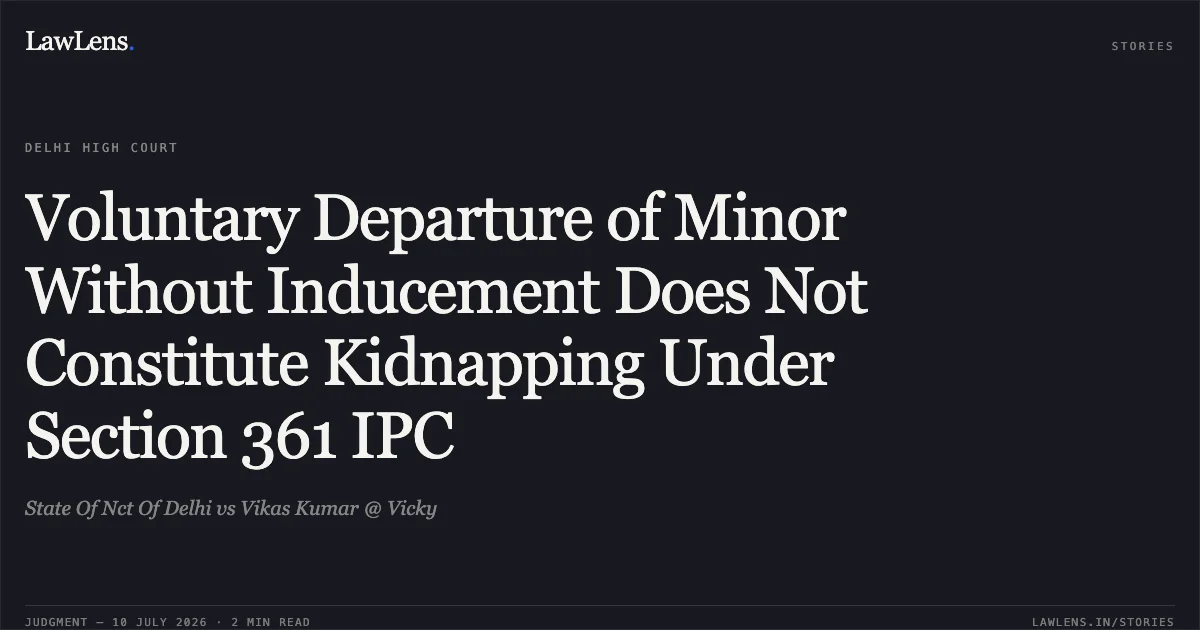
The State appealed against the trial court's judgment dated 28.11.2014, which acquitted the Respondent of charges under Sections 363, 366, 506 of the IPC and Section 12 of the POCSO Act
Source reference: p. 1-2The prosecution alleged that on 31.07.2013, the Respondent kidnapped the victim (PW3), a minor aged 17, by threatening to upload her photographs to the internet, and subsequently sexually assaulted her
Source reference: p. 2The victim initially supported these claims in her Section 164 Cr.P.C. statement
Source reference: p. 7However, during trial, PW3 admitted that she traveled with the Respondent through crowded public terminals and buses without seeking help, despite the presence of police and the public
Source reference: p. 8-9She further admitted the Respondent never physically harmed or sexually assaulted her and that she was unsure if he even possessed the alleged photographs
Source reference: p. 9Issues
1. Whether there is any infirmity in the trial court's judgment acquitting the accused that warrants interference by the High Court
Source reference: p. 6, para 132. Whether the Respondent "took" or "enticed" the minor out of lawful guardianship under Section 363 IPC in light of her conduct and admissions
Source reference: p. 10-13Law Applied
Section 361 of the IPC, which defines kidnapping from lawful guardianship as "taking" or "enticing" a minor without the guardian's consent
Source reference: p. 10Section 366 IPC regarding the abduction of a woman to compel marriage or illicit intercourse through criminal intimidation
Source reference: p. 10Sections 11 and 12 of the POCSO Act, which require proof of sexual harassment
Source reference: p. 14S. Varadarajan v. State of Madras (1965), which establishes a distinction between "taking" a minor and a minor voluntarily accompanying an accused; if a minor of sufficient understanding joins the accused without active inducement, it does not constitute "taking"
Source reference: p. 12-13Reasoning
The Court observed that while the victim was a minor, her testimony during cross-examination severely undermined the prosecution's case. The Court found that the alleged "taking" by force or threat was unsubstantiated because PW3 admitted the accused never slapped her and she was unaware if he had the photographs used for the alleged blackmail
Source reference: p. 11The Court emphasized the victim's conduct: she traveled via public transport (autorickshaws and buses) and frequented busy terminals (Anand Vihar and Haridwar) where police were present, yet she never raised an alarm or sought assistance
Source reference: p. 11-12Following the ratio in S. Varadarajan, the Court reasoned that the Respondent did not "take" the victim, as her voluntary accompaniment through public spaces suggested a lack of coercion
Source reference: p. 13Regarding POCSO, the Court noted the victim's own admission that no sexual assault or inappropriate touching occurred, thereby failing to meet the requirements of sexual harassment under Section 11
Source reference: p. 14Holding
The Court held that the prosecution failed to establish the essential ingredients of "taking" or "enticing" under Section 363 IPC, and found no evidence of sexual harassment under the POCSO Act
The High Court dismissed the appeal and upheld the acquittal of the Respondent
Source reference: p. 15Acts & Sections Cited
12 provisions across 3 statutes referred to in this judgment. Each provision opens on LawLens.
Code of Criminal Procedure, 19736
Indian Penal Code, 18604
Protection of Children from Sexual Offences Act, 20122
Original Court PDF
State Of Nct Of DelhivsVikas Kumar @ Vicky
Click to open original judgment
Original judgment, available to read, download and summarize on LawLens.in