Facts
The deceased, Smt. Santosh, married Shiv Kumar approximately five years prior to the incident and was allegedly subjected to ill-treatment by her in-laws
Source reference: para. 3, 8On 29.05.1979, after a period of separation, she returned to her matrimonial home following a reconciliation
Source reference: para. 3, 8On 30.05.1979, at approximately 06:30 AM, it is alleged that the appellant, Shyam Kali, and the co-accused, Bhanwarkali, set the deceased on fire after sprinkling kerosene on her
Source reference: para. 3, 28The deceased was admitted to Irwin Hospital, Delhi, where her dying declaration was recorded by ASI Ranbir Singh (PW-6) in the presence of Dr. Ashok Gupta at 06:15 PM
Source reference: para. 5, 13, 28She succumbed to her injuries (75% burns) on 31.05.1979
Source reference: para. 11, 39The Fourth Additional Sessions Judge, Meerut, convicted the appellants under Section 302 read with Section 34 of the IPC on 12.09.1985
Source reference: para. 1The appeal for Bhanwarkali abated due to her death, and the current proceedings concern only Shyam Kali
Source reference: para. 2Issues
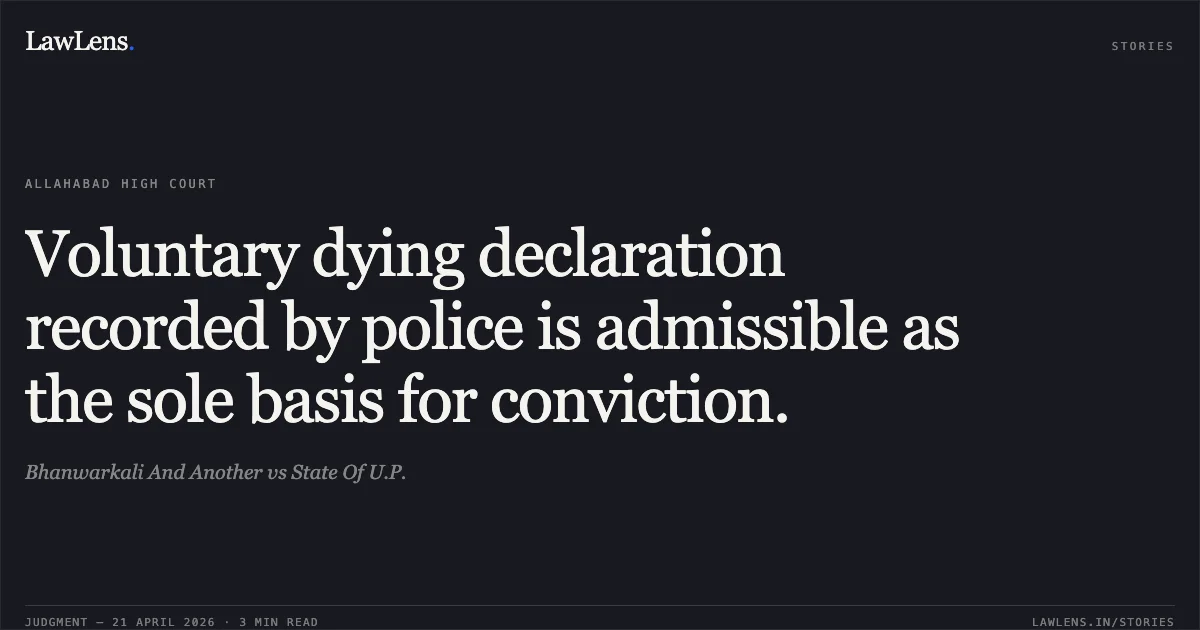
1. Whether a dying declaration recorded by a police officer, rather than a Magistrate, is admissible and can form the sole basis for conviction.
Source reference: para. 42, 452. Whether the deceased, having sustained 75% burn injuries, was in a fit mental state to provide a voluntary and coherent statement.
Source reference: para. 18, 363. Whether the absence of the smell of kerosene during the post-mortem examination, conducted 28 hours after the incident, vitiates the prosecution's case.
Source reference: para. 19, 394. Whether the non-examination of the Investigating Officer and independent neighborhood witnesses is fatal to the prosecution.
Source reference: para. 21, 23, 52, 59Law Applied
The court applied Section 302/34 of the IPC regarding murder and common intention
Source reference: para. 1It relied on the principle of Nemo moriturus praesumitur mentire (a man will not meet his maker with a lie in his mouth) regarding dying declarations
Source reference: para. 29The court applied the precedent of Laxman v. State of Maharashtra, establishing that a doctor’s certification of fitness is a rule of caution, not an absolute necessity, if the declarant is otherwise proven fit
Source reference: para. 35Following State of Jharkhand v. Shailendra Kumar Rai, the court held that dying declarations recorded by police personnel are not inadmissible per se
Source reference: para. 50the court noted that under Section 294(3) of the CrPC, documents whose genuineness is not disputed may be read in evidence without formal proof
Source reference: para. 57, 58Reasoning
The Court rejected the appellant's contention that 75% burns rendered the deceased incapable of giving a statement, noting that PW-6 (ASI) and PW-5 (Dr. Govila) testified to her consciousness and mental fitness
Source reference: para. 36, 37It held that the endorsement by Dr. Ashok Gupta at 04:50 PM, certifying the patient's fitness, was accepted as true as it was not challenged in cross-examination
Source reference: para. 55Regarding the recording of the dying declaration by a police officer, the Court reasoned that since it was recorded after court hours in a critical situation, and the officer was not part of the investigating team, the statement was independent and reliable
Source reference: para. 46, 61The Court dismissed the argument regarding the lack of kerosene smell, clarifying that the 28-hour lapse between the incident and the autopsy naturally allowed the scent to dissipate, distinguishing the facts from Suresh v. State
Source reference: para. 39-41the non-examination of the Investigating Officer was deemed non-fatal because the defense had admitted the genuineness of the site plan and charge sheet under Section 294 CrPC
Source reference: para. 59The court found the dying declaration to be consistent, voluntary, and free from tutoring
Source reference: para. 63, 65Holding
The High Court dismissed the appeal and upheld the conviction and life sentence of Shyam Kali
The Court held that a dying declaration, if found truthful and voluntary, can form the sole basis of conviction without corroboration
Source reference: para. 62, 63The Court answered the issues by affirming that the deceased was in a fit state of mind at the time of the statement and that the procedural recording by the police did not invalidate the declaration given the exigent circumstances
Source reference: para. 36, 50The appellant’s bail bonds were cancelled, and she was directed to surrender within three weeks to serve the remainder of her sentence
Source reference: para. 70Acts & Sections Cited
4 provisions across 2 statutes referred to in this judgment. Each provision opens on LawLens.
Indian Penal Code, 18602
Code of Criminal Procedure, 19732
Original Court PDF
Bhanwarkali And AnothervsState Of U.P.
Click to open original judgment
Original judgment, available to read, download and summarize on LawLens.in


![Subsequent exoneration does not retrospectively invalidate a finalized promotion select list.. UNNIKRISHNAN M vs M/o Environment And Forests. CAT - ['Ernakulam']. LawLens](/stories/thumbnails/subsequent-exoneration-does-not-retrospectively-invalidate-a-finalized-promotion-select-li-ce80a0e84f2f4887857271e8b4341c42.webp)