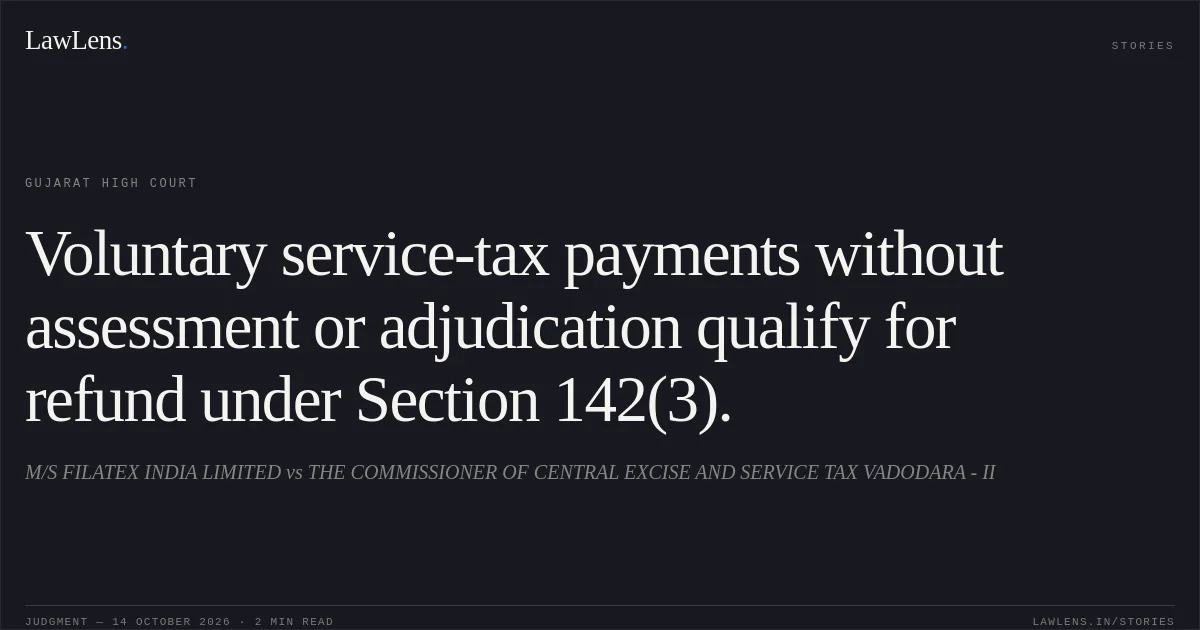
Facts
Before 1 July 2017, Filatex was subject to the central excise and service-tax regime and availed CENVAT credit.
Source reference: paras. 3–4It had received banking and financial services from overseas institutions for external commercial borrowings between January 2013 and June 2017 but had not paid service tax under the reverse-charge mechanism.
Source reference: para. 5After the DGGI sought information in January 2018, Filatex paid service tax of ₹36,34,040, with interest and penalty; the investigation was subsequently closed.
Source reference: paras. 6–8Filatex’s refund application was rejected, as were its appeals to the Commissioner (Appeals) and CESTAT. CESTAT treated the payment as recovery following an investigation and applied Section 142(8)(a) of the CGST Act.
Source reference: paras. 9–12Issues
1. Whether Filatex’s payment, made after the DGGI’s inquiry but without assessment or adjudication proceedings, was a voluntary payment or a recovery within Section 142(8)(a) of the CGST Act.
Source reference: paras. 17–192. Whether Filatex could seek a refund under Section 142(3) of the CGST Act of service tax paid after the appointed day, where the corresponding CENVAT credit could not be availed under the GST regime.
Source reference: paras. 15, 19–20Law Applied
Section 142(8)(a) of the CGST Act concerns amounts recoverable pursuant to assessment or adjudication proceedings instituted under the existing law; it does not apply in the absence of such proceedings.
Source reference: para. 19Section 142(3) provides that refund claims for CENVAT credit, duty, tax, interest or other amounts paid under the existing law are to be disposed of under that law, with any amount eventually accruing payable in cash, subject to the statutory provisos, including Section 11B(2) of the Central Excise Act, 1944.
Source reference: para. 19Section 174 of the CGST Act preserves specified rights and liabilities under the repealed enactments.
Source reference: para. 20The Court also directed the Adjudicating Authority to consider the decisions relied on by Filatex when processing the claim.
Source reference: paras. 13.1, 21Reasoning
The Court found that the DGGI’s request for information and Filatex’s ensuing payment did not amount to assessment or adjudication proceedings.
Source reference: paras. 18–19The payment therefore could not be treated as a recovery under Section 142(8)(a), and CESTAT had erred in relying on that provision to deny the claim.
Source reference: paras. 18–19Because the service tax related to the pre-GST period and the transitional refund provision applied, the refund claim was required to be processed under Section 142(3), read with the applicable existing law and Section 174.
Source reference: paras. 19–21Holding
The Court answered the admitted questions in Filatex’s favour, allowed the appeal, and quashed the CESTAT’s order and the Commissioner (Appeals)’ order.
It remanded the matter to the Adjudicating Authority to process the refund claim in accordance with law, particularly Section 142(3), and the decisions relied on by Filatex.
Source reference: para. 21Filatex stated that it would not claim interest on the refund.
Source reference: para. 21Acts & Sections Cited
5 provisions across 2 statutes referred to in this judgment. Each provision opens on LawLens.
Central Excise Act, 19442
Central Goods and Services Tax Act, 20173
Original Court PDF
M/S FILATEX INDIA LIMITEDvsTHE COMMISSIONER OF CENTRAL EXCISE AND SERVICE TAX VADODARA - II
Click to open original judgment
Original judgment, available to read, download and summarize on LawLens.in
![A police constable cannot be removed for unauthorized absence without a Rule 359-compliant inquiry.. Mohammad Sidiq Khan vs D/o Home Ut Of Jammu & Kashmir. CAT - ['Srinagar']. LawLens](/stories/thumbnails/a-police-constable-cannot-be-removed-for-unauthorized-absence-without-a-rule-359-compliant-7b43fc316bd94f22a62676153bbc9d54.webp)
![A Review DPC lacks authority to determine or alter inter se seniority.. SAURABH KUMAR vs REVENUE. CAT - ['Patna']. LawLens](/stories/thumbnails/a-review-dpc-lacks-authority-to-determine-or-alter-inter-se-seniority-4b21640f20af46fcabdfc8273d2ce959.webp)