Facts
The petitioner challenged, under Article 226 of the Constitution, a Foreigners’ Tribunal opinion declaring him a foreigner of the post-25 March 1971 stream.
Source reference: pp. 2–4, paras. 2–4He relied on electoral rolls from 1965, 1970 and 1997, EPICs, a PAN card and a Gaonburah certificate to establish his link to projected family members.
Source reference: pp. 2–4, paras. 2–4The Tribunal rejected the claimed link, noting inconsistencies in the evidence of the petitioner and his projected father, and declared him a foreigner.
Source reference: pp. 4–5, paras. 5–7The High Court reviewed the Tribunal record and dismissed the writ petition.
Source reference: p. 6, para. 11; p. 12, para. 34Issues
Whether the petitioner established, through the electoral rolls and supporting evidence, a reliable link to his projected father and grandparents sufficient to warrant interference with the Tribunal’s opinion.
Source reference: pp. 6–12, paras. 12–31Whether the EPIC, PAN card and Gaonburah certificate could independently establish the petitioner’s citizenship or support the claimed family link.
Source reference: pp. 7–8, paras. 15–16; pp. 10–12, paras. 23–24, 32–33Law Applied
In exercising writ jurisdiction under Article 226, the Court assessed whether the Tribunal’s opinion warranted interference on the evidence before it.
Source reference: p. 2, para. 2; p. 12, para. 34It relied on Md. Babul Islam v. Union of India for the principle that EPICs and PAN cards, being post-1971 documents issued on the basis of declarations, do not prove citizenship without supporting evidence.
Source reference: p. 7, para. 15Under Basiron Bibi v. Union of India, evidence in an electoral roll must be considered as a whole; a party cannot rely only on favourable entries or ask the Court to treat an entry as incorrect without proof.
Source reference: pp. 7–8, para. 16The Court noted that an age discrepancy may be overlooked where the identity of the family is otherwise established, applying Md. Sirajul Hoque v. State of Assam.
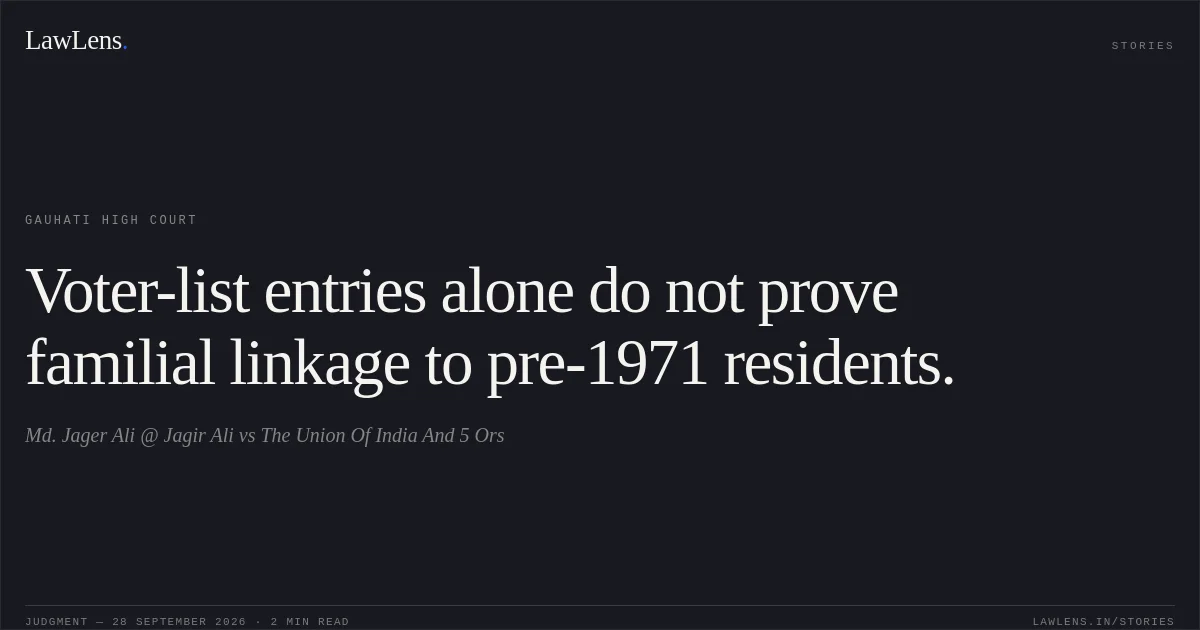
Source reference: p. 8, para. 16It also applied Aziz Mia @ Md. Aziz Mia v. Union of India, holding that merely identifying persons in electoral rolls as one’s relatives does not conclusively prove the relationship or discharge the evidentiary burden.
Source reference: pp. 5–6, para. 10; pp. 11–12, para. 31Under Basiron Nessa v. Union of India, documentary evidence must be established from the record; oral testimony or a Gaonburah certificate based on an EPIC is insufficient on its own.
Source reference: p. 12, para. 33Reasoning
The Court found that the petitioner had not established a consistent family link to the persons named in the electoral rolls.
Source reference: pp. 10–12, paras. 25–33The projected father’s evidence that his father died in 1970 when he was a small boy conflicted with the electoral-roll entry and his disclosed age, which indicated that he was an adult by 1970.
Source reference: pp. 10–11, paras. 26–29The petitioner and his projected father also gave inconsistent accounts of the petitioner’s schooling and the names of his siblings.
Source reference: pp. 10–11, paras. 25, 30The Gaonburah lacked knowledge of the petitioner’s family and had issued the certificate without spot verification, relying instead on the petitioner’s EPIC.
Source reference: p. 10, para. 23; p. 11, para. 24In those circumstances, the electoral rolls did not establish the claimed relationship, and the EPIC, PAN card and certificate did not cure the evidentiary deficiencies.
Source reference: pp. 11–12, paras. 31–33Holding
The Court held that the petitioner had not established a basis for interfering with the Tribunal’s opinion declaring him a foreigner of the post-25 March 1971 stream.
It dismissed the writ petition, directed that the consequences of the Tribunal’s opinion follow, ordered return of the Tribunal record, and revoked the petitioner’s bail.
Source reference: p. 12, paras. 34–37Original Court PDF
Md. Jager Ali @ Jagir AlivsThe Union Of India And 5 Ors
Click to open original judgment
Original judgment, available to read, download and summarize on LawLens.in