Facts
The Respondent No. 1 (Pawan Hans Ltd.) issued an advertisement in January 2025 for the post of Assistant (Finance & Accounts).
Source reference: p. 2, para. 3Selection was based on a written/skill aptitude test. The Appellant and another candidate (Roll No. 202506043) both secured 44 out of 50 marks.
Source reference: p. 2, paras. 3-4To resolve the tie, the Respondent applied a "seniority in age" criterion; the older candidate was selected and joined the post, while the Appellant was placed on the panel.
Source reference: p. 2, para. 4On December 5, 2025, the selected candidate resigned.
Source reference: p. 2, para. 5The Appellant sought appointment against this vacancy, but the Respondent rejected his representation on February 16, 2026, stating that the recruitment process concluded once the selected candidate joined and that a waitlist cannot fill vacancies arising from resignations.
Source reference: p. 3, paras. 7-8The Appellant’s writ petition challenging this refusal was dismissed by a Single Judge on April 30, 2026.
Source reference: p. 4, para. 9Issues
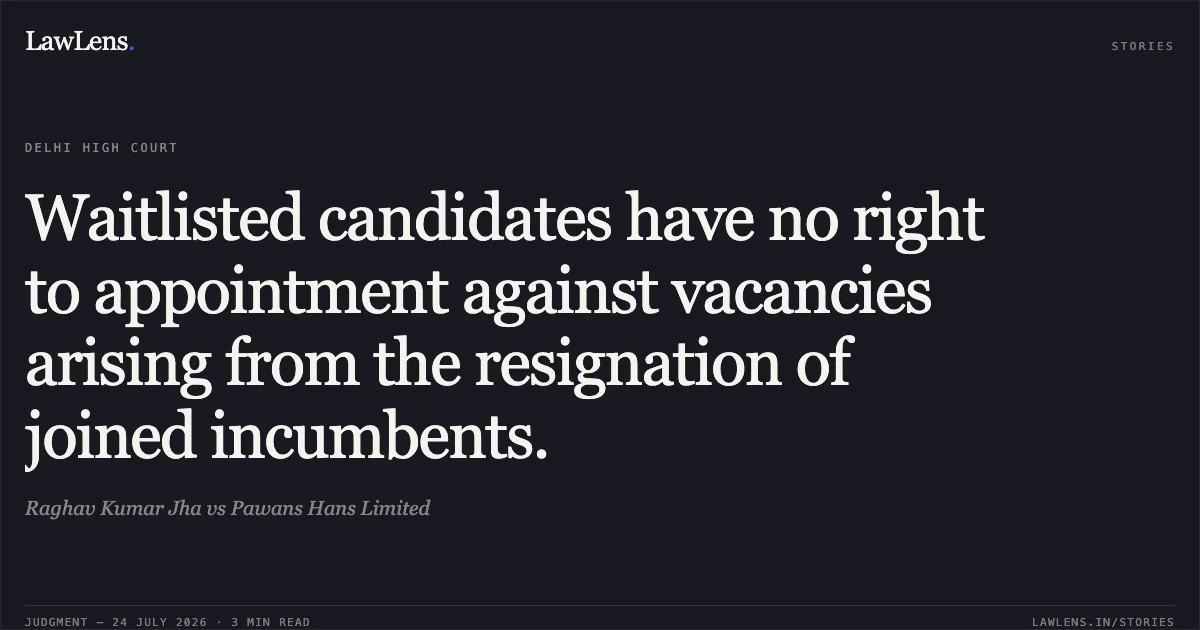
1. Whether a waitlisted candidate has a legal right to be appointed to a vacancy created by the resignation of a selected candidate who had already joined and served in the position
Source reference: p. 4, para. 122. Whether the adoption of "seniority in age" as a tie-breaking mechanism, in the absence of a prior prescription in the advertisement, is arbitrary or constitutes "changing the rules of the game" mid-process
Source reference: p. 5, para. 173. Whether the recruitment rules of a separate entity (ONGC) regarding resignations and waitlists can be applied to the Respondent organization by way of parity
Source reference: p. 6, para. 19Law Applied
The Court applied Article 16 of the Constitution of India, which ensures equality of opportunity in matters of public employment and prohibits filling subsequent vacancies from old panels if it deprives other eligible candidates of participation.
Source reference: p. 5, para. 14It further applied the principle that Article 14 forbids arbitrariness but permits the adoption of any reasonable method (such as age) to resolve a tie where recruitment rules are silent.
Source reference: p. 6, para. 17The Court relied on the precedent Kalu Ram Saini v. Union of India & Ors. to affirm that age is a valid determining factor for resolving ties in the absence of specific guidelines.
Source reference: p. 6, para. 17Reasoning
The Court reasoned that the purpose of a waiting list is exhausted once a selected candidate joins the post; it exists only to meet the exigency of a candidate failing to join.
Source reference: p. 4, para. 13Since the incumbent actually worked before resigning, the vacancy became a fresh one that must be advertised to satisfy the constitutional mandate of Article 16.
Source reference: p. 4, para. 14Regarding the tie-breaking method, the Court held that using "seniority in age" was neither arbitrary nor a "change in the rules of the game," as it was a fair and standard practice used to resolve a mid-selection deadlock where the advertisement was silent.
Source reference: p. 5, para. 17The Court rejected the Appellant’s reliance on ONGC’s internal rules, noting that different organizations have distinct administrative frameworks and the Appellant failed to prove that the Respondent had adopted similar rules.
Source reference: p. 6, para. 19Holding
The Court held that a waitlisted candidate acquires no vested right to appointment once the recruitment cycle concludes with the joining of a selected candidate.
The vacancy arising from a subsequent resignation must be filled via a fresh recruitment process.
Source reference: p. 4, para. 14The Court held that seniority in age is a reasonable and valid tie-breaking criterion in the absence of specific rules.
Source reference: p. 6, para. 18The Court dismissed the appeal, affirming the Single Judge's judgment. The delay in filing the LPA was condoned, but no costs were awarded.
Source reference: p. 7, para. 21; p. 1, CM APPL 45661/2026Original Court PDF
Raghav Kumar JhavsPawans Hans Limited
Click to open original judgment
Original judgment, available to read, download and summarize on LawLens.in