01Facts
The petitioners, claiming to be the President and Secretary of the managing committee of the concerned Wakf institution, challenged the Karnataka State Board of Auqaf’s Official Memorandum dated 12 February 2026 constituting an eleven-member ad hoc committee for eleven months under the chairmanship of respondent No. 3.
¶ 1, 40–42The earlier managing committee’s tenure had expired on 12 June 2023.
¶ 3–8The petitioners alleged that the Board had repeatedly appointed an Administrator or ad hoc committee instead of following the statutory procedure under Rule 54 of the Karnataka Wakf Rules, 2017.
¶ 3–8Earlier proceedings before the High Court had resulted in directions to maintain status quo and to reconsider the matter in accordance with law.
¶ 28–29, 47In W.P. No. 103432 of 2025, the Court had quashed the previous appointment of an Administrator and directed the Board to redo the exercise.
¶ 28–29, 47Despite this, the Board approved the ad hoc committee as a “special case” on the recommendation of the Minister for Wakf.
¶ 41–42The respondents objected to the maintainability of the writ petition, contending that the petitioners had an efficacious alternative remedy before the Wakf Tribunal under Section 83 of the Wakf Act, 1995.
¶ 10–1402Issues
i.Whether the constitution of an ad hoc committee for a period of eleven months was amenable to the writ jurisdiction of the High Court under Article 226 of the Constitution?
¶ 15(i)ii.Whether the dispute was covered by Section 6 of the Wakf Act, 1995, thereby requiring the petitioners to approach the Wakf Tribunal under Section 83?
¶ 15(ii)iii.Whether the constitution of the eleven-month ad hoc committee violated Section 32 of the Wakf Act read with Rules 48 and 54 of the Karnataka Wakf Rules, 2017?
¶ 15(iii)03Law Applied
The Court applied Sections 6, 7 and 83 of the Wakf Act, 1995, holding that the Wakf Tribunal’s jurisdiction is attracted principally where the Act requires determination of disputes concerning the nature or character of Wakf property, including whether property is Wakf property or whether a Wakf is Shia or Sunni.
¶ 16–19The availability of a Tribunal remedy does not create an absolute bar to Article 226 jurisdiction, particularly where the challenge concerns the legality, competence or statutory validity of action taken by the Wakf Board.
¶ 21–25, 32–35Section 32 confers general superintendence over auqaf, including powers necessary for their maintenance, control and administration; however, such general powers cannot override a specific procedure prescribed by the Rules.
¶ 43–45Rule 54 requires the Board to constitute managing committees in accordance with the applicable scheme; it prescribes the process for constituting a succeeding committee and provides under Rule 54(5) that, where no succeeding committee is constituted, management and supervision automatically vest in the District Waqf Officer, who must secure constitution of the succeeding committee within three months.
¶ 37–39Rule 48 and Form-42 govern formulation of the scheme.
¶ 50The Court relied on Managing Committee, Masjid-E-Idgah, Mysore v. State of Karnataka, 1997 SCC OnLine Kar 147, for the principle that the Board cannot displace or alter Wakf management except in accordance with the statutory framework.
¶ 9, 46It distinguished Board of Wakf, West Bengal v. Anis Fatma Begum, (2010) 14 SCC 588, and relied on State of Andhra Pradesh (now State of Telangana) v. A.P. State Waqf Board, 2022 INSC 155, for the principle that the alternative Tribunal remedy is not an absolute exclusion of writ jurisdiction where the challenge is to the legality of the Board’s action itself.
¶ 21–25Provisions in the judgment · 8 · Linked ones open on LawLens
Unified Waqf Management, Empowerment, Efficiency and Development Act, 1995 Section 4Section 5Section 6Section 7Section 32Section 69Section 83Section 85
04Reasoning
The Court held that the petitioners’ challenge did not involve title, possession, the character of Wakf property, or any question specifically reserved for determination by the Wakf Tribunal under Sections 6, 7 and 83 of the Wakf Act.
¶ 18–20, 26–27It was instead a challenge to the Board’s exercise of statutory power and its alleged failure to comply with Rule 54 and earlier binding directions of the High Court.
¶ 30–35Accordingly, the writ petition was maintainable notwithstanding the alternative remedy.
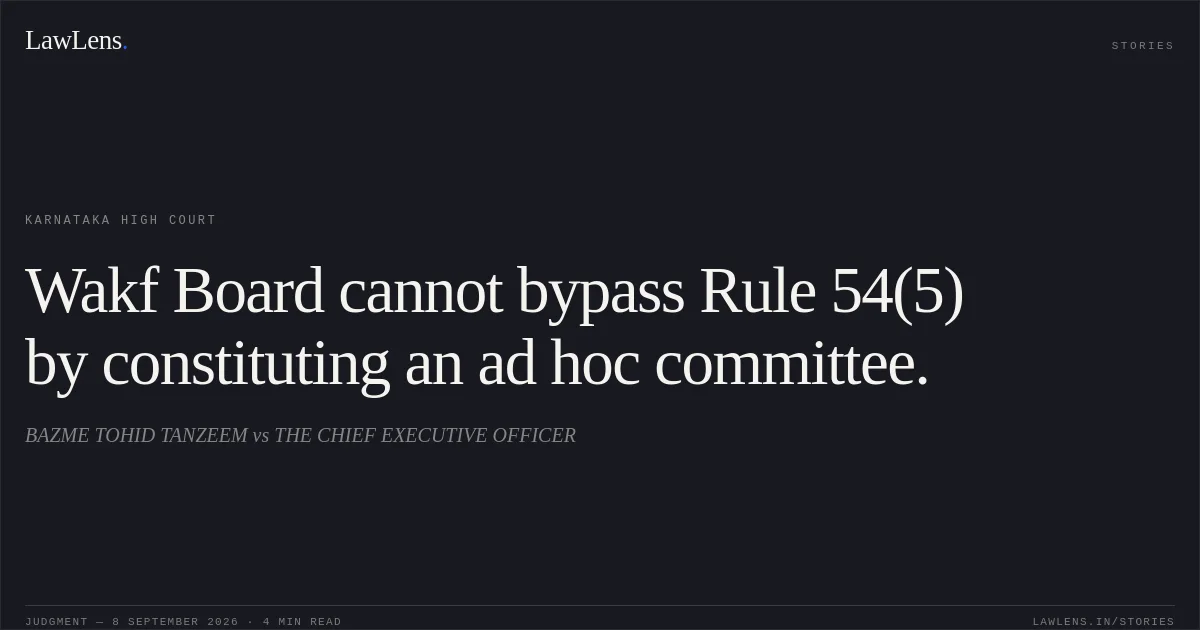
¶ 30–35On merits, Rule 54(5) prescribed the specific consequence of failure to constitute a succeeding committee: management was to vest in the District Waqf Officer, who was required to initiate the process for constitution of the succeeding committee.
¶ 38–45The Board could not invoke its general power under Section 32(2)(o) to create an alternative eleven-month ad hoc arrangement, as that would render Rule 54(5) redundant and defeat the statutory scheme.
¶ 38–45The impugned memorandum itself showed that the ad hoc committee had been approved as a “special case” without demonstrating any statutory basis for bypassing Rule 54.
¶ 41–44The action was therefore contrary both to the prescribed Rules and to the earlier directions requiring the Board to redo the exercise in accordance with law.
¶ 47–5405Holding
The writ petition was allowed, and the Official Memorandum dated 12 February 2026 constituting the eleven-member ad hoc committee was quashed and set aside.
¶ 57(i)–(ii)The District Waqf Officer, Chikodi, was directed to immediately assume management and supervision of the Wakf institution under Rule 54(5), convene a widely publicised General Body Meeting, formulate the scheme in accordance with Form-42 and Rule 48, and forward it to the State Wakf Board.
¶ 57(iii)–(v)The entire process was to be completed within four months.
¶ 57Until then, the District Waqf Officer alone was to control and supervise the institution, without interference from the petitioners, the erstwhile committee, the ad hoc committee or any other person, and was directed to secure and preserve the institution’s records and accounts.
¶ 57(vi)–(vii)The Court expressly left open the eligibility or entitlement of individuals to serve on the succeeding managing committee.
¶ 56, 57(viii)Original Court PDF
BAZME TOHID TANZEEMvsTHE CHIEF EXECUTIVE OFFICER
Click to open original judgment
Original judgment, available to read, download and summarize on LawLens.in