Facts
On May 29, 2023, the deceased (Sh. Govind) was allegedly traveling from Taj Nagar to Sarai Rohilla.
Source reference: p. 2The appellants claimed that due to a heavy rush, the deceased accidentally fell from a running train and was subsequently struck by another train (No. 14731) on the adjoining track, leading to fatal injuries.
Source reference: p. 2A journey ticket was recovered from the deceased.
Source reference: p. 2The Railway Claims Tribunal dismissed the claim on May 9, 2025, ruling that the incident was not an "untoward incident" and the deceased was not a bona fide passenger.
Source reference: p. 2The appellants challenged this, asserting an accidental fall.
Source reference: p. 2-3Conversely, the respondent relied on the testimony of the loco pilot (RW-1) and the DRM report, which suggested the deceased was a trespasser run over while walking on the tracks.
Source reference: p. 3Issues
Whether the deceased was a bona fide passenger at the time of the incident.
Source reference: p. 3, para 7Whether the injuries sustained by the deceased resulted from an "untoward incident" as defined under the Railways Act, 1989.
Source reference: p. 3, para 7Law Applied
The court primarily applied Section 23 of the Railway Claims Tribunal Act, 1987 regarding the right to appeal.
Source reference: p. 1-2It interpreted Section 123(c) of the Railways Act, 1989, which defines an "untoward incident" specifically as the accidental falling of a passenger from a train carrying passengers.
Source reference: p. 5, para 11Furthermore, the court considered the statutory liability under Section 124-A of the Railways Act, noting that compensation is contingent upon the occurrence of an "untoward incident".
Source reference: p. 5, para 12Reasoning
The court found the appellants' version of an "accidental fall" lacked evidentiary support, as the primary witness (AW-1) admitted she was not an eyewitness and was unaware the deceased was even traveling.
Source reference: p. 3-4, para 8Furthermore, the claim application failed to specify the train number.
Source reference: p. 4, para 8In contrast, the court prioritized the testimony of the loco pilot of Train No. 14731 (RW-1), who provided a consistent account of seeing the deceased walking between the tracks and attempting to apply emergency brakes—a "run-over" scenario.
Source reference: p. 4, para 9This testimony was corroborated by the DRM report and official railway records.
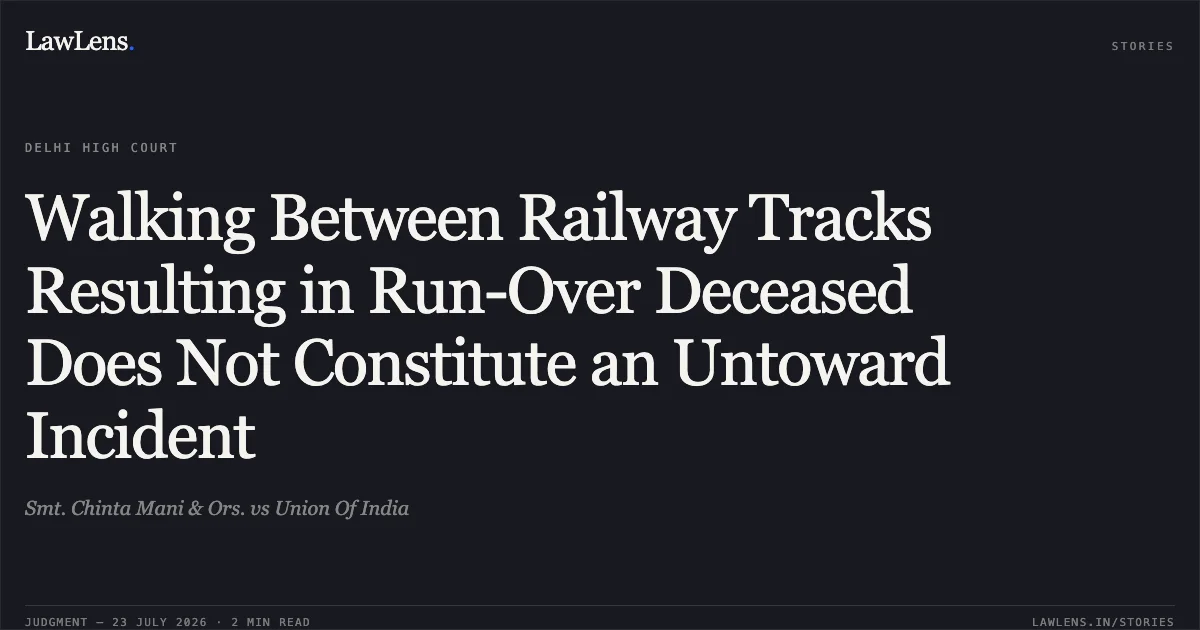
Source reference: p. 4, para 10The court reasoned that since the evidence pointed to the deceased walking on the tracks rather than falling from a train, the foundational requirement of an "untoward incident" under Section 123(c) was not met.
Source reference: p. 5, para 11Holding
The court held that the appellants failed to establish that the death was caused by an "untoward incident".
Even if the deceased possessed a valid ticket, the lack of an accidental fall precluded liability under Section 124-A. The appeal was dismissed, and the Tribunal’s order was upheld. The court also condoned an 8-day filing delay via CM APPL. 59152/2025.
Source reference: p. 5-6, p. 1Acts & Sections Cited
2 provisions across 2 statutes referred to in this judgment. Each provision opens on LawLens.
Railway Claims Tribunal Act, 19871
Railways Act, 19891
Original Court PDF
Smt. Chinta Mani & Ors.vsUnion Of India
Click to open original judgment
Original judgment, available to read, download and summarize on LawLens.in