01Facts
The Petitioner (husband/father) and Respondent No. 2 (wife/mother) are Indian nationals who married in California in 2013 and later registered their marriage in Goa in 2014
p. 3, 33Their daughter (Respondent No. 3) was born in New York in 2022 and is a US citizen
p. 3, 9On October 7, 2025, the Petitioner initiated divorce and custody proceedings in a Utah Court, obtaining a Domestic Relation Injunction (DRI)
p. 4On October 8, 2025, the wife left the U.S. for India with the child, allegedly in violation of the DRI
p. 4The Petitioner sought a Writ of Habeas Corpus for the repatriation of the child to the U.S., alleging "abduction"
pp. 2-3The wife contended she left due to fear for her safety, lack of support, and allegations of the Petitioner's sexual abuse of the child
pp. 19-21A POCSO FIR was filed in Goa, where a cancellation report is currently pending
p. 4402Issues
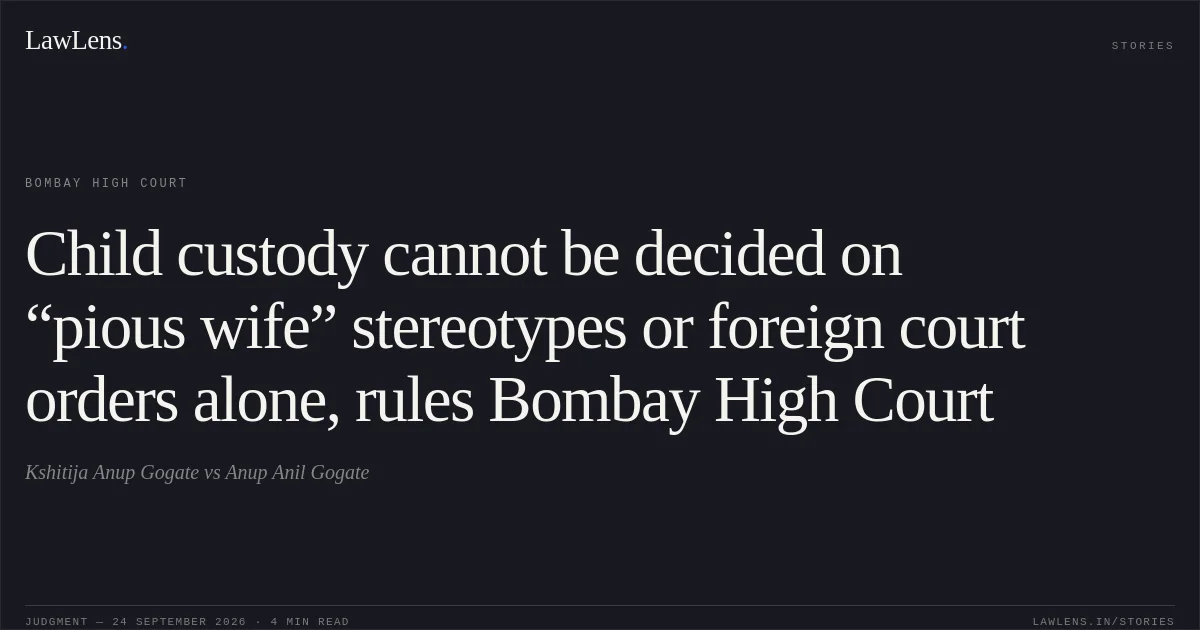
i.Whether the custody of the minor girl child with her biological mother can be deemed "illegal" or "unlawful" to warrant a Writ of Habeas Corpus
¶ 11, 14ii.Whether the principle of "comity of courts" and the existence of a foreign court order outweigh the "paramount interest and welfare" of the child
¶ 11, 14iii.Whether the child's U.S. citizenship and habitual residence necessitate her immediate repatriation regardless of her age and attachment to the mother
¶ 32, 4003Law Applied
The Court applied the parens patriae jurisdiction, emphasizing that the welfare of the child is the "paramount consideration" in custody matters
¶ 10, 14It relied on Nithya Anand Raghavan v. State of NCT of Delhi, holding that custody with a biological mother is presumed lawful and a foreign court order does not automatically render it unlawful
¶ 11It further applied Kanika Goel v. State of Delhi and Yashita Sahu v. State of Rajasthan, noting that for children under five (especially girls), the mother's guardianship is of "utmost significance"
¶ 11, 12The court also noted the applicability of the Portuguese Civil Code (1867) regarding the ratification of foreign decrees in Goa
¶ 21Provisions in the judgment · 3 · Linked ones open on LawLens
Code of Civil Procedure, 1908 Section 13
Hindu Minority and Guardianship Act, 1956 Section 6
Guardians and Wards Act, 1890 Section 9
04Reasoning
The Court found that the Petitioner suppressed material facts, specifically the 2014 Goa marriage registration, which triggers local laws requiring the ratification of foreign decrees
¶ 21-22It rejected the "abduction" claim, noting the Petitioner had previously booked India travel tickets for the wife and child and sent a text message permitting her to "go wherever you wish" on the day of departure
¶ 26-27The analysis highlighted that the child, aged 3.5 years, was breastfed at least until August 2025, necessitating her proximity to the mother
¶ 29, 31The Court found the Petitioner's visa status unstable (expiring 2028) and his living conditions in the U.S. potentially harmful, citing a "vile" email he sent demanding "absolute authority" over the wife and child and imposing traditionalist restrictions
¶ 34, 37-38The Court reasoned that the child’s integration into Goa (schooling and Marathi-speaking environment) and the presence of maternal grandparents provided a "nurturing environment" superior to the Petitioner's proposal of remote work and childcare
¶ 35, 3905Holding
The Court held that no "exceptional situation" existed to take the child away from the biological mother, as custody with the mother is lawful
¶ 14, 40The Court dismissed the Writ Petition and discharged the Rule
¶ 42, 44The court concluded that the welfare of a 3.5-year-old breastfed child is best served in the mother's custody in India, and the principle of comity of courts must yield to the child's best interests
¶ 40The parties were directed to resolve permanent custody disputes through the pending statutory proceedings before the Civil Judge in Goa
¶ 41, 43Original Court PDF
Aditya BakayavsState Of Maharashtra Thr Station House Officer (Sho) And 2 Ors
Click to open original judgment
Original judgment, available to read, download and summarize on LawLens.in