Facts
The claimant sustained serious spinal injuries on 7 May 2019 when the offending bus, bearing registration no. WB 57-4281, allegedly driven rashly and negligently, hit him while he was cycling towards Berhampore. He was initially treated at Murshidabad Medical College and Hospital, thereafter referred to Kolkata, and ultimately treated at Good Samaritan Hospital, where he underwent surgery
Source reference: p.1The claimant instituted a motor accident compensation proceeding against the vehicle owner and United India Insurance Co. Ltd. The owner did not contest, while the insurer filed a written statement and contested the claim
Source reference: p.2The Trial Court awarded Rs.16,64,393 with interest at 6% per annum from the date of filing of the claim case, with a default rate of 9% per annum from the date of the award
Source reference: p.2The insurer appealed, contending that the FIR was lodged after an 86-day delay, that the claimant continued to receive pension without any loss of income, and that the compensation was excessive
Source reference: p.3Issues
Whether the 86-day delay in lodging the FIR rendered the claimant’s case doubtful or fatal to the claim?
Source reference: p.3–4Whether compensation for loss of earning capacity could be awarded where the claimant continued to receive pension and suffered no actual loss of regular income?
Source reference: p.4–7Whether the compensation of Rs.16,64,393 awarded by the Trial Court was excessive and required modification?
Source reference: p.7–8Law Applied
The Court considered the claim under the Motor Vehicles Act, 1988, particularly the principles governing compensation in proceedings under Section 166, although the Trial Court’s order referred to Section 163A
Source reference: p.1–2Mere delay in lodging an FIR is not, by itself, fatal where the delay is reasonably explained, particularly in accident cases where family members ordinarily prioritise medical treatment over approaching the police
Source reference: p.4Relying on T.J. Parameshwar-reppa v. The Branch Manager, New India Assurance Co. Ltd., MANU/SC/1510/2022, the Court held that the percentage of medical or permanent disability cannot automatically be equated with the percentage of loss of earning capacity; the relevant inquiry is the effect of the disability on the claimant’s earning capacity
Source reference: p.4–5Relying on Anoop Maheswari v. Oriental Insurance Co. Ltd., MANU/SC/1233/2025, the Court reiterated that functional disability, rather than merely medical disability, is relevant for assessing loss of earning capacity, and that future prospects should not be mechanically added where the claimant remains capable of continuing his livelihood
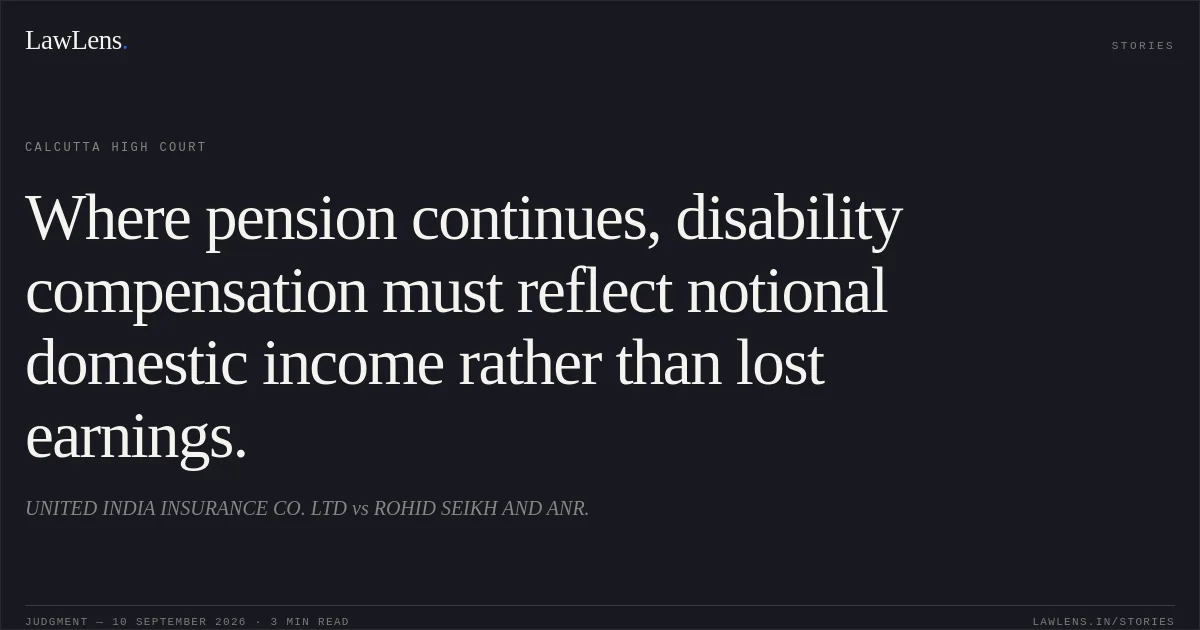
Source reference: p.5–6Even where there is no proved monetary loss, compensation may be awarded for the claimant’s inability to perform domestic or personal work, including the consequential need for outside assistance or notional expenditure
Source reference: p.7Reasoning
The Court rejected the insurer’s challenge based on the delayed FIR because the delay had been explained and the claimant’s family had initially concentrated on securing emergency and subsequent medical treatment; therefore, the delay did not undermine the claim
Source reference: p.4On loss of income, the Court applied the functional-disability principle and examined the claimant’s actual financial position rather than mechanically applying the percentage of disability. Since the claimant’s source of income was pension and his pension had increased after the accident, there was no established loss of regular income or earning capacity
Source reference: p.7Nevertheless, the Court recognised that the claimant’s disability impaired his ability to perform domestic and personal functions and could require assistance or additional expenditure. It therefore considered a notional component of loss, but held that the Trial Court’s award of Rs.16,64,393 was excessive in the absence of actual pensionary loss
Source reference: p.7–8Holding
The appeal was disposed of and the Trial Court’s award was modified. The claimant was held entitled to Rs.10,00,000 from United India Insurance Co. Ltd., together with interest at 6% per annum from the date of filing of the claim case until the date of the High Court’s order
The insurer was directed to deposit the amount with accrued interest before the Registrar General, High Court at Calcutta, within eight weeks of communication of the order; no further deposit was required if the Trial Court’s award had already been deposited
Source reference: p.8The claimant was permitted to withdraw the compensation upon compliance with formalities, and any balance amount with accrued interest was directed to be returned to the insurer
Source reference: p.8Acts & Sections Cited
2 provisions across 1 statute referred to in this judgment. Each provision opens on LawLens.
Motor Vehicles Act, 19882
Original Court PDF
UNITED INDIA INSURANCE CO. LTDvsROHID SEIKH AND ANR.
Click to open original judgment
Original judgment, available to read, download and summarize on LawLens.in