Facts
Rathnawwa and her minor son Chetan were injured when the Tum-Tum in which they were travelling collided with a tractor and trailer on 24 January 2021.
Source reference: p. 4–8, 11–12They claimed compensation for their injuries, including permanent impairment.
Source reference: p. 4–8, 11–12The Tribunal awarded Rathnawwa ₹1,45,239 and Chetan ₹1,07,879, with interest at 6% per annum. They appealed under Section 173(1) of the Motor Vehicles Act, contending that the Tribunal had underestimated their disability and compensation under non-pecuniary heads.
Source reference: p. 4–8, 11–12The High Court considered the medical records and the evidence of the treating doctor, who assessed limb disability at 10% for Rathnawwa and 5% for Chetan.
Source reference: p. 13–14, 20–22Issues
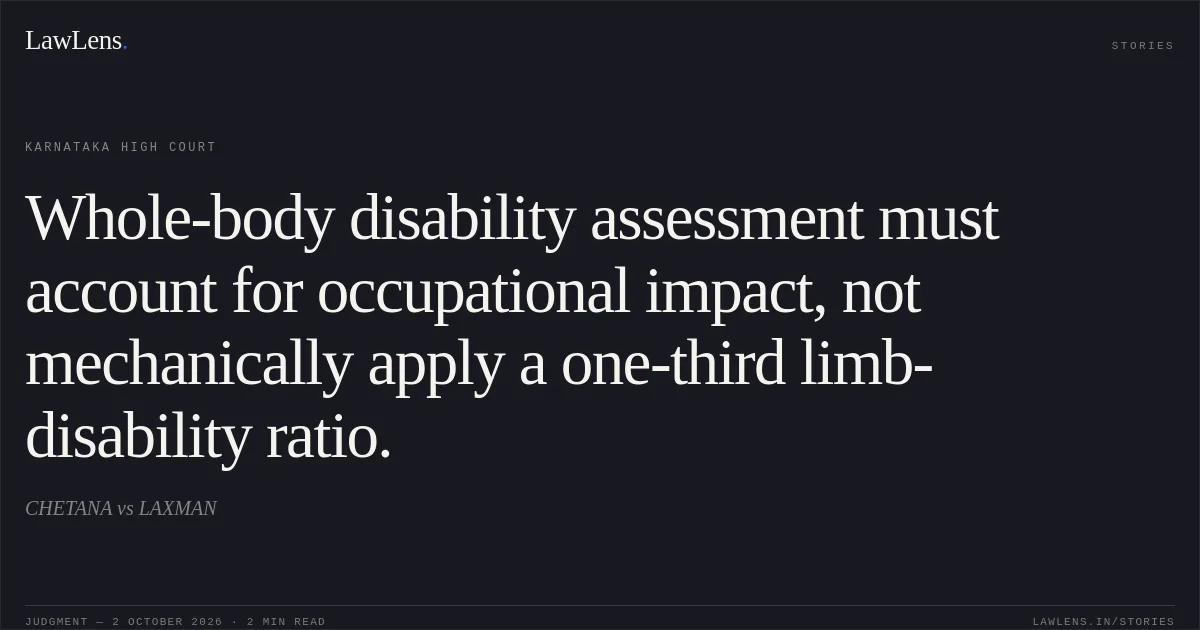
Whether the Tribunal correctly assessed the claimants’ whole-body disability by taking one-third of their limb disability, or whether a different assessment was warranted in light of their occupation and functional impairment.
Source reference: p. 25–29Whether the compensation awarded for loss of earning capacity and other heads required enhancement.
Source reference: p. 29–32Law Applied
Section 173(1) of the Motor Vehicles Act provides for an appeal against a Claims Tribunal’s award.
Source reference: p. 2–3The Court referred to the Central Government/National Institute for Orthopedically Handicapped guidelines, under which the percentage of disability assessed for a particular joint is converted to limb disability, and limb disability may be divided by three to derive whole-body disability.
Source reference: p. 26–27It also applied the principle in Sarwan Singh v. State of Punjab, AIR 2002 SC 3652, that where a party declines to challenge evidence on a material point in cross-examination, the unchallenged evidence may be accepted.
Source reference: p. 23–24In assessing compensation, the Court considered the practical effect of permanent impairment on the injured person’s occupation and earning capacity.
Source reference: p. 27–29Reasoning
The Court accepted the doctor’s evidence of limb disability and found that the claimants’ assertions of continuing impairment had not been specifically challenged in cross-examination.
Source reference: p. 20–24Although it held that taking one-third of limb disability as whole-body disability was arithmetically consistent with the cited guidelines, it considered that assessment inadequate in light of the claimants’ vegetable-vending work, which required substantial use of their limbs.
Source reference: p. 25–29It therefore assessed whole-body disability at 5% for Rathnawwa and 2.5% for Chetan.
Source reference: p. 25–29Applying the relevant income, future-prospects additions and multipliers, the Court recalculated loss of earning capacity and enhanced certain amounts for attendant charges, conveyance, pain and suffering, and loss of amenities. It left the medical-expense awards undisturbed.
Source reference: p. 29–32Holding
The appeals were allowed in part.
Rathnawwa was awarded enhanced compensation of ₹1,20,155 and Chetan ₹44,709, each with interest at 6% per annum from the date of the claim petition until realization.
Source reference: p. 32–34The Insurance Company was directed to deposit the enhanced amounts within six weeks of receiving a certified copy of the judgment.
Source reference: p. 32–34Acts & Sections Cited
1 provisions across 1 statute referred to in this judgment. Each provision opens on LawLens.
Motor Vehicles Act, 19881
Original Court PDF
CHETANAvsLAXMAN
Click to open original judgment
Original judgment, available to read, download and summarize on LawLens.in