Facts
The applicant’s father-in-law, Late Shri Ishwar Singh, died in harness on January 23, 2014, while serving as a Senior Accounts Auditor.
Source reference: para. 3Initially, his son (the applicant’s husband, Rahul Chaudhary) applied for compassionate appointment.
Source reference: para. 3His claim was rejected twice, first for being a married son and subsequently for failing the indigency criteria.
Source reference: para. 3Rahul Chaudhary challenged the rejection in O.A. No. 1530/2017 but died during the pendency of the litigation, leading to the dismissal of that application on April 16, 2024, for lack of surviving cause of action.
Source reference: para. 3The applicant, as the widowed daughter-in-law, then submitted a fresh representation for compassionate appointment.
Source reference: para. 3The respondents rejected her claim via an order dated August 28, 2024, on the ground that a "daughter-in-law" is not included in the definition of a "dependent family member" under the extant Department of Personnel and Training (DoP&T) instructions.
Source reference: para. 3 & 5Issues
1. Whether a widowed daughter-in-law is entitled to be considered for compassionate appointment as a "dependent family member" under a liberal and purposive interpretation of the scheme.
Source reference: para. 102. Whether the rejection of the applicant’s claim solely on the basis of her status as a daughter-in-law was legally sustainable.
Source reference: para. 12Law Applied
The court primarily considered the DoP&T Master Circular dated August 2, 2022, which defines "dependent family member" to include spouses, sons, daughters, and, in specific cases, siblings.
Source reference: para. 5It further relied on the legal principles established in State of Rajasthan & Ors. v. Sushila Devi (Rajasthan High Court), which held that rules for compassionate appointment must be purposively construed to advance the object of beneficent legislation.
Source reference: para. 7Additionally, the court applied the precedent from Vibha Tiwari v. State of U.P. and others (Allahabad High Court), which established that a daughter-in-law should be treated as an integral part of the family and that the term "family" requires a liberal construction to relieve a household from distress following the death of the sole breadwinner.
Source reference: para. 10-11Reasoning
The Tribunal reasoned that while the strict literal definition in the DoP&T instructions might exclude a daughter-in-law, judicial precedents consistently advocate for a liberal interpretation in cases involving widowed daughters-in-law who were dependent on the deceased employee.
Source reference: para. 10The court observed that the primary objective of compassionate appointment is to provide immediate financial relief to the family of the deceased.
Source reference: para. 11Since the applicant’s husband—the original claimant—had died before his claim could be finalized, the cause of action shifted to the applicant as his widow and a dependent of the original deceased employee’s family.
Source reference: para. 12The Tribunal held that treating the applicant's status as a daughter-in-law as an absolute bar to consideration was unjustified and contrary to the settled legal position regarding the inclusive nature of "family" in social welfare contexts.
Source reference: para. 12Holding
The Tribunal set aside the impugned order dated August 28, 2024, which had rejected the applicant’s claim.
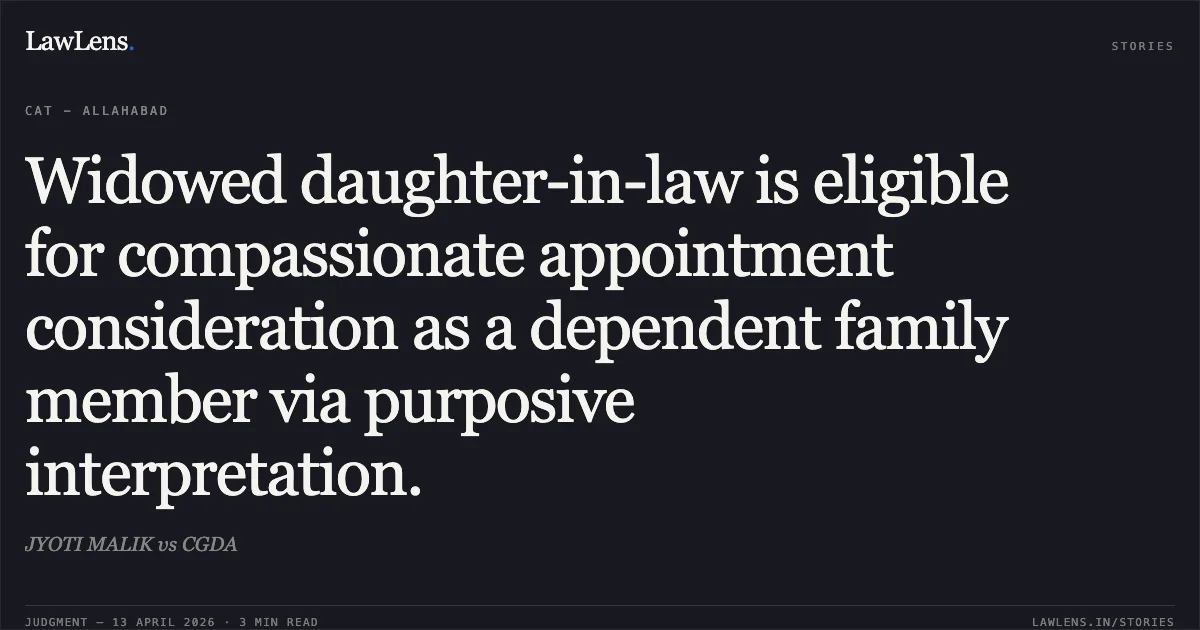
It held that the applicant has the right to be considered for compassionate appointment as a dependent family member following the death of her husband.
Source reference: para. 12The respondents were directed to reconsider the applicant’s case, treating her as a dependent family member, in light of the judicial observations provided.
Source reference: para. 12The final reasoned and speaking order must be passed within four months or at the next meeting of the Compassionate Review Committee (CRC), whichever is earlier.
Source reference: para. 12Acts & Sections Cited
1 provisions across 1 statute referred to in this judgment. Each provision opens on LawLens.
Administrative Tribunals Act, 19851
Original Court PDF
JYOTI MALIKvsCGDA
Click to open original judgment
Original judgment, available to read, download and summarize on LawLens.in


