01Facts
The applicant, the widow of a Senior Research Assistant who died in service on 2 May 2024, sought family pension, death gratuity and other terminal benefits.
¶ 1The respondents did not dispute her status as his wife but withheld processing of her claims, citing the deceased’s nomination of his mother for DCRG and the absence of the parents’ NOC.
¶ 3–4The deceased and the applicant had a minor child; the Tribunal also noted apparent disputes between the applicant and her in-laws.
¶ 1, 3–4The applicant challenged the insistence on an NOC and sought payment of the benefits.
¶ 302Issues
i.Whether the respondents could require the deceased’s parents’ NOC or consent before granting family pension to the applicant as his widow.
¶ 3, 5–7ii.Whether the applicant was entitled to the deceased’s death gratuity and other terminal benefits, and how those benefits should be released in light of the nomination in favour of his mother.
¶ 3, 8–903Law Applied
The Tribunal held that Rule 50(6) of the Central Civil Services (Pension) Rules, 2021 governed the family-pension claim and treated the widow’s entitlement as a statutory right.
¶ 5It relied on Smt. Violet Issaac v. Union of India, which establishes that family pension is not part of the deceased’s estate and is payable to the person designated under the rules, rather than under a nomination.
¶ 6It also relied on Jodh Singh v. Union of India, which explains that a pension arising from widowhood is a status-based entitlement and cannot be disposed of as part of the deceased’s estate.
¶ 7For DCRG and other terminal benefits, the Tribunal applied the principle that devolution is governed by the deceased’s personal law; it referred to Section 8 of the Hindu Succession Act and treated the nominee as a trustee who cannot appropriate the benefits to the exclusion of other legal heirs.
¶ 8–9Provisions in the judgment · 1 · Linked ones open on LawLens
Hindu Succession Act, 1956 Section 8
04Reasoning
The applicant’s status as the deceased’s widow was undisputed, and no one alleged that she had remarried.
¶ 5–7Applying Rule 50(6), the Tribunal concluded that the parents’ objection was irrelevant to her family-pension claim: the entitlement arose from her status under the rules, not from the deceased’s estate or his mother’s nomination.
¶ 5–7The absence of an NOC therefore could not lawfully prevent processing or payment of family pension.
¶ 5–7By contrast, DCRG and other terminal benefits formed part of the deceased’s estate and were subject to succession law.
¶ 8–9The nomination in favour of the mother did not entitle her to retain those benefits exclusively; release was to be made on production of documents based on Section 8 of the Hindu Succession Act.
¶ 8–905Holding
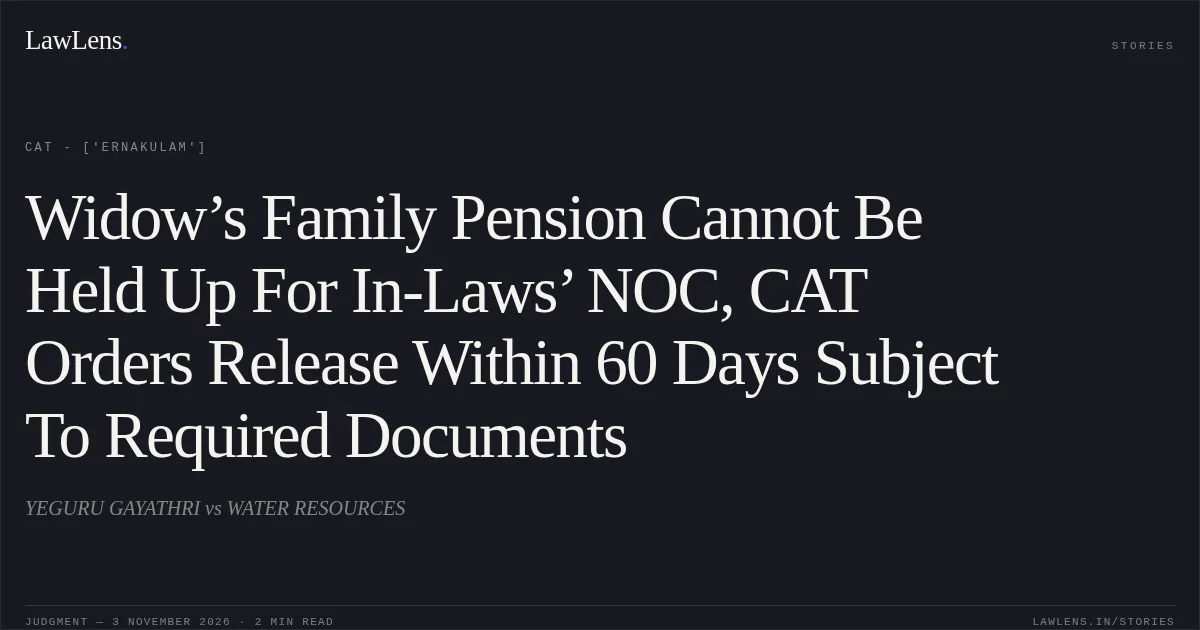
The Tribunal directed respondents 1–3 to release the applicant’s family pension within 60 days of receiving the order, subject to production of documents required by law, and prohibited them from insisting on the parents’ NOC or consent.
¶ 7It directed that DCRG and other terminal benefits be released subject to production of the documents required under Section 8 of the Hindu Succession Act.
¶ 8–9The Original Application was disposed of with no order as to costs.
¶ 10Original Court PDF
YEGURU GAYATHRIvsWATER RESOURCES
Click to open original judgment
Original judgment, available to read, download and summarize on LawLens.in