01Facts
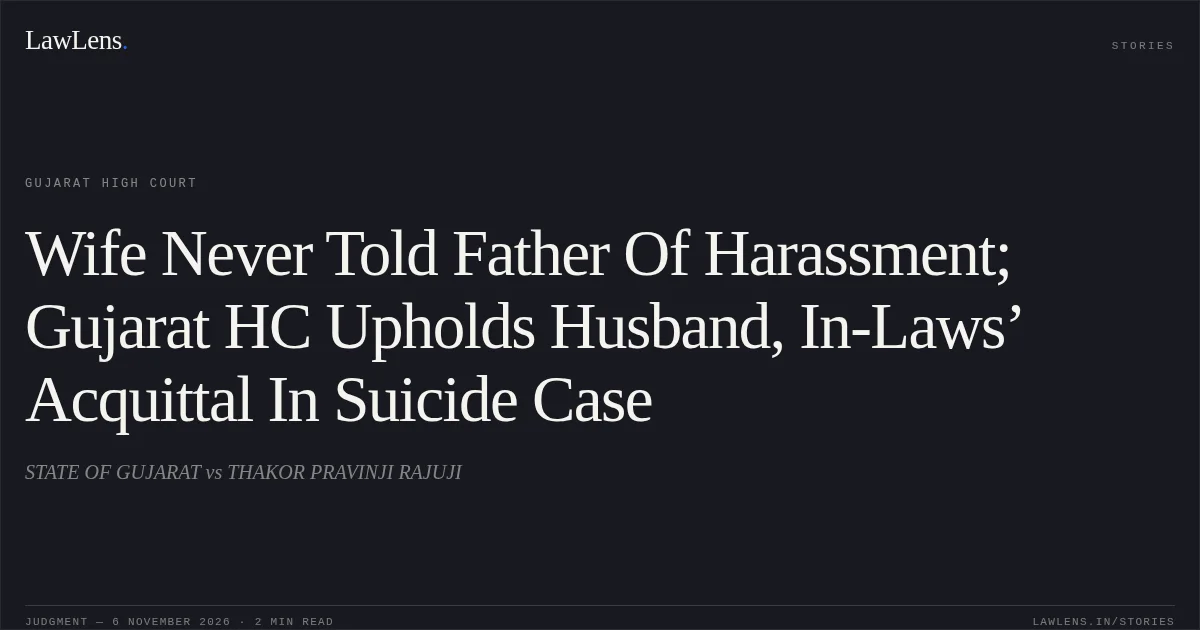
Alkaben, married to the accused for about four years, died by drowning in a canal on 26 August 2013.
pp. 2–4Her mother alleged that the accused verbally and physically harassed Alkaben after she objected to his phone conversations with another woman.
pp. 2–4The State charged him under Sections 498A, 306 and 504 of the Indian Penal Code, 1860 (IPC).
pp. 2–4The Sessions Court acquitted him on 6 June 2016, and the State appealed under Section 378 of the Code of Criminal Procedure, 1973 (CrPC).
pp. 2–4On appeal, the High Court reappreciated the prosecution evidence, including testimony that no prior complaint or treatment for abuse had been reported, that the alleged other woman was never identified, and that the post-mortem evidence found no injuries.
pp. 11–1502Issues
i.Whether the prosecution proved that the accused subjected Alkaben to cruelty or harassment punishable under Section 498A IPC
pp. 11–16ii.Whether the accused abetted Alkaben’s suicide within the meaning of Sections 306 and 107 IPC
pp. 6–10, 15–16iii.Whether the Sessions Court’s acquittal disclosed a basis for appellate interference under Section 378 CrPC
pp. 6, 15–1703Law Applied
Section 306 IPC punishes abetment of suicide, and Section 107 IPC defines abetment as instigation, participation in a conspiracy, or intentional aid.
pp. 6–10As explained in Amalendu Pal alias Jhantu v. State of West Bengal, conviction under Section 306 requires proof of an active role involving instigation or intentional aid; harassment alone, without a positive act sufficiently connected to the suicide, is insufficient.
pp. 6–10The court also relied on Randhir Singh v. State of Punjab, State of W.B. v. Orilal Jaiswal and Kishori Lal v. State of M.P. for the need to assess whether the conduct induced the suicide and whether the statutory elements of abetment were established.
pp. 7–10In an appeal against acquittal, the appellate court may reappreciate the evidence, but should not interfere where the trial court’s view is a possible one; an acquittal further strengthens the presumption of innocence.
p. 6The appeal concerned charges under Sections 498A and 504 IPC as well, although the judgment’s stated legal discussion focuses principally on abetment of suicide.
pp. 1, 6–10Provisions in the judgment · 8 · Linked ones open on LawLens
Code of Criminal Procedure, 1973 Section 378Section 209Section 207Section 313
Indian Penal Code, 1860 Section 306Section 504Section 107Section 109
04Reasoning
The High Court found no reliable evidence that the accused had an affair or that Alkaben was subjected to mental or physical harassment during her lifetime.
pp. 11–15The alleged woman was not identified, the family witnesses lacked personal knowledge of an affair, and no prior complaint or medical treatment for abuse was shown.
pp. 11–15The medical evidence recorded drowning as the cause of death and disclosed no injuries.
pp. 11–15Applying the principles on abetment, the court held that the evidence did not establish instigation, intentional aid, or a proximate positive act by the accused that led Alkaben to take her life.
pp. 6–10, 15–16It therefore found the Sessions Court’s acquittal to be a proper and possible view, with no ground for appellate intervention.
pp. 15–1705Holding
The High Court answered the issues against the State, held that the prosecution had not established the charged offences, and found no illegality or infirmity in the acquittal.
pp. 15–17It dismissed the appeal and confirmed the Sessions Court’s judgment and order of acquittal; the bail bond was cancelled and the record and proceedings were ordered to be returned to the trial court.
p. 17Original Court PDF
STATE OF GUJARATvsVIJAYKUMAR BHANUBHAI BARAIYA
Click to open original judgment
Original judgment, available to read, download and summarize on LawLens.in