Facts
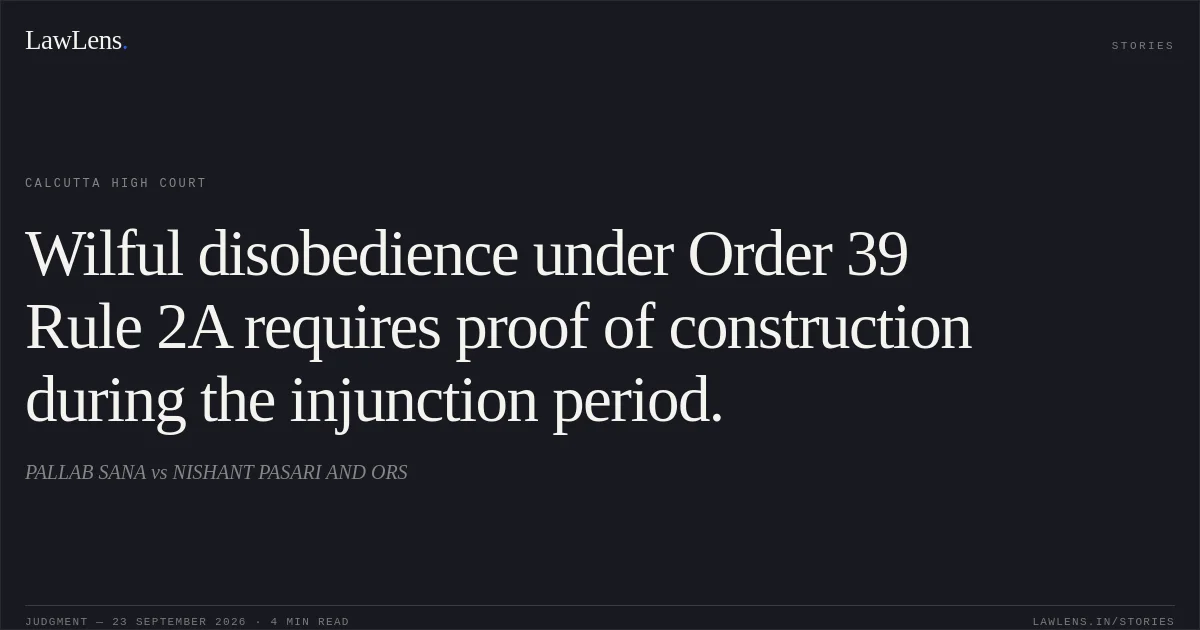
The petitioner instituted Title Suit No. 199 of 2015 seeking a declaration that he was a monthly tenant in respect of three structures measuring approximately 5,000 sq. ft. at Premises No. 16, Mondal Temple Lane, Kolkata, along with permanent injunction and damages.
Source reference: paras. 3–5The Trial Court granted interim protection restraining the defendants from obstructing the petitioner’s possession or dispossessing him, and subsequently decreed the suit ex parte in part by declaring the petitioner a tenant, though it declined permanent injunction.
Source reference: paras. 3–5The petitioner preferred Title Appeal No. 100 of 2019, in which the Appellate Court granted a similar interim injunction on 14 June 2019.
Source reference: para. 6Alleging that the opposite parties had continued construction over the property in violation of the injunction orders, the petitioner filed an application under Order 39 Rule 2A CPC seeking detention in civil prison, attachment of property, and compensation.
Source reference: paras. 7–8, 23The Appellate Court dismissed the application, holding that the petitioner had not specified the constructed area, the persons responsible, or the period during which the alleged violation occurred.
Source reference: para. 2The petitioner challenged that dismissal under Article 227 of the Constitution.
Source reference: no citationIssues
1. Whether a revision under Article 227 of the Constitution is maintainable against an order passed by an Appellate Court rejecting an application under Order 39 Rule 2A CPC.
Source reference: paras. 14–182. Whether the petitioner established wilful and deliberate disobedience of the subsisting injunction orders so as to attract action under Order 39 Rule 2A CPC.
Source reference: paras. 23–253. Whether the Appellate Court’s dismissal of the Order 39 Rule 2A application disclosed any jurisdictional error, patent perversity, or grave miscarriage of justice warranting interference under Article 227.
Source reference: para. 25Law Applied
The Court applied Order 39 Rule 2A CPC, under which wilful disobedience of an injunction must be established before coercive consequences such as detention in civil prison or attachment of property can be imposed.
Source reference: para. 25Proceedings under the provision are quasi-criminal in nature and require proof of deliberate and contumacious breach, not merely proof of the existence of construction activity.
Source reference: para. 25The Court also considered Sections 104(2) and 107(2) CPC, holding that Section 104(2) bars a further appeal from an order passed by an Appellate Court in exercise of its appellate jurisdiction, including an order under Order 39 Rule 2A; consequently, a revision may be maintainable where no further appellate remedy exists.
Source reference: paras. 16–18Although orders under Order 39 Rules 1, 2, 2A, 4 and 10 may generally be appealable under Order 43 Rule 1 CPC, that remedy does not extend to a further appeal from an order already passed by the Appellate Court.
Source reference: paras. 14–18The Court relied on Aligarh Municipal Board v. Ekka Tonga Mazdoor Union, (1970) 3 SCC 98, Md. Sahajahan v. Md. Sarafat Hussain, FMAT 2 of 2025, and Koushik Mutually Aided Cooperative Housing Society v. Ameena Begum, 2023 SCC OnLine SC 1662.
Source reference: paras. 12, 15–18The supervisory jurisdiction under Article 227 is limited to correcting patent perversity, jurisdictional error, or grave miscarriage of justice.
Source reference: para. 25Reasoning
The Court first held that the revision was maintainable because the impugned order had been passed by the Appellate Court while exercising appellate jurisdiction under Section 107(2) CPC.
Source reference: paras. 16–18By virtue of Section 104(2), no further appeal lay against that order, notwithstanding the general appellate remedy under Order 43 Rule 1 CPC; therefore, the absence of a further appeal justified recourse to Article 227.
Source reference: paras. 16–18On the merits, the petitioner alleged continuing construction but did not specify when the construction occurred, identify the particular portion of the 5,000 sq. ft. suit property allegedly affected, or establish which opposite party participated in the alleged breach.
Source reference: paras. 2, 23The petitioner also did not seek a commission to measure or identify the relevant construction and requested disposal of the application without adducing evidence.
Source reference: para. 23Since construction was admittedly being undertaken over a larger property measuring approximately 19,536 sq. ft., the mere fact of construction did not prove that it occurred within the suit property or during the subsistence of the injunction orders.
Source reference: paras. 21–24Applying the quasi-criminal standard applicable to Order 39 Rule 2A proceedings, the Court found no proof of wilful and deliberate disobedience.
Source reference: para. 25The Appellate Court’s reasoning was therefore neither perverse nor jurisdictionally erroneous.
Source reference: para. 25Holding
The Court held that the revision under Article 227 was maintainable because no further appeal lay against the Appellate Court’s order rejecting the Order 39 Rule 2A application.
However, the petitioner failed to establish, by specific particulars or evidence, that the opposite parties had wilfully and deliberately violated the injunction orders.
Source reference: para. 25Finding no patent perversity, jurisdictional error, or grave miscarriage of justice, the Court dismissed C.O. No. 822 of 2025, affirmed the judgment dated 12 December 2024, disposed of connected applications, and vacated any subsisting interim order.
Source reference: paras. 25–29Acts & Sections Cited
4 provisions across 1 statute referred to in this judgment. Each provision opens on LawLens.
Code of Civil Procedure, 19084
Original Court PDF
PALLAB SANAvsNISHANT PASARI AND ORS
Click to open original judgment
Original judgment, available to read, download and summarize on LawLens.in