Facts
The petitioners, former directors of a company now in liquidation, were declared "Willful Defaulters" by the respondent-Bank’s Identification Committee on 31/07/2025.
Source reference: p. 1-2, 4This decision was subsequently confirmed by the Review Committee on 30/01/2026.
Source reference: p. 2, 5The Bank’s actions were primarily based on a Forensic Audit Report dated 22/06/2022.
Source reference: p. 3On 13/03/2026, the National Company Law Tribunal (NCLT), Ahmedabad, while adjudicating an application under the Insolvency and Bankruptcy Code involving the same parties, ruled that the said Forensic Audit Report was unreliable as it did not follow prescribed procedures and failed to provide a definite opinion.
Source reference: p. 3, 6The petitioners moved the High Court to quash the "Willful Defaulter" designation based on the NCLT’s findings.
Source reference: no citationIssues
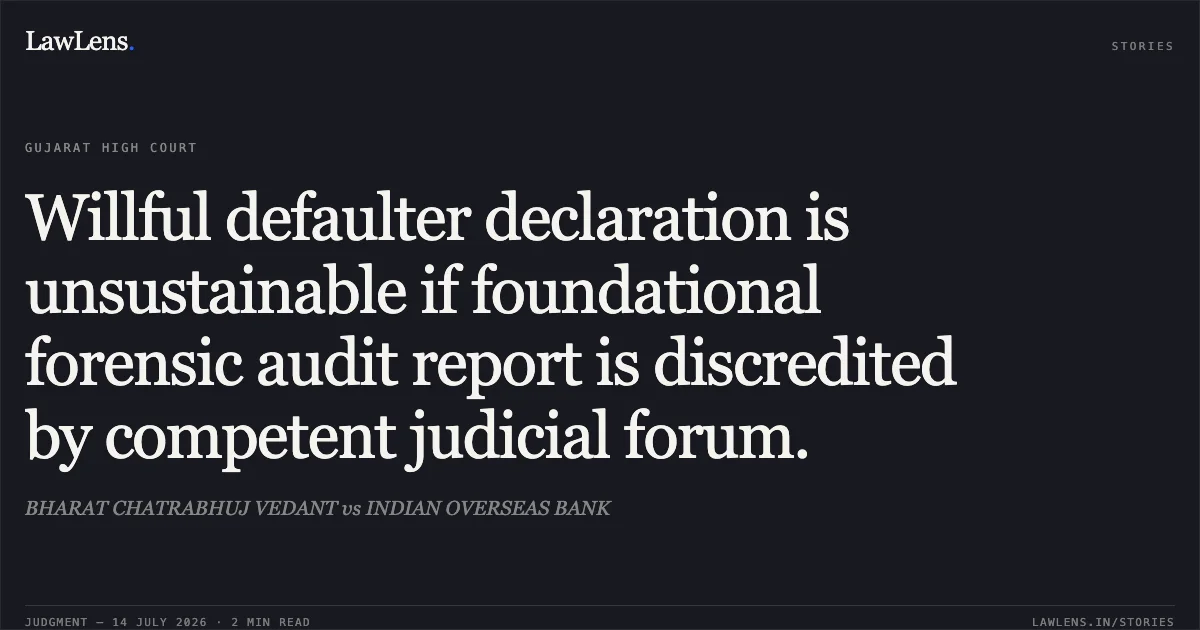
1. Whether the declaration of the petitioners as "Willful Defaulters" can be sustained when the underlying Forensic Audit Report has been discredited by a competent judicial forum (NCLT).
Source reference: p. 3, 62. Whether follow-up actions based on a report that has "lost its substratum" violate the legal requirements for declaring a willful defaulter under RBI Guidelines.
Source reference: p. 7Law Applied
The court relied on the Master Circular on Willful Defaulters issued by the Reserve Bank of India (RBI), which governs the procedure for identification and review by designated committees.
Source reference: p. 2Administrative or quasi-judicial findings must be based on valid, evidentiary material; if the primary evidence (the Forensic Audit Report) is declared procedurally flawed and inconclusive by a competent tribunal, any order based on such material loses its legal efficacy.
Source reference: p. 7Reasoning
The Court observed that while the Bank claimed there was independent material against the petitioners, the show-cause notice and the orders of both the Identification and Review Committees revealed that the Forensic Audit Report was the "prime consideration" and the only documentary proof cited.
Source reference: p. 4-5Since the NCLT—a competent forum evaluating the same corporate debtor—explicitly found that the auditor failed to follow prescribed procedures and declined to accept the report's findings, the High Court determined that the very foundation of the Bank’s decision had collapsed.
Source reference: p. 6-7The Court reasoned that even if principles of natural justice (hearings) were followed, the substantive evidence used to reach the conclusion was now legally void, rendering the "Willful Defaulter" status unsustainable.
Source reference: p. 7Holding
The Court held that the orders lost their substratum due to the NCLT’s rejection of the Forensic Audit Report.
The Court allowed the petition and quashed the Show Cause Notice dated 05/02/2025, the Identification Committee's order dated 31/07/2025, and the Review Committee's order dated 30/01/2026, granting the respondent-Bank liberty to initiate fresh proceedings against the petitioners in accordance with the law.
Source reference: p. 8Acts & Sections Cited
2 provisions across 2 statutes referred to in this judgment. Linked provisions open on LawLens.
Insolvency And Bankruptcy Code, 20161
Fixing fees payable upon engagements and discharges effected before shipping master1
Original Court PDF
BHARAT CHATRABHUJ VEDANTvsINDIAN OVERSEAS BANK
Click to open original judgment
Original judgment, available to read, download and summarize on LawLens.in