01Facts
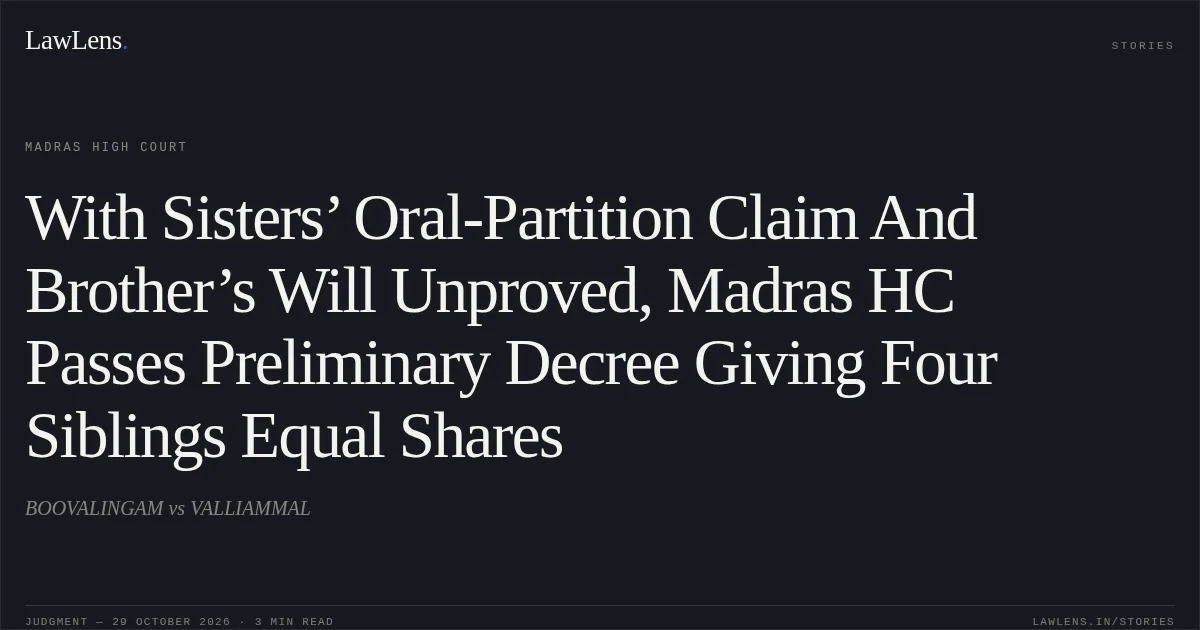
The plaintiffs, sisters of the appellant and second defendant, claimed that a village panchayat had effected an oral partition after their mother’s death, allotting the mother’s properties to the daughters and the father’s properties to the sons.
¶ 3–6They sought a declaration of title and permanent injunction.
¶ 3–6The appellant denied the partition, relied on a Will allegedly executed by the mother in his favour, and alternatively pleaded adverse possession.
¶ 3–6The trial court accepted the oral-partition claim and decreed the suit; the first appellate court affirmed. The appellant brought this second appeal against those concurrent findings.
¶ 3–602Issues
i.1. Whether the finding that the plaintiffs acquired the suit properties through an oral partition was sustainable in the absence of evidence meeting the requirements of Section 101 of the Evidence Act.
¶ 7ii.2. Whether the courts below were justified in disbelieving the Will merely because it bequeathed the testatrix’s property to her daughter-in-law and made no provision for her daughters.
¶ 703Law Applied
Under Section 100 CPC, the High Court may interfere with concurrent factual findings where they are perverse, based on misreading or non-consideration of material evidence, or otherwise unsustainable on the evidence.
¶ 11The party asserting an oral partition bears the burden of proving it; such a partition must be specifically pleaded and established by cogent evidence identifying the properties and the allotments made.
¶ 12–16A Will must be proved in accordance with Section 63(c) of the Indian Succession Act, 1925 and Section 68 of the Evidence Act, but formal compliance does not require acceptance where the attesting witness is unreliable or the surrounding circumstances undermine the Will.
¶ 19–21A civil court may mould relief under Order VII Rule 7 CPC where the relief is supported by the pleadings and facts established at trial, causes no prejudice, and serves complete justice; the judgment relied, among other authorities, on J. Ganapatha v. M/s. N. Selvarajalou Chetty Trust.
¶ 24–25The court also referred to the principles governing proof of oral partition in Vineeta Sharma v. Rakesh Sharma and applied the Hindu Succession Act, 1956 in allocating equal shares among the four children.
¶ 13, 25Provisions in the judgment · 2 · Linked ones open on LawLens
Code of Civil Procedure, 1908 Section 100
Indian Succession Act, 1925 Section 63
04Reasoning
The court found that PW-2’s account did not specify the properties, allotments, or terms of the alleged partition, and that the appellant’s evidence acknowledged at most that a panchayat had occurred—not that the pleaded partition had been completed.
¶ 14–17The absence of contemporaneous evidence of separate ownership or enjoyment further weakened the plaintiffs’ case; the concurrent findings accepting the partition therefore involved misappreciation of evidence and could be revisited under Section 100 CPC.
¶ 14–17The Will was also not proved: the courts below found DW-2 unreliable, and the expert could not give a definite opinion on a thumb impression on the Will; considered with the surrounding circumstances, this left the Will unestablished.
¶ 19–21Since neither the partition nor the Will was proved, the court treated the suit properties as joint property of the parties and moulded relief to avoid further litigation.
¶ 22–2705Holding
The court held that the plaintiffs had not proved the oral partition and that the appellant had not proved the Will.
¶ 28It set aside the lower courts’ judgments and decrees to that extent and, moulding the relief, passed a preliminary decree declaring each of the two plaintiffs, the first defendant/appellant, and the second defendant entitled to a one-fourth share in the suit properties.
¶ 28The parties may pursue final-decree proceedings before the jurisdictional trial court; there was no order as to costs.
¶ 28Original Court PDF
BOOVALINGAMvsVALLIAMMAL
Click to open original judgment
Original judgment, available to read, download and summarize on LawLens.in