Facts
The petitioner, as plaintiff No. 2, instituted Title Suit No. 133 of 2018 challenging the validity of a gift deed dated 23 January 2018 allegedly executed by defendant No. 2 in favour of defendant No. 1, and the consequential development agreement dated 13 February 2018 executed by defendant No. 1 in favour of the pro forma defendants.
Source reference: pp. 2–4, 9During the pendency of the suit, the plaintiffs applied under Order XXIII Rule 1(3) of the Code of Civil Procedure, 1908, seeking permission to withdraw the suit with liberty to institute a fresh suit on the same cause of action.
Source reference: pp. 3–5, 9The trial court permitted withdrawal of the suit but refused liberty to institute a fresh suit, principally on the ground that the application was filed after defendant No. 2, who was suffering from cancer and was a material witness regarding the gift deed, had filed her examination-in-chief; the court considered the withdrawal application to be intended to prevent her evidence from being recorded.
Source reference: pp. 10–13Issues
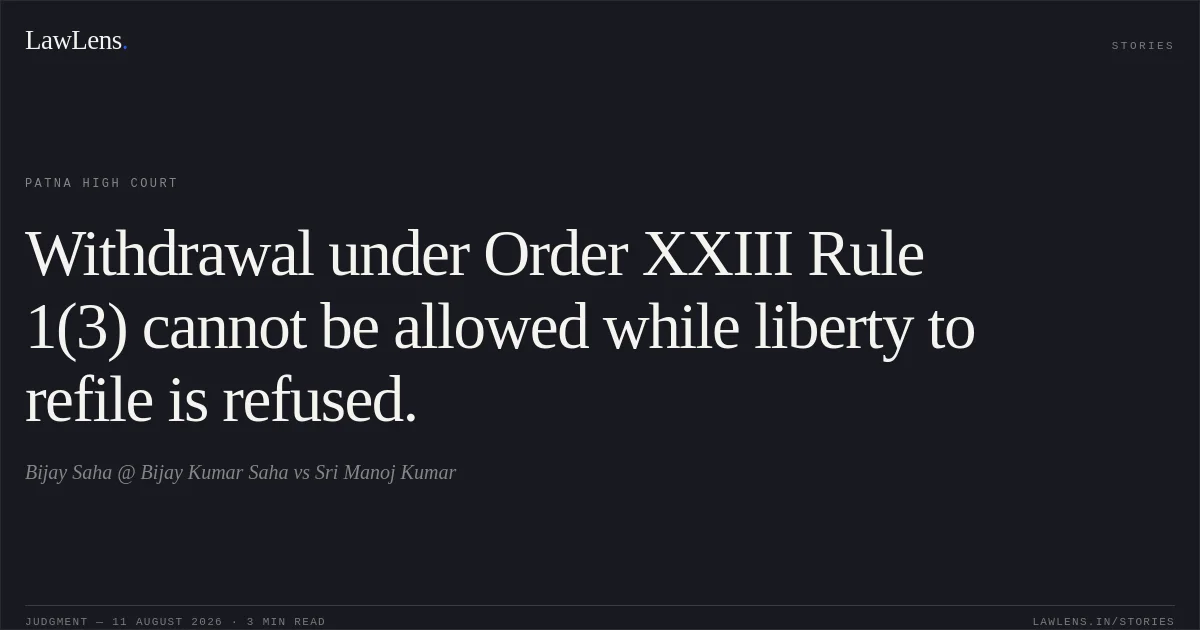
Whether a court exercising jurisdiction under Order XXIII Rule 1(3) CPC can allow withdrawal of a suit while refusing the accompanying prayer for liberty to institute a fresh suit on the same cause of action?
Source reference: pp. 4–6, 9–10Whether the plaintiffs’ alleged mala fide intention in seeking withdrawal, particularly after the filing of defendant No. 2’s examination-in-chief, justified denying them the opportunity to have the validity of the gift deed and development agreement adjudicated by a competent court?
Source reference: pp. 10–14Law Applied
The Court applied Order XXIII Rule 1(3) CPC, which governs withdrawal of a suit with permission to institute a fresh suit on the same subject matter and cause of action where the suit must fail by reason of a formal defect or where sufficient grounds exist.
Source reference: pp. 4–6, 9–10The Court relied on the principle that an application seeking withdrawal with liberty to file a fresh suit is an indivisible prayer: the court must either allow or reject the application as a whole and cannot permit withdrawal while separately refusing the consequential liberty.
Source reference: pp. 4–6, 9–10It followed Rajasundari v. Gowri @ Avaduai Ammal, AIR 2006 Madras 156; 2006 (1) CTC 700, which held that the court cannot bifurcate an application under Order XXIII Rule 1(3) by granting withdrawal but denying leave to institute a fresh suit.
Source reference: pp. 4–6The Court also recognised that a party’s conduct and alleged mala fides may be relevant under the law of evidence and may be considered while deciding the merits of the suit, but such conduct cannot deprive the party of adjudication of an otherwise legally maintainable challenge.
Source reference: pp. 14–15Reasoning
The High Court held that the original suit directly challenged the gift deed and the development agreement, neither of which had been adjudicated on merits.
Source reference: pp. 9–10Although the trial court had validly identified circumstances suggesting that the withdrawal application was intended to prevent the recording and cross-examination of defendant No. 2’s evidence, that alleged mala fide conduct did not justify denying the petitioner a determination of the genuineness and legal effect of the disputed documents by a competent court.
Source reference: pp. 10–14Applying the principle in Rajasundari, the High Court concluded that the trial court had impermissibly divided the plaintiffs’ prayer under Order XXIII Rule 1(3) into two parts—allowing withdrawal but refusing liberty to institute a fresh suit.
Source reference: pp. 9–10, 14The petitioner’s conduct could instead be considered at the stage of final adjudication, particularly because defendant No. 2’s evidence had not been recorded or tested by cross-examination.
Source reference: pp. 14–15Holding
The High Court allowed the civil miscellaneous application and set aside the trial court’s order insofar as it permitted withdrawal while denying liberty to institute a fresh suit.
The petitioner was directed to contest the suit, and the issues concerning the alleged conduct of the petitioner and the circumstances in which defendant No. 2’s evidence was not recorded were left open for consideration at the time of final judgment.
Source reference: pp. 14–15Thus, the Court held that the trial court could not bifurcate the reliefs under Order XXIII Rule 1(3) CPC and that the petitioner could not be denied adjudication of the disputed gift deed and development agreement solely on the basis of alleged mala fide conduct.
Source reference: no citationOriginal Court PDF
Bijay Saha @ Bijay Kumar SahavsSri Manoj Kumar
Click to open original judgment
Original judgment, available to read, download and summarize on LawLens.in