Facts
The complainant alleged that on 8 February 2010 the appellant entered her home at night and attempted to rape her. She filed a complaint after approaching the local police and seeking village intervention; the complaint was referred for investigation, and the appellant was charged under Sections 376/511 and 448 of the Indian Penal Code (IPC).
Source reference: para. 2–3At trial, the prosecutrix testified that the appellant entered her home, extinguished the lamp, lay upon her, and pressed her mouth. A neighbour testified that he arrived after hearing her alarm and saw the appellant being removed from the house by villagers. The other two prosecution witnesses were declared hostile; neither the Investigating Officer nor a medical witness testified.
Source reference: para. 4–5, 13–15The trial court convicted the appellant under Sections 376/511 and 448 IPC. On appeal, the High Court found the appellant’s presence in the house established but considered whether the evidence proved an attempt to rape or instead an offence under Section 354 IPC.
Source reference: para. 6, 16–21Issues
Whether the prosecution proved beyond reasonable doubt that the appellant entered the prosecutrix’s house on the night of the occurrence
Source reference: para. 16–18Whether the appellant’s conduct amounted to an attempt to commit rape under Sections 376/511 IPC, or instead constituted an offence under Section 354 IPC
Source reference: para. 21, 24–31Whether the appellate court could convict the appellant under Section 354 IPC despite the absence of a charge under that provision
Source reference: para. 32–33Whether the conviction under Section 448 IPC and the sentence required interference
Source reference: para. 34–39Law Applied
Section 511 IPC requires proof that the accused did an act towards the commission of the offence; conduct that has not progressed beyond preparation does not establish an attempt.
Source reference: no citationUnder Aman Kumar v. State of Haryana, an attempt to rape requires conduct showing a determination to gratify sexual passion despite resistance, and the distinction from an indecent assault turns on whether the accused was proceeding towards sexual intercourse.
Source reference: para. 28Tarkeshwar Sahu v. State of Bihar supports conviction under Section 354 IPC where the evidence establishes an indecent assault but no attempt at penetration.
Source reference: para. 29Section 354 IPC, as applicable to the 2010 occurrence, criminalised assault or criminal force against a woman with intent to outrage, or knowledge of the likelihood of outraging, her modesty; the court referred to Rupan Deol Bajaj v. Kanwar Pal Singh Gill and Raju Pandurang Mahale v. State of Maharashtra on the nature of that offence.
Source reference: para. 26–27, 30Under Sections 222(2) and 386(b)(ii) CrPC, an appellate court may convict for a minor offence where the proved facts support it, provided no failure of justice or prejudice results; Dalbir Singh v. State of U.P. addresses that inquiry.
Source reference: para. 32–33Section 448 IPC punishes house-trespass, and Section 357(1)(b) CrPC permits compensation to be paid from a fine; the court also relied on Hari Singh v. Sukhbir Singh and Ankush Shivaji Gaikwad v. State of Maharashtra concerning victim compensation.
Source reference: para. 34, 36–37Reasoning
The prosecutrix’s evidence and the neighbour’s account established that the appellant was present in her home at night, and the court found the delay in complaint and non-examination of other villagers or the Investigating Officer insufficient to undermine that finding.
Source reference: para. 16–20However, the evidence did not establish that the appellant undressed either person, removed or displaced clothing, or performed an overt act towards penetration; the prosecutrix also stated that her clothes and body bore no marks and described the incident to the villagers as an attempt.
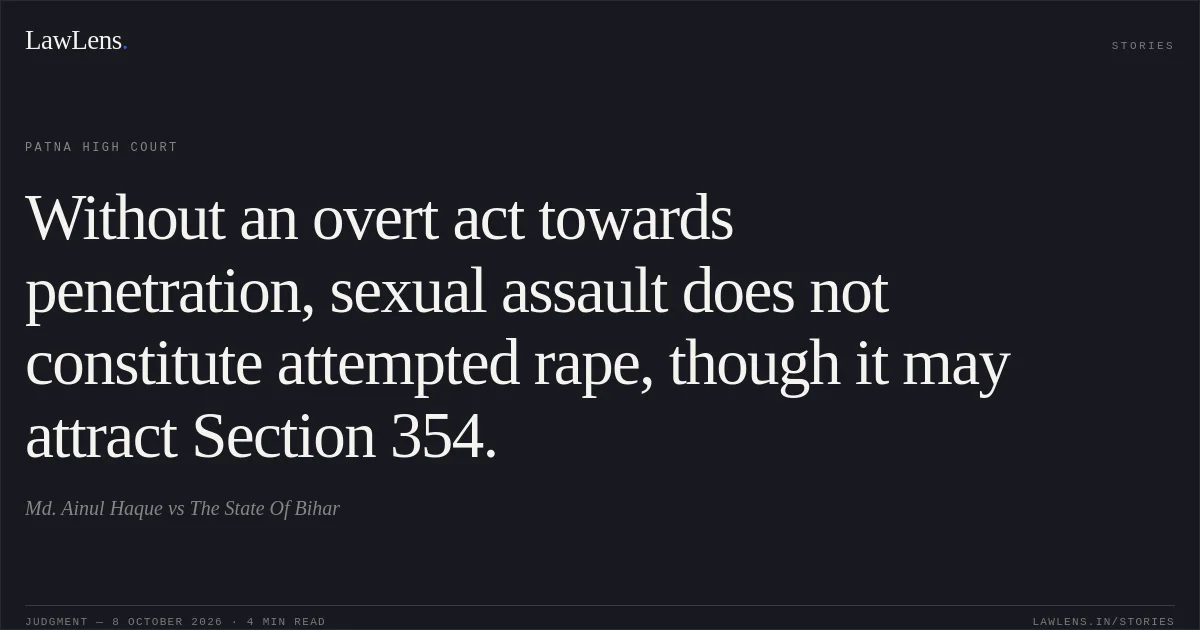
Source reference: para. 24The court therefore held that the evidence did not prove an attempt to rape, but that entering the home at night, lying upon the prosecutrix, and pressing her mouth demonstrated criminal force and the requisite intent for Section 354 IPC.
Source reference: para. 25, 31Because those underlying facts had been put to the appellant and tested at trial, substituting the cognate minor offence caused no prejudice.
Source reference: para. 32–33The entry into the dwelling with intent to commit the offence also supported the Section 448 conviction.
Source reference: para. 34Holding
The appeal was allowed in part. The conviction and sentence under Sections 376/511 IPC, including the associated fine, were set aside; the appellant was instead convicted under Section 354 IPC, as applicable before the 2013 amendment. The conviction under Section 448 IPC was affirmed.
The substantive sentences for both offences were reduced to the period already undergone, and a fine of Rs. 25,000 was imposed under Section 354 IPC, with the entire amount payable to the prosecutrix as compensation. The appellant was directed to deposit the fine within eight weeks, subject to adjustment of any fine already paid.
Source reference: para. 35–39Acts & Sections Cited
16 provisions across 2 statutes referred to in this judgment. Each provision opens on LawLens.
Indian Penal Code, 1860
Code of Criminal Procedure, 19736
Original Court PDF
Md. Ainul HaquevsThe State Of Bihar
Click to open original judgment
Original judgment, available to read, download and summarize on LawLens.in