01Facts
The applicants, Rahmatben and Valibhai, respectively the mother and uncle of original accused No. 1, Sohil Karimbhai Juneja, sought quashing under Section 482 of the Code of Criminal Procedure, 1973, of FIR C.R. No. I-41 of 2017 registered at Dhrangadhra City Police Station for offences under Sections 306, 506(2) and 114 of the Indian Penal Code, 1860 (“IPC”).
p. 1 · ¶ 1The prosecution alleged that Sohil wished to marry the deceased, but her family opposed the marriage because the parties belonged to different castes.
p. 2 · ¶ 2It was further alleged that the accused persons threatened the complainant’s family, pressured them to agree to the marriage, and harassed the deceased, who thereafter committed suicide by strangulation on 27 June 2017.
p. 2 · ¶ 2During the pendency of the application, Sohil was acquitted by the Sessions Court after trial, by judgment dated 4 October 2025, on benefit of doubt.
p. 3 · ¶ 3.2The applicants contended that the FIR did not disclose the ingredients of abetment to suicide or criminal intimidation and that their continuation in the prosecution would constitute an abuse of process.
pp. 3–4 · ¶ 3.2–3.502Issues
i.Whether the allegations in the FIR, even if accepted in their entirety, disclosed the ingredients of abetment of suicide under Sections 306 and 107 IPC against the applicants.
pp. 7–10 · ¶ 6.1–6.5ii.Whether the allegations disclosed the ingredients of criminal intimidation punishable under Section 506(2) IPC, including an intention to cause alarm.
p. 11 · ¶ 6.6iii.Whether Section 114 IPC could be invoked against the applicants in the absence of the substantive offences under Sections 306 and 506(2) IPC.
p. 12 · ¶ 6.7iv.Whether continuation of the FIR and consequential proceedings against the applicants amounted to an abuse of process warranting exercise of the High Court’s inherent jurisdiction under Section 482 CrPC.
pp. 6–8, 12 · ¶ 6–6.3, 6.803Law Applied
The Court applied Section 482 CrPC, which empowers the High Court to quash criminal proceedings to prevent abuse of process or secure the ends of justice.
pp. 5–8 · ¶ 6It relied on State of Haryana v. Bhajan Lal, AIR 1992 SC 604, particularly the categories permitting quashing where the allegations, taken at face value, do not constitute an offence, are inherently improbable, or are manifestly malicious.
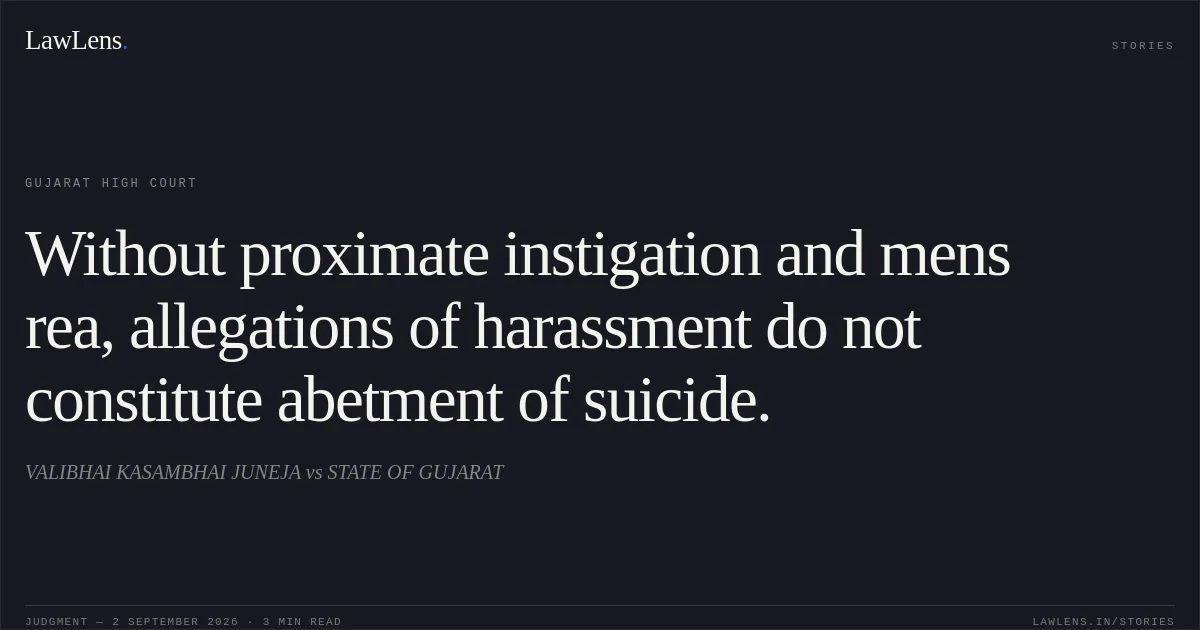
pp. 5–8 · ¶ 6For Section 306 IPC, read with Section 107 IPC, the Court held that mere harassment or pressure is insufficient; there must be a proximate prior act, positive instigation, intentional aid, or conspiracy, together with the requisite mens rea showing that the accused consciously intended, or could be inferred to have intended, to drive the deceased to suicide.
pp. 8–10 · ¶ 6.4The Court relied on Abhinav Mohan Delkar v. State of Maharashtra, (2026) 6 SCC 233, for the requirement of a proximate act and deliberate intention.
pp. 8–10 · ¶ 6.4Section 506(2) IPC requires a threat of injury accompanied by an intention to cause alarm or to compel or prevent an act; Section 114 IPC operates only where the substantive offence has been established.
pp. 11–12 · ¶ 6.6–6.7Provisions in the judgment · 7 · Linked ones open on LawLens
Code of Criminal Procedure, 1973 Section 482Section 156Section 155
Indian Penal Code, 1860 Section 306Section 506Section 114Section 107
04Reasoning
The FIR alleged only that the applicants pressured the complainant to arrange the deceased’s marriage with Sohil and threatened the family if they refused.
p. 8 · ¶ 6.3It did not specify when the threats were made, the exact words used, any proximate incident preceding the suicide, or any particular overt act demonstrating that the applicants intended to instigate or aid the deceased’s suicide.
pp. 8–10 · ¶ 6.3–6.5Applying the principle that continuous harassment, without a proximate and intentional act directly connected with the suicide, does not constitute abetment, the Court found the ingredients of Sections 306 and 107 IPC absent.
pp. 9–10 · ¶ 6.4–6.5The allegations also failed to establish that the applicants’ threats were intended to cause alarm, as required for Section 506(2) IPC.
p. 11 · ¶ 6.6Consequently, Section 114 IPC could not independently survive.
p. 12 · ¶ 6.7The acquittal of Sohil, who was alleged to have played the more significant role, further supported the conclusion that continuation of proceedings against the applicants would be futile and abusive, though the quashing was confined to the applicants.
p. 12 · ¶ 6.805Holding
The High Court allowed the application and held that the FIR did not prima facie establish abetment of suicide under Sections 306/107 IPC, criminal intimidation under Section 506(2) IPC, or liability under Section 114 IPC against the applicants.
pp. 10–12 · ¶ 6.5–6.8FIR C.R. No. I-41 of 2017 and all consequential criminal proceedings were quashed and set aside qua the present applicants only.
p. 12 · ¶ 7 · p. 13 · ¶ 7.1The rule was made absolute, and direct service was permitted.
p. 12 · ¶ 7 · p. 13 · ¶ 7.1Original Court PDF
VALIBHAI KASAMBHAI JUNEJAvsSTATE OF GUJARAT
Click to open original judgment
Original judgment, available to read, download and summarize on LawLens.in