Facts
The first petitioner, the victim’s mother, lodged an FIR initially alleging that her minor daughter had been kidnapped.
Source reference: para. 10During the investigation, the victim alleged that, from December 2023 to July 2024, the first petitioner threatened and forced her to have sexual relations with the second petitioner, and remained present during the assaults.
Source reference: paras. 10–11The allegations spanned the periods when the IPC and the BNS were in force; charges were framed under, among other provisions, sections 376D IPC/70 BNS and section 6 of the POCSO Act.
Source reference: paras. 3, 20, 55The petitioners challenged the order on charge, arguing that a woman could not be charged with gang rape.
Source reference: paras. 2, 12–17Issues
1. Whether a woman can be charged with gang rape under section 376D IPC or section 70 BNS.
Source reference: para. 42. Whether the Supreme Court’s decisions in Priya Patel v. State of M.P. and State of Rajasthan v. Hemraj preclude such a charge under the post-2013 statutory provisions.
Source reference: paras. 14–17, 57–60Law Applied
Section 376D IPC and section 70 BNS make it an offence for a woman to be raped by one or more persons constituting a group or acting in furtherance of a common intention, and provide that each such person is “deemed to have committed” rape.
Source reference: paras. 20, 74–80The provisions impose joint liability on persons who constitute the group or act in furtherance of the common intention; an accused need not personally commit the physical act of rape, and liability is not restricted by gender.
Source reference: paras. 81–84Priya Patel v. State of M.P., (2006) 6 SCC 263, and State of Rajasthan v. Hemraj, (2009) 12 SCC 403, concerned the pre-2013 framework, when gang rape was an aggravated form of rape under section 376(2)(g) IPC, and were distinguished from the later, standalone offence under section 376D IPC.
Source reference: paras. 57–60, 72–77The court also relied on Sundari Gautam v. State of NCT of Delhi, 2024:DHC:5944, for the gender-neutral application of section 3 of the POCSO Act.
Source reference: paras. 45–46, 88Reasoning
The court held that the 2013 amendment created gang rape as a separate substantive offence, subsequently retained in section 70 BNS, so its scope was not confined to the definition of rape in section 375 IPC or section 63 BNS.
Source reference: paras. 74–79It gave effect to the statutory references to “persons,” “a common intention,” and the deeming provision, concluding that a woman who facilitates or otherwise acts in furtherance of a common intention to have rape committed may be charged even if she did not personally commit the physical act.
Source reference: paras. 80–84The court therefore rejected the contention that Priya Patel and Hemraj barred the charge under the later provisions.
Source reference: paras. 57–60, 85It expressly left open whether a woman acting alone could commit rape under section 375 IPC or section 63 BNS.
Source reference: paras. 87–88Holding
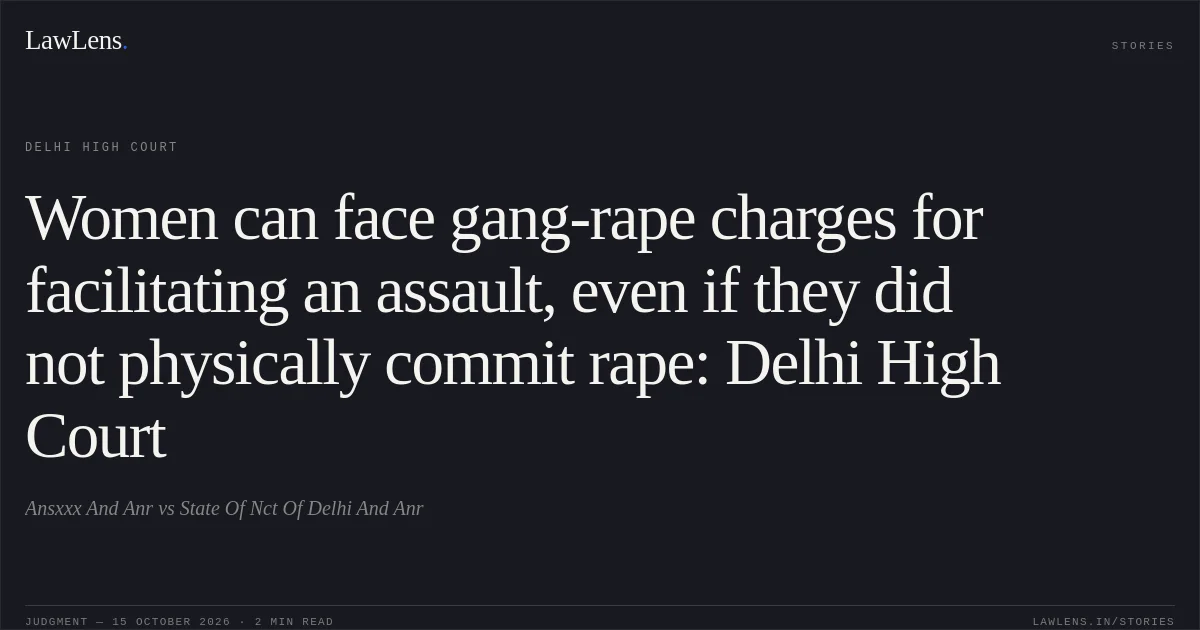
The court answered that a woman can be charged with gang rape under section 376D IPC or section 70 BNS, provided the statutory requirements are met; it did not decide whether a woman acting alone can commit rape.
It upheld the order on charge, including the charge under section 6 of the POCSO Act, dismissed the petition, and disposed of the pending applications.
Source reference: paras. 88–91Acts & Sections Cited
40 provisions across 5 statutes referred to in this judgment. Each provision opens on LawLens.
Bharatiya Nagarik Suraksha Sanhita, 20234
Bharatiya Nyaya Sanhita, 20237
Indian Penal Code, 1860
Code of Criminal Procedure, 19731
Original Court PDF
Ansxxx And AnrvsState Of Nct Of Delhi And Anr
Click to open original judgment
Original judgment, available to read, download and summarize on LawLens.in