Facts
The litigation originated 66 years ago in 1960 involving the Deity "Shree Shree Radha Krishna" at Thakurbari, Imphal
Source reference: p. 7, para 2Two cross-suits (O.S. No. 1 of 1974 and O.S. No. 2 of 1974) resulted in a common judgment dated 30.11.1974.
Source reference: p. 7-8, para 2In O.S. No. 1, Purnananda Sharma (predecessor of the Petitioners) was declared a co-shebait. However, in O.S. No. 2, the court decreed the recovery of possession of temple property in favor of the Deity, specifically directing the demolition of all structures standing thereon
Source reference: p. 7-8, para 2In 2012, Ashok Kumar Aggarwal, acting as a worshipper and next friend of the Deity, filed Execution Case No. 9 of 2012 to enforce the decree for possession
Source reference: p. 8, para 3The Petitioners (Judgment Debtors and legal heirs of Purnananda Sharma) challenged the execution, asserting that a worshipper—who was not a party to the original suit—could not represent the Deity in execution
Source reference: p. 8, para 3The Executing Court, via an order dated 14.05.2025, overruled the objections, holding the Deity to be in the position of a minor representable by a worshipper
Source reference: p. 8, para 3The Petitioners challenged this order under Article 227
Source reference: p. 6, para 1Issues
1. Whether a Civil Revision Petition under Article 227 of the Constitution is maintainable against an order of the Executing Court determining the representation of a Deity
Source reference: p. 18-20, para 7-82. Whether a worshipper can represent an Idol as a "next friend" in execution proceedings when the interests of the Shebaits are adverse to the Deity
Source reference: p. 21-23, para 10-113. Whether an Executing Court travels beyond the decree by directing the demolition of structures if such a direction was part of the original decree for possession
Source reference: p. 29-30, para 17Law Applied
Article 227 of the Constitution of India, affirming that supervisory jurisdiction is available when an order is not appealable and that the "alternative remedy" rule is a matter of judicial discretion rather than an absolute bar
Source reference: p. 19-20, para 7Hindu Idol is a juridical person holding the status of a minor
Source reference: p. 21, para 10while a Shebait normally represents the Deity, a worshipper may act as a "next friend" if the Shebait is negligent or acts prejudicially to the Deity’s interests (Vemareddi Ramaraghava Reddy v. Konduru Seshu Reddy (1966) and Bishwanath v. Sri Thakur Radha Ballabhji (1967))
Source reference: p. 21-24, para 10-12A.A. Gopalakrishnan v. Cochin Devaswom Board (2007) to emphasize the court's duty to protect religious endowments
Source reference: p. 24, para 12Reasoning
The court first rejected the maintainability objection, finding that the impugned order was not appealable under Section 99A or Order XXI Rules 98-103 of the CPC
Source reference: p. 20, para 7-8the court observed that the Petitioners were the legal heirs of the party against whom the decree for recovery of possession was passed
Source reference: p. 27, para 14Since the Petitioners (as purported Shebaits) were actively resisting the Deity’s recovery of property, their interests were fundamentally adverse to the Deity
Source reference: p. 27-28, para 14Following Bishwanath, the court reasoned that an Idol is left "in a lurch" when its legal representative is the guilty party; therefore, a worshipper must be permitted to represent the "minor" Idol to prevent irreparable injury to the endowment
Source reference: p. 23, para 10Regarding the demolition of structures, the court examined the 1974 decree and found it explicitly mandated "delivery of possession... by demolishing all the structures"
Source reference: p. 30, para 17Consequently, the Executing Court did not exceed its jurisdiction but merely enforced the literal terms of the decree
Source reference: p. 30, para 17Holding
The High Court dismissed the Civil Revision Petition, holding that the Executing Court’s order was legally sound
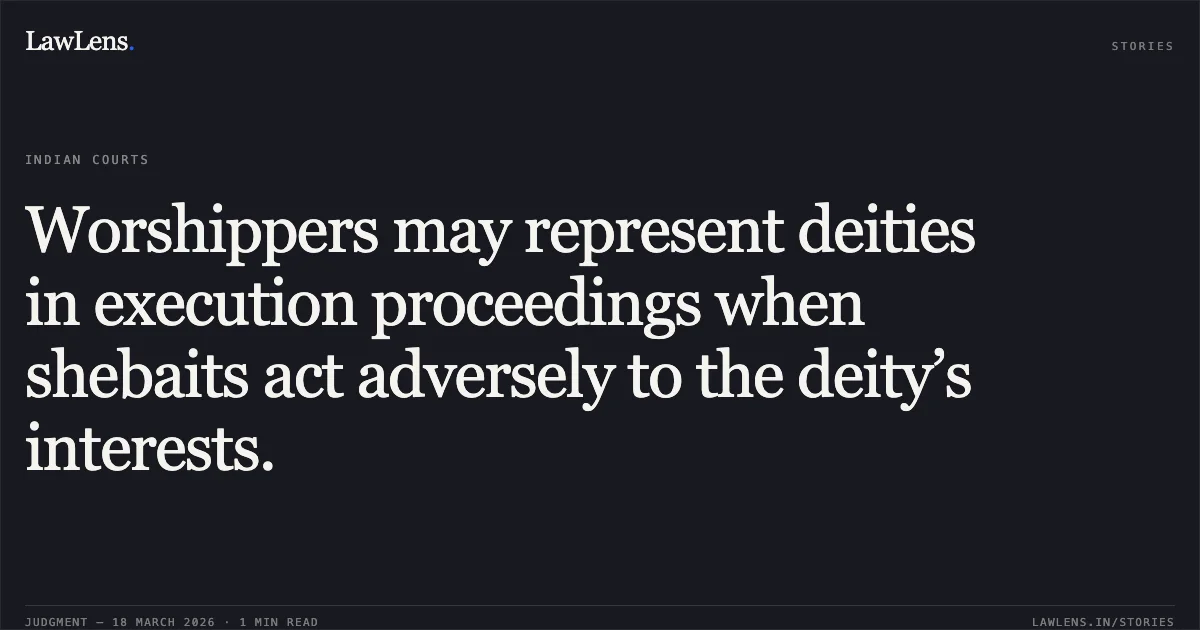
The Court held that a worshipper is competent to act as a next friend for an Idol in execution proceedings when the Shebaits’ interests are adverse to the Deity
Source reference: p. 27-28, para 14The court further held that enforcing a decree for possession via demolition is valid if specifically provided for in the decree
Source reference: p. 30, para 17All interim orders were vacated
Source reference: p. 31, para 20Acts & Sections Cited
3 provisions across 2 statutes referred to in this judgment. Each provision opens on LawLens.
Limitation Act, 19631
Code of Civil Procedure, 19082
Original Court PDF
Vinod Kumar Sharma and AnrvsRadha Krishna and 6 Ors
Click to open original judgment
Original judgment, available to read, download and summarize on LawLens.in


![Subsequent exoneration does not retrospectively invalidate a finalized promotion select list.. UNNIKRISHNAN M vs M/o Environment And Forests. CAT - ['Ernakulam']. LawLens](/stories/thumbnails/subsequent-exoneration-does-not-retrospectively-invalidate-a-finalized-promotion-select-li-ce80a0e84f2f4887857271e8b4341c42.webp)