Facts
The petitioner purchased land at Saradapally Bhutgoria, Bankura, after his wife’s death and constructed a residential house there.
Source reference: paras. 5–6; p. 2His handicapped son, Tapas Chakraborty, married respondent no. 6, Riya Neogi, who thereafter began residing in the house with them.
Source reference: paras. 5–6; p. 2The petitioner alleged that respondent no. 6 and Barun Garai subjected him and his son to threats and torture, resulting in their leaving the house and residing elsewhere.
Source reference: paras. 7–12; pp. 2–3The police report disclosed cross-cases between the parties.
Source reference: para. 13; p. 3A case was registered against respondent no. 6 and Barun Garai under Sections 115(2) and 351 of the Bharatiya Nyaya Sanhita, 2023, Section 92(a) of the Rights of Persons with Disabilities Act, 2016, and Section 24 of the Maintenance and Welfare of Parents and Senior Citizens Act, 2007; the investigation culminated in a charge-sheet.
Source reference: paras. 13–16; pp. 3–4Respondent no. 6 also lodged a case against the petitioner and his son under provisions of the Bharatiya Nyaya Sanhita, 2023 and Sections 3 and 4 of the Dowry Prohibition Act, 1961, which likewise culminated in a charge-sheet.
Source reference: paras. 17–18; p. 4Issues
Whether the petitioner was entitled to police protection against respondent no. 6 in circumstances where the petitioner and his son had already left the disputed house and were not alleged to be facing continuing harassment at their present residence
Source reference: para. 20; p. 5Whether the writ court could direct the State authorities to restore the petitioner’s possession of the house allegedly occupied by respondent no. 6
Source reference: para. 20; p. 5Whether any further direction was warranted when the State authorities had acted upon the petitioner’s complaints and criminal proceedings were pending between the parties
Source reference: paras. 14–20; pp. 3–5Law Applied
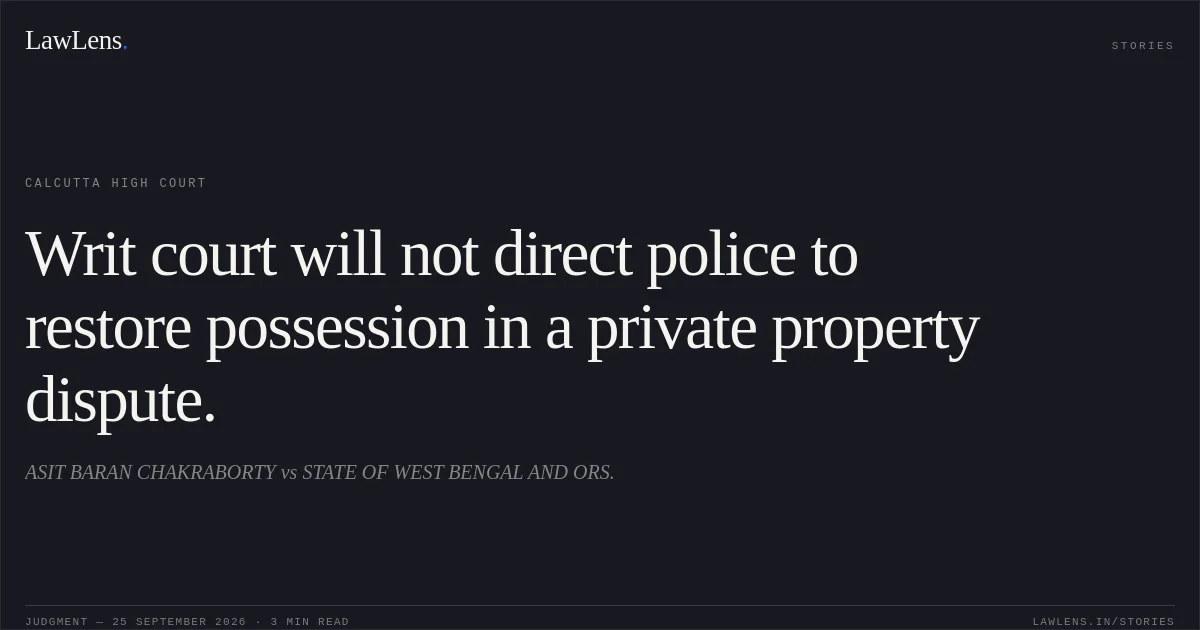
The Court applied the principle that the writ jurisdiction of the High Court cannot ordinarily be used to restore possession of disputed immovable property, particularly where the dispute involves competing factual allegations and pending criminal proceedings.
Source reference: para. 20; p. 5The Court also proceeded on the basis that police protection is not warranted in the absence of a continuing threat requiring such protection, especially where the alleged harassment is connected with a disputed residence rather than the petitioner’s current place of residence.
Source reference: para. 20; p. 5The Court noted that the petitioner could pursue appropriate remedies under the Maintenance and Welfare of Parents and Senior Citizens Act, 2007, if so advised.
Source reference: para. 19; p. 5The criminal proceedings were governed by the cited provisions of the Bharatiya Nyaya Sanhita, 2023, the Rights of Persons with Disabilities Act, 2016, the Maintenance and Welfare of Parents and Senior Citizens Act, 2007, and the Dowry Prohibition Act, 1961.
Source reference: paras. 15–18; pp. 3–4Reasoning
The Court found that the State had responded to the petitioner’s complaints by conducting an inquiry, registering a criminal case against respondent no. 6 and Barun Garai, and filing a charge-sheet.
Source reference: paras. 14–16; pp. 3–4At the same time, respondent no. 6 had instituted a counter-case against the petitioner and his son, which had also resulted in a charge-sheet.
Source reference: paras. 17–18; p. 4These competing proceedings were required to reach their logical conclusions through the appropriate legal processes.
Source reference: no citationSince the petitioner and his son were no longer residing with respondent no. 6, and there was no allegation that she was visiting or harassing them at their current residence, the Court found no present basis for granting police protection.
Source reference: para. 20; p. 5The petitioner’s principal grievance concerned recovery of possession of the house, but the Court held that restoration of possession was not a function of the respondent authorities in the writ proceedings and that the issue could not be adjudicated in the present petition.
Source reference: para. 20; p. 5Holding
The Court held that the petitioner was not entitled to an order of police protection at that stage and that the writ court could not direct the State authorities to restore possession of the disputed house.
The petitioner was left at liberty to initiate appropriate proceedings under the Maintenance and Welfare of Parents and Senior Citizens Act, 2007, if advised.
Source reference: para. 19; p. 5The writ petition, W.P.A. 26541 of 2025, was accordingly disposed of without any order as to costs.
Source reference: paras. 22–23; p. 5Since no order was passed against respondent no. 6, the matter was decided in her absence; the allegations in the writ petition were not treated as admitted because no affidavit had been called for.
Source reference: paras. 21, 24; pp. 5–6Acts & Sections Cited
8 provisions across 4 statutes referred to in this judgment. Each provision opens on LawLens.
Bharatiya Nyaya Sanhita, 20234
Rights of Persons with Disabilities Act, 2016.1
Maintenance and Welfare of Parents and Senior Citizens Act, 20071
Original Court PDF
ASIT BARAN CHAKRABORTYvsSTATE OF WEST BENGAL AND ORS.
Click to open original judgment
Original judgment, available to read, download and summarize on LawLens.in