Facts
The BDA’s predecessor acquired Site No. 30/A, measuring 8,100 sq. ft., belonging to Anantha Narayana.
Source reference: para. 16–24Following court proceedings and a BDA resolution, Anantha Narayana relinquished that site to the BDA, which allotted Sites Nos. 68 and 69 to him in exchange and executed a registered sale deed for Site No. 68.
Source reference: para. 16–24Respondent No. 6, Ramamurthy, had earlier been allotted the same site—then numbered Site No. 72—and had paid the consideration, but no sale deed was executed while related litigation was pending.
Source reference: para. 16–24Ramamurthy filed a writ petition in 2018 challenging the allotment and sale deed in Anantha Narayana’s favour; he amended it in 2022 to seek cancellation of the registered sale deed.
Source reference: para. 25–26The Single Judge allowed the petition. Anantha Narayana’s widow appealed.
Source reference: para. 25–26; opening case detailsIssues
Whether Ramamurthy’s writ petition seeking to quash the allotment and cancel the registered sale deed was maintainable under Article 226?
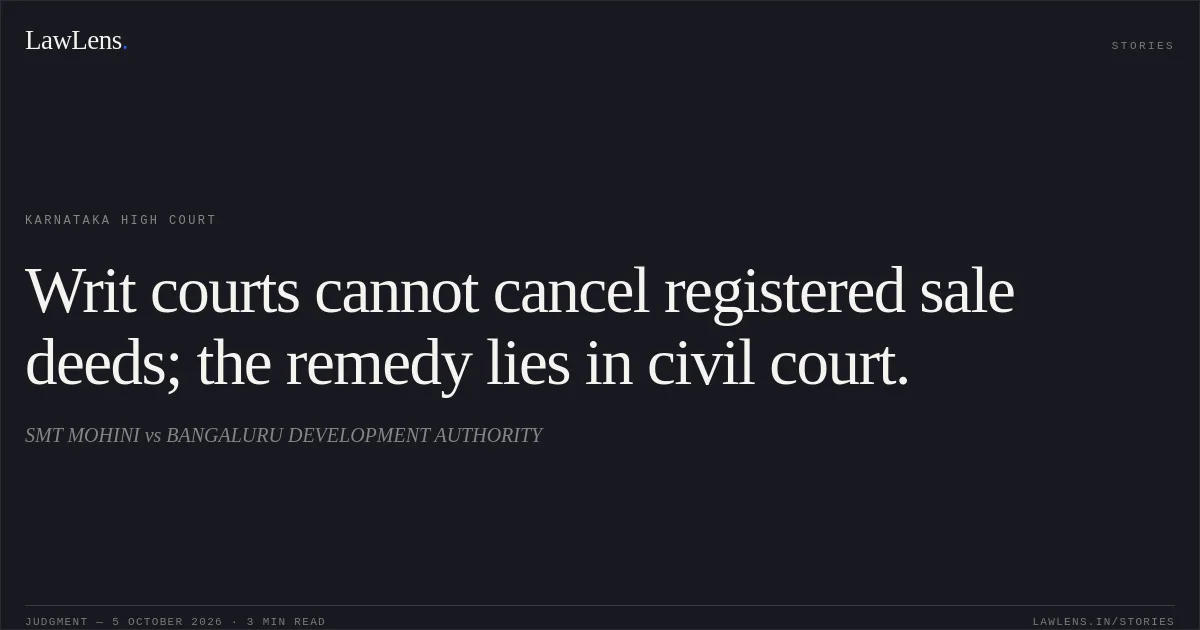
Source reference: para. 15(1), paras. 29–32, 41Whether the High Court could set aside the registered sale deed in writ jurisdiction when a civil remedy under Section 31 of the Specific Relief Act, 1963, was available?
Source reference: para. 15(2), paras. 29–36Whether the amended prayer to cancel the sale deed was barred by limitation?
Source reference: paras. 25–28Law Applied
Article 226 jurisdiction is extraordinary and discretionary; it is generally not a substitute for a civil suit to resolve private property disputes, contested title, or the validity of a registered instrument.
Source reference: paras. 30–32, 39–40Article 59 of the Limitation Act, 1963, allows three years from when the relevant facts first become known to seek cancellation or setting aside of an instrument.
Source reference: para. 27Under Section 31 of the Specific Relief Act, 1963, a person against whom a written instrument is void or voidable may sue for its cancellation; a registered instrument’s cancellation is for the court to order.
Source reference: paras. 35–37The court also applied Section 54 of the Transfer of Property Act, 1882, concerning transfer of ownership by sale.
Source reference: paras. 34–36Rule 11-A of the BDA (Allotment of Sites) Rules, 1984, concerns alternative sites for an existing allottee when the BDA cannot deliver the originally allotted site for reasons not attributable to the allottee; the court held it did not govern this exchange allotment.
Source reference: paras. 42–45The court relied on Roshina T. v. Abdul Azeez K.T., Satya Pal Anand v. State of M.P., Binny Mill Labour Welfare House Building Co-operative Society Ltd. v. D.R. Mruthyunjaya Aradhya, and Sri K. Raju v. Bangalore Development Authority on the limits of writ jurisdiction and cancellation of registered instruments.
Source reference: paras. 37–40Reasoning
Ramamurthy knew of the BDA’s sale deed in April 2016 but sought its cancellation only by amendment in July 2022; the court therefore held that the three-year period under Article 59 had expired in April 2019.
Source reference: paras. 26–28Independently, the challenge required adjudication of property rights and the validity of a registered sale deed, matters for a competent civil court under Section 31 rather than writ proceedings.
Source reference: paras. 29–32, 41The court further found that the BDA’s allotment to Anantha Narayana arose from the acquisition, the court proceedings, and the exchange for his relinquished land—not under Rule 11-A—so the Single Judge’s reliance on that rule and its restrictions was misplaced.
Source reference: paras. 42–46Holding
The Division Bench allowed the appeal and set aside the Single Judge’s order.
It held that the amended cancellation claim was time-barred and that the writ petition was not the proper remedy for challenging the registered sale deed; it reserved liberty to Ramamurthy to pursue an appropriate civil remedy.
Source reference: paras. 28–29, 41; Order, clauses i–iiThe BDA was directed to refund the consideration paid by Ramamurthy, with interest at 12% per annum.
Source reference: Order, clause iiiNo order as to costs was made.
Source reference: Order, clause vActs & Sections Cited
4 provisions across 4 statutes referred to in this judgment. Each provision opens on LawLens.
KARNATAKA HIGH COURT ACT, 19611
Specific Relief Act, 19631
Limitation Act, 19631
Transfer of Property Act, 18821
Original Court PDF
SMT MOHINIvsBANGALURU DEVELOPMENT AUTHORITY
Click to open original judgment
Original judgment, available to read, download and summarize on LawLens.in