Facts
The petitioner, appearing in person, filed a writ petition under Article 226 seeking directions to the Union of India and the State of Tamil Nadu to enact a comprehensive “Road Safety Act” and to implement numerous measures concerning road safety, including construction of footpaths, removal of encroachments, speed regulation, parking controls, separate lanes for two-wheelers, regulation of roadside shops and bus operations, auto-rickshaw fares, stray dogs, road signs, a Road Safety Force, a separate Ministry, and a Road Safety Engineering University
Source reference: pp.2–4; paras.1, 4–5The petitioner had previously approached the Supreme Court under Article 32 for a nationwide Road Safety Law. The Supreme Court dismissed that petition on 07.07.2023, while granting liberty to approach the jurisdictional High Court for reliefs specific to Tamil Nadu.
Source reference: p.6; para.3The present petition contained nineteen distinct prayers but was filed on payment of a single court fee.
Source reference: p.6; paras.5–6Issues
Whether a constitutional court exercising writ jurisdiction can direct Parliament or a State Legislature to enact a law in a specified form and on a particular subject, namely, a “Road Safety Act”?
Source reference: pp.7–11; paras.7–11Whether a single writ petition containing nineteen distinct and largely unconnected reliefs, arising from different facts and involving different authorities, can be maintained on payment of a single court fee?
Source reference: pp.12–14; paras.12–15Law Applied
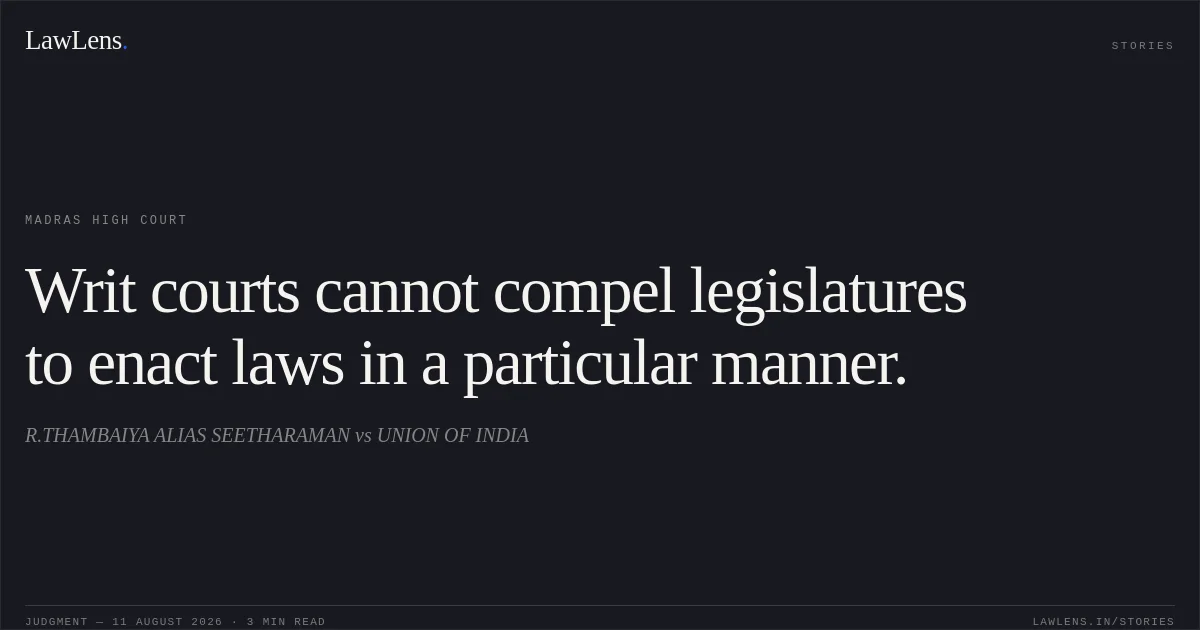
The Court applied the constitutional separation of powers and the settled principle that courts interpret and enforce existing law but cannot issue a mandamus directing the Legislature to enact a law in a particular manner.
Source reference: pp.7–11; paras.7–9Relying on Ashwini Kumar Upadhyay v. Union of India, Order dated 29.04.2026 in W.P.(C) No.943 of 2021, the Court held that judicial directions may temporarily fill interstitial gaps to protect constitutional rights, but cannot supplant the legislative function or create an enduring statutory framework.
Source reference: pp.8–11; para.9The Court also relied on Union of India v. K. Pushpavanam, (2023) 20 SCC 736, which held that a writ court cannot direct the Government to introduce a Bill or compel the Legislature to enact a law on a particular subject in a particular manner, although it may indicate the need for legislative reform.
Source reference: pp.9–11; para.9Rule 3(3) of the Madras High Court Writ Rules, 2021 permits multiple or alternate reliefs in one writ petition only when they arise from the same cause of action; distinct reliefs require separate court fees and may be directed to be pursued through separate petitions.
Source reference: pp.12–13; para.13Reasoning
The Court found that the principal reliefs expressly sought a direction to enact a Road Safety Act, with prayers for a Road Safety Force, separate Ministry, and specialised university additionally seeking the creation of new legislative or executive policy structures.
Source reference: p.12; para.10Applying the separation-of-powers rule, the Court held that the petitioner’s evidence regarding the seriousness of road accidents and the desirability of comprehensive legislation could not confer jurisdiction on the Court to compel legislative action.
Source reference: p.12; para.11The Court further held that the nineteen prayers did not arise from a single cause of action: construction of footpaths, regulation of auto-rickshaw fares, control of pet dogs, removal of encroachments, and examination of bus licences involved different facts, authorities, and legal considerations.
Source reference: pp.13–14; para.14The common subject of “road safety” was considered too broad to satisfy Rule 3(3), and permitting the petition to proceed would improperly allow the petitioner to avoid the court fee applicable to separate and distinct reliefs.
Source reference: p.14; para.15Holding
The Court answered both issues against the petitioner.
It held that a writ court cannot direct the Legislature or Government to enact a specified Road Safety Act or introduce legislation in a particular form.
Source reference: pp.10–12; paras.9–11It also held that the omnibus petition containing nineteen unrelated reliefs was procedurally impermissible under Rule 3(3) of the Madras High Court Writ Rules, 2021.
Source reference: pp.12–14; paras.12–15Accordingly, W.P. No.34400 of 2023 was dismissed without costs.
Source reference: p.15; para.16The petitioner was granted liberty to pursue specific grievances—such as the absence of a footpath on an identified road stretch, an identified unauthorised structure, or an authority’s failure to act on a particular complaint—through separate writ petitions upon payment of the requisite court fee.
Source reference: p.15; para.17Original Court PDF
R.THAMBAIYA ALIAS SEETHARAMANvsUNION OF INDIA
Click to open original judgment
Original judgment, available to read, download and summarize on LawLens.in