01Facts
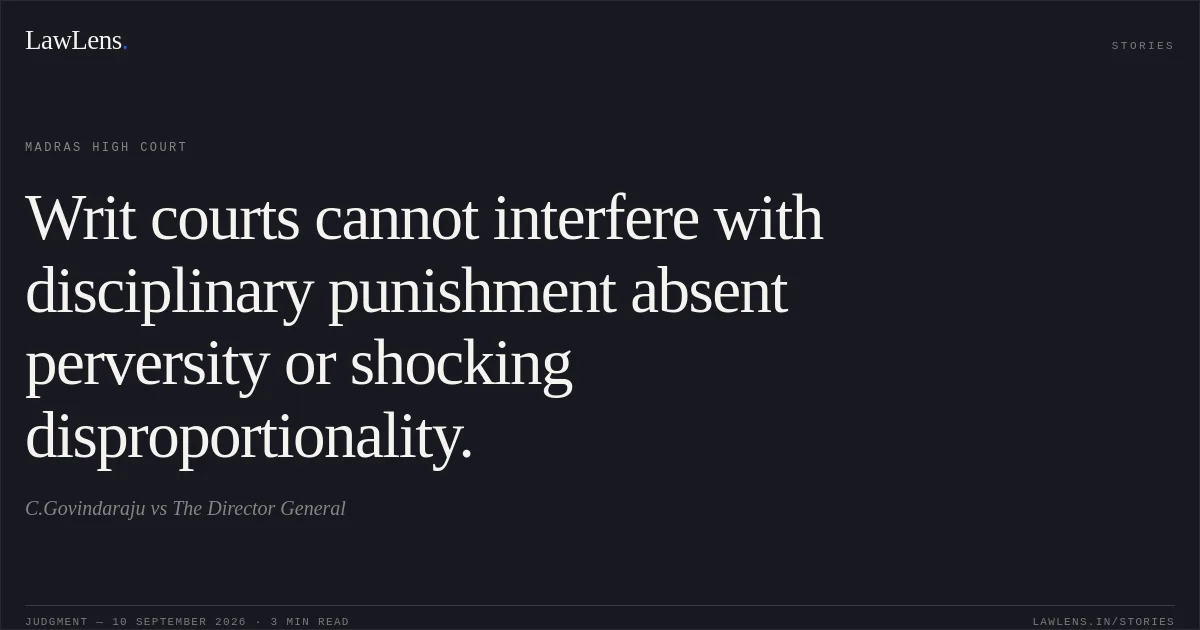
The petitioner, a CISF employee, challenged disciplinary proceedings arising from two charges: intimidating or attempting to influence Yasoob, a departmental witness, and misconduct involving failure to properly pay compliments to superior officers.
¶ 1–3 · pp. 2–4The Disciplinary Authority imposed the penalty of reduction of pay by two stages—from ₹37,500 to ₹35,300 in Pay Matrix Level 4—for two years, with postponement of future increments.
¶ 1–3 · pp. 2–4The Appellate Authority and Revisional Authority confirmed the penalty by orders dated 17 March 2021 and 10 November 2021 respectively.
¶ 1–3 · pp. 2–4The petitioner contended that the charges were based on unreliable and self-serving material, that no corresponding General Diary entry had been made, and that the translated telephone conversation had not been supplied to him.
¶ 1–3 · pp. 2–4The respondents relied on the limited scope of judicial review and the petitioner’s nine previous instances of misconduct and punishment.
¶ 3–3.1 · pp. 4–502Issues
i.Whether the findings that the petitioner attempted to influence or intimidate a departmental witness and thereby interfere with the domestic enquiry were unsupported or perverse?
¶ 5 · p. 5ii.Whether the absence of a General Diary entry rendered the special report, and consequently the disciplinary findings, unreliable or unsustainable?
¶ 6–8 · pp. 6–7iii.Whether the penalty of reduction of pay by two stages, with postponement of future increments, was disproportionate to the misconduct proved against the petitioner?
¶ 9–11 · pp. 7–803Law Applied
The Court applied the principles governing judicial review of disciplinary proceedings under Article 226 of the Constitution: a writ court does not reappreciate evidence or substitute its own view for that of the disciplinary authorities, and interference is warranted only where the findings are perverse, unsupported by the record, or unreasonable.
¶ 6–8 · pp. 6–7The Court further applied the principle that an alternative or possible view of the evidence is insufficient to justify judicial interference when the disciplinary findings are probable and reasonable.
¶ 8 · p. 7On punishment, the Court applied the proportionality standard that interference is justified only where the punishment is “shockingly disproportionate” to the gravity of the misconduct.
¶ 11 · p. 8The Court also recognised that duly considered past misconduct may be relevant in assessing the proportionality of the penalty.
¶ 9–11 · pp. 7–804Reasoning
The Court held that the first charge sufficiently alleged an attempt to interfere with the domestic enquiry by influencing a departmental witness; therefore, the charge disclosed misconduct.
¶ 5 · p. 5Regarding the second charge, the Court noted that the petitioner could not demonstrate that the General Diary objection had been raised during the enquiry.
¶ 6–8 · pp. 6–7In the presence of the special report, even though it was undated, the authorities were entitled to rely on it, and their conclusions were not shown to be perverse or unsupported by the record.
¶ 6–8 · pp. 6–7The Court declined to reassess the evidence merely because another view might be possible.
¶ 6–8 · pp. 6–7In determining proportionality, it considered the petitioner’s nine previous punishments, including misconduct involving disrespect to superiors, improper conduct, and other disciplinary violations.
¶ 9–11 · pp. 7–8In that context, the present misconduct and the penalty imposed did not meet the threshold of being shockingly disproportionate.
¶ 9–11 · pp. 7–805Holding
The Madras High Court dismissed the writ petition, holding that the disciplinary, appellate, and revisional orders disclosed no jurisdictional error, perversity, or disproportionate punishment warranting interference under Article 226.
¶ 12 · p. 9The penalty of reduction of pay by two stages for two years, with postponement of future increments, was upheld.
¶ 12 · p. 9The connected miscellaneous petitions were closed, with no order as to costs.
¶ 12 · p. 9Original Court PDF
C.GovindarajuvsThe Director General
Click to open original judgment
Original judgment, available to read, download and summarize on LawLens.in