Facts
The petitioner, a Patwari, was subjected to disciplinary proceedings pursuant to a charge-sheet dated 28.03.2014 alleging dereliction of duty in failing to conduct a survey and assess crop loss caused by hailstorm pursuant to an order dated 28.02.2014.
Source reference: paras. 2–3She submitted her reply and relied on her illness and subsequent medical documents.
Source reference: para. 3The Enquiry Officer, by report dated 23.07.2015, found the charges proved, and the disciplinary authority imposed the penalty of withholding one increment with cumulative effect by order dated 07.12.2015.
Source reference: para. 8The petitioner’s appeal was initially dismissed on the ground of delay.
Source reference: para. 3In Writ Petition No. 21425 of 2018, the matter was remanded to the appellate authority for consideration on merits.
Source reference: para. 3On remand, the appeal was dismissed by order dated 11.03.2019.
Source reference: para. 3The petitioner consequently invoked Article 226 of the Constitution seeking quashing of both orders, full wages for the suspension period, and consequential benefits.
Source reference: para. 1Issues
Whether the disciplinary and appellate orders finding the petitioner guilty of dereliction of duty were perverse, arbitrary, or unsupported by the material on record?
Source reference: paras. 3–9Whether the High Court, while exercising judicial review under Article 226, could reappreciate the evidence and substitute its own assessment for that of the departmental authorities?
Source reference: paras. 10–12Whether the penalty of withholding one increment with cumulative effect warranted interference as unjustified, disproportionate, or without jurisdiction?
Source reference: paras. 8, 11–12Law Applied
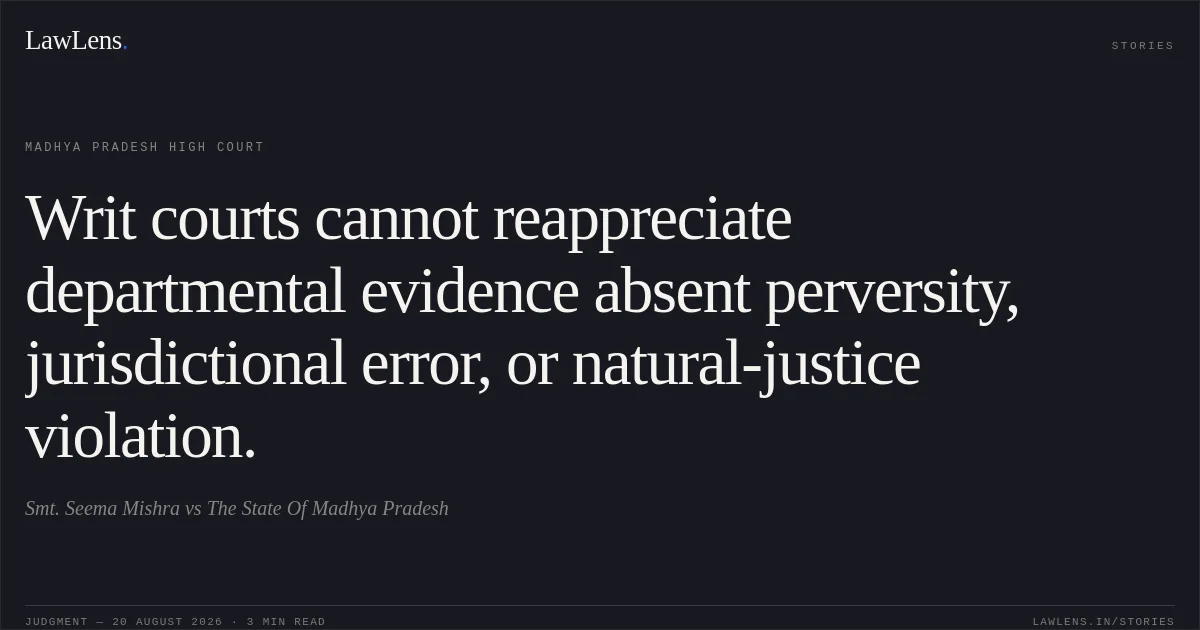
The Court applied the principles governing judicial review of departmental disciplinary proceedings under Article 226 of the Constitution.
Source reference: paras. 10–11It held that the High Court does not act as an appellate authority and cannot reappreciate evidence; interference is confined to errors of law, procedural irregularity, violation of natural justice, perversity, manifest miscarriage of justice, lack of jurisdiction, or an absolutely unjustified or disproportionate penalty.
Source reference: paras. 10–11The Court relied on Government of Andhra Pradesh v. Mohd. Nasrullah Khan, (2006) 2 SCC 373, which establishes that judicial review is not equivalent to appellate adjudication on the merits and that the High Court cannot reassess evidence merely because another view is possible.
Source reference: para. 10Reasoning
The Court found that the petitioner was present when the survey team was constituted on 28.02.2014 and was assigned the duty of assessing hailstorm-related crop loss.
Source reference: paras. 4–7Her defence relied principally on absence and medical documents relating to the period beginning 01.03.2014, whereas the alleged failure to perform the assigned duty occurred on 28.02.2014.
Source reference: paras. 4–7The Enquiry Officer had considered the departmental evidence and the petitioner’s documents before recording a finding of guilt, and the appellate authority independently considered the petitioner’s contentions and documents.
Source reference: paras. 7–8The Court further noted that the petitioner had not expressly denied the charges in her reply but had offered a different explanation.
Source reference: para. 9Since no perversity, jurisdictional error, violation of natural justice, or manifest disproportionality was established, the Court declined to reassess the evidence or interfere with the departmental findings under Article 226.
Source reference: paras. 9–12Holding
The Court answered the issues against the petitioner.
It held that the charges of dereliction of duty were supported by the enquiry material, that the disciplinary and appellate authorities had properly exercised their jurisdiction, and that the penalty of withholding one increment with cumulative effect did not warrant interference.
Source reference: paras. 8–12The writ petition was accordingly dismissed as meritless, and no relief regarding quashing of the orders, full suspension wages, or consequential benefits was granted.
Source reference: para. 13Original Court PDF
Smt. Seema MishravsThe State Of Madhya Pradesh
Click to open original judgment
Original judgment, available to read, download and summarize on LawLens.in