Facts
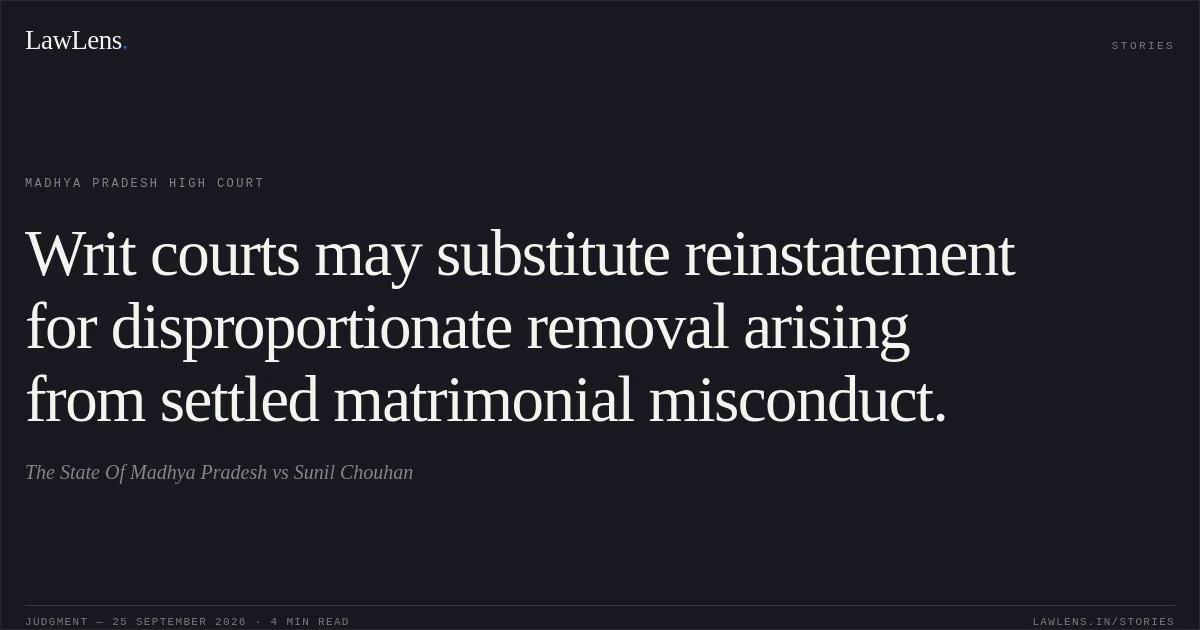
The respondent, a Constable in the Madhya Pradesh Police Department, faced disciplinary proceedings following an FIR registered by his wife under Sections 498-A, 323, 294 and 506 IPC, arising from a matrimonial altercation involving the respondent, his wife and her family members.
Source reference: para. 4A departmental enquiry was conducted, in which the wife and her family members supported the charges; all three charges were found proved, and the respondent was removed from service on 27 September 2016. His departmental appeal and mercy petition were subsequently rejected.
Source reference: para. 4During the departmental proceedings, the criminal dispute was compromised. The compoundable offences were compounded, the prosecution witnesses turned hostile, and the respondent was acquitted of the non-compoundable offence under Section 498-A IPC on merits by judgment dated 8 December 2017.
Source reference: para. 5The respondent challenged the removal, appellate order and rejection of his mercy petition in W.P. No. 15885/2018.
Source reference: para. 6The learned Single Judge upheld the departmental findings and the procedural fairness of the enquiry, but held that removal from service was shockingly disproportionate to the matrimonial misconduct. The Court directed reinstatement without back wages, but with continuity of service and consequential benefits.
Source reference: para. 7The State preferred the present writ appeal with a delay of 160 days. The delay was condoned on the ground of administrative processing and sanction within the State machinery.
Source reference: paras. 1–2Issues
Whether the Writ Court exceeded the limited scope of judicial review by interfering with the quantum of punishment after upholding the departmental enquiry and findings of guilt?
Source reference: paras. 8–9Whether, having found the punishment of removal disproportionate, the Writ Court could itself direct reinstatement without back wages and with continuity of service, instead of remanding the matter to the Disciplinary Authority for reconsideration of punishment?
Source reference: paras. 8, 11–12Whether the subsequent matrimonial compromise and the respondent’s acquittal in the criminal case justified interference with the punishment imposed in the departmental proceedings?
Source reference: paras. 10–13Law Applied
The Court applied the principle that judicial review under Articles 226 and 227 ordinarily does not extend to reassessing evidence or substituting the disciplinary authority’s findings, but interference with punishment is permissible where it is shockingly disproportionate to the misconduct.
Source reference: paras. 8–9This principle was drawn from B.C. Chaturvedi v. Union of India, (1995) 6 SCC 749, and Lucknow Kshetriya Gramin Bank v. Rajendra Singh, (2013) 12 SCC 372.
Source reference: paras. 8–9The Court also considered Union of India v. P. Gunasekaran, (2015) 2 SCC 610, concerning the limited scope of judicial review in disciplinary matters.
Source reference: para. 8Relying on Pramod Singh Kirar v. State of M.P., (2023) 1 SCC 423 and Ram Lal v. State of Rajasthan, (2024) 1 SCC 175, the Court held that where disciplinary action arises from a matrimonial dispute subsequently settled between the parties, denial of service benefits solely on that ground may be unwarranted.
Source reference: para. 10It further relied on Sunil Kumar Singh v. Bihar Legislative Council, 2025 SCC OnLine SC 439, which recognised that a constitutional court may directly mould relief by ordering reinstatement without monetary benefits where the punishment is highly excessive and disproportionate, without necessarily remanding the matter.
Source reference: para. 11Reasoning
The Division Bench found that the learned Single Judge had not interfered with the departmental findings or the validity of the enquiry; the interference was confined to the proportionality of the punishment, which fell within the permissible scope of judicial review.
Source reference: para. 9The misconduct arose from a private matrimonial dispute, the parties had subsequently compromised, and the witnesses who supported the departmental case had turned hostile in the criminal trial. The respondent was also acquitted of the Section 498-A charge on merits.
Source reference: para. 10In these circumstances, removal from service was held to be shockingly disproportionate.
Source reference: para. 10The relief of reinstatement without back wages balanced the respondent’s service interests against the State’s interests.
Source reference: paras. 10–13The Court rejected the State’s contention that the matter necessarily had to be remanded, holding that the Writ Court had already determined an appropriate proportionate consequence and that termination or compulsory retirement would also be disproportionate.
Source reference: para. 12The respondent’s failure to challenge the Single Judge’s order was additionally treated as acceptance of the relief granted.
Source reference: para. 12Holding
The Court held that the Writ Court acted within its jurisdiction in modifying the punishment after upholding the departmental enquiry and findings of guilt.
The subsequent compromise in the matrimonial dispute, the respondent’s criminal acquittal, and the excessive nature of removal justified reinstatement without back wages, while preserving continuity of service and consequential benefits.
Source reference: paras. 10–13The writ appeal was dismissed, the order dated 30 August 2024 in W.P. No. 15885/2018 was affirmed, and any interim stay was vacated.
Source reference: para. 14The State was directed to implement the Single Judge’s order in accordance with law. No order as to costs.
Source reference: para. 15Acts & Sections Cited
3 provisions across 1 statute referred to in this judgment. Each provision opens on LawLens.
Indian Penal Code, 18603
Original Court PDF
The State Of Madhya PradeshvsSunil Chouhan
Click to open original judgment
Original judgment, available to read, download and summarize on LawLens.in