01Facts
Respondents 1 and 2 sought partition under Section 178 of the Madhya Pradesh Land Revenue Code of jointly held agricultural land at village Chiruli, Tehsil Dabra.
pp. 1–3The Tehsildar ordered partition on 12 February 2014.
pp. 1–3The Sub-Divisional Officer allowed the petitioners’ appeal and set aside that order on 31 March 2015; on the respondents’ further appeal, the Additional Commissioner set aside the SDO’s order and restored the Tehsildar’s partition order on 22 August 2017.
pp. 1–3The petitioners challenged the Additional Commissioner’s order under Article 226, alleging defects in publication, the Patwari’s partition Fard, identification of allotted land, and opportunity to be heard
pp. 1–302Issues
i.1. Whether the Additional Commissioner erred in restoring the Tehsildar’s partition order despite the petitioners’ alleged procedural defects in the partition proceedings
pp. 2–4ii.2. Whether the Additional Commissioner’s order disclosed a jurisdictional error, perversity, violation of natural justice, or manifest illegality warranting interference under Article 226
pp. 4–603Law Applied
Section 178 of the Madhya Pradesh Land Revenue Code governs partition proceedings concerning jointly held land
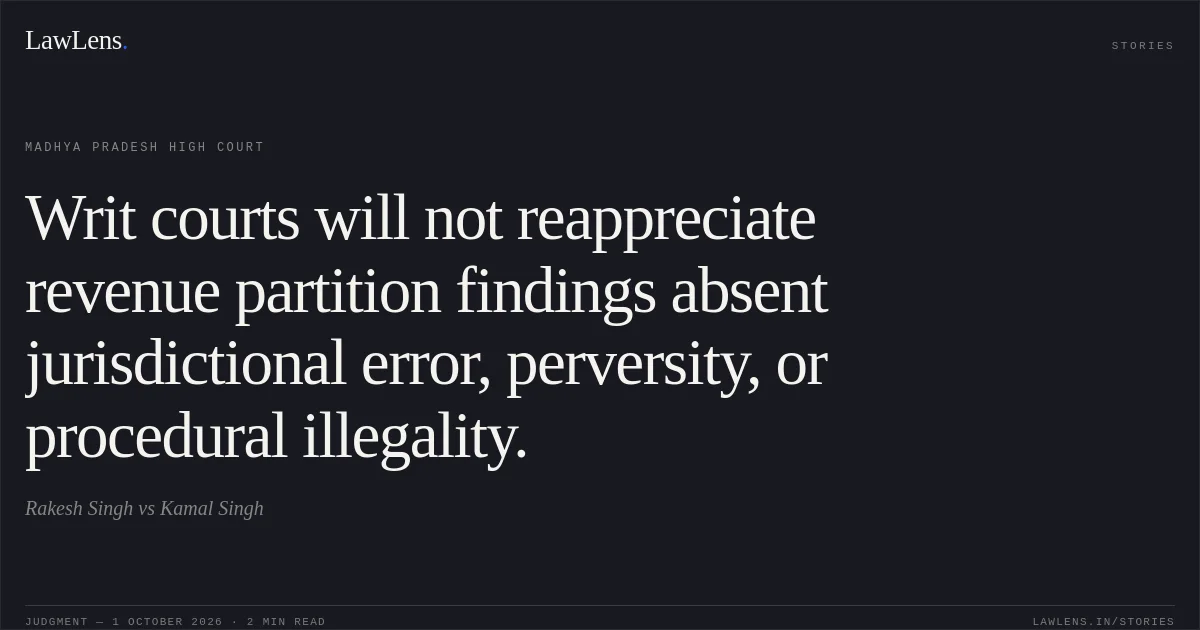
p. 4Under Article 226, the High Court exercises supervisory rather than appellate jurisdiction over decisions of competent statutory authorities; it does not reappreciate evidence or substitute its view merely because another view is possible. Interference is warranted where an order involves patent jurisdictional error, perversity, violation of natural justice, or manifest illegality
pp. 4–5No judicial precedent was cited.
Provisions in the judgment · 1 · Linked ones open on LawLens
MP Land Revenue Code 1959 Section 178
04Reasoning
The Court found from the revenue record that notice and publication had been effected, no objection had been received, and the Patwari had prepared and published the partition Fard before the Tehsildar made the partition order
p. 4It held that the petitioners had not established, beyond oral submissions, that the proceedings lacked notice, violated natural justice, or disregarded a mandatory statutory requirement.
pp. 4–6The Additional Commissioner had considered the SDO’s order and the record while exercising appellate jurisdiction; the Court found no demonstrated jurisdictional error or other ground meeting the threshold for writ interference
pp. 4–605Holding
The Court answered the issues against the petitioners, holding that the Additional Commissioner’s order dated 22 August 2017 disclosed no patent illegality, perversity, or jurisdictional infirmity warranting interference under Article 226
p. 6The writ petition was dismissed as devoid of merit, and the Tehsildar’s partition order remained restored
p. 6Original Court PDF
Rakesh SinghvsKamal Singh
Click to open original judgment
Original judgment, available to read, download and summarize on LawLens.in